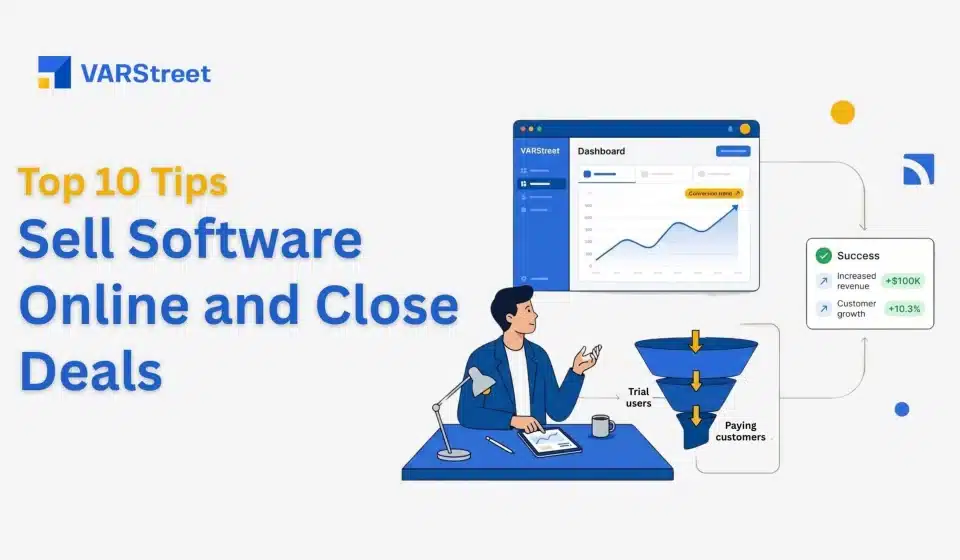

Top 10 Tips to Sell Software Online and Close More Deals in 2026
Table of Content
- 1. Get Clear on Who You Are Actually Selling To
- 2. Fix Your Pricing Page Before You Fix Anything Else
- 3. Build Free Trials That Show Value Before Buyers Lose Interest
- 4. Match Your Pricing Model to How Your Buyers Actually Evaluate Software
- 5. Create Content That Reaches Buyers When They Are Ready to Buy
- 6. Make Email Work by Sending It at the Right Moment
- 7. Put Social Proof Where Buyers Are Hesitating
- 8. Use Video to Show the Product Working, Not Talking About It
- 9. Make It Easy to Pay and Easy to Get Help
- 10. Treat Retention as Part of Your Sales Strategy
- Conclusion
- FAQs
You have priced your product sensibly and built something solid, but trials stall, pricing pages confuse, and buyers vanish before they see any value. The median trial-to-paid conversion rate for B2B SaaS is below 25%, and users who never achieve a clear first win in their first session convert at rates 3-5x lower. That means most of your signups are silently churning, and every month that continues costs you revenue and marketing budget you cannot get back.
This post gives 10 operational fixes, ordered by where they typically move the needle fastest. For each fix, you will get a clear action, the metric to track, and a realistic target so you can diagnose what to fix first and prove it worked.
Key Takeaways:
- Most software sales problems are operational, not product-related. Friction at trial, pricing, and checkout kills conversions before the product gets a fair evaluation.
- Free trials fail when buyers do not reach a clear first win in the first session.
- Social proof placed next to friction points, not just on a dedicated testimonials page, is one of the highest-leverage conversion changes a software seller can make.
- Email is the highest-ROI channel for software sales, but only when sequences are triggered by user behavior rather than a fixed calendar.
- Retention is not a post-sale concern. Buyers who activate quickly stay longer, expand more, and refer others, which compounds into lower acquisition cost over time.
1. Get Clear on Who You Are Actually Selling To
Most software companies are not selling to the wrong people. They are selling to too broad a group, which spreads resources thin and drives down conversion across the board.
Your Ideal Customer Profile (ICP) is not a marketing exercise. It is the specific description of the buyer type where your win rate, retention, and expansion are consistently highest. Selling to your ICP typically produces conversion rates three times higher than selling to unqualified signups. Every resource spent outside that profile quietly inflates your acquisition cost.
- Pull your last 20 closed-won deals and look for patterns: industry, company size, job title of the buyer, and what problem they were solving
- Separate who signs the contract from who uses the tool daily. These people have different objections and need different messages
- Build two to three buyer personas with specific job titles and one core pain point each
- In your CRM, tag leads by ICP fit before they enter any nurture sequence. Some teams take this a step further by qualifying opportunities against factors such as timeline, scope, value, and budget before investing sales resources. Unqualified leads in a nurture sequence inflate your metrics and waste your team’s time.
Metric to track: Conversion rate by buyer persona. If ICP conversion is not at least twice your overall average, the profile needs tightening.
2. Fix Your Pricing Page Before You Fix Anything Else
Your pricing page is where most software deals are decided. Buyers arrive with one question: is this worth it for my situation? A page that makes them work to determine which tier applies to them loses the deal before a conversation even starts.
Tier Structure
- Lead every tier description with what the buyer can accomplish
- Mark one tier as the recommended option. Buyers without a strong preference default to the clearly framed middle option
- Place the annual-versus-monthly pricing toggle above the fold. The saving has to be visible for buyers to choose it
Proof and Comparison
- Add a comparison table against your two most common alternatives. Buyers are already comparing you. Give them the answer on your page instead of sending them to find it elsewhere
- Place one customer testimonial with a specific measurable outcome directly beside the pricing table, not at the bottom of the page
Metric to track: Pricing page bounce rate (above 60% means the page is not answering the right question) and pricing page to trial or purchase conversion rate.
3. Build Free Trials That Show Value Before Buyers Lose Interest
A free trial that does not deliver value in the first session is a delayed rejection. B2B buyers are nearly 70% through their purchasing process before engaging with sellers, which means the trial is often their first meaningful interaction with your product.
By that point, they have already researched alternatives, compared options, and formed expectations. The trial needs to quickly validate those expectations.
- Pre-populate trial accounts with realistic sample data so new users see a working product, not an empty state
- Add in-app tooltips or a guided checklist that points users toward one specific win in the first session
- Set up behavior-triggered emails rather than time-based ones: Day 3 if the user has not taken any action, Day 7 with a specific use case walkthrough, Day 14 with a conversion prompt
- Track Day 7 activation separately from signup volume. They are measuring different things
Metric to track: Trial-to-paid conversion (target 25% or higher) and Day 7 activation rate (target above 60%).
4. Match Your Pricing Model to How Your Buyers Actually Evaluate Software
Freemium, free trial, and paid-only each work for different products and different buyers. Running the wrong model is one of the most common reasons conversion stalls despite strong product-market fit.
VARStreet Head of Sales notes, “The companies we see struggle most with conversion are running freemium for a product that needs onboarding to show value. Free users never see what the product actually does, so they never upgrade.”
| Model | Works When | Fails When |
|---|---|---|
| Freemium | Free tier delivers standalone value and the paid tier removes a real constraint | The product needs setup or guidance before it shows value |
| Free Trial | Product takes time and configuration to demonstrate its core benefit | Onboarding is passive and users hit a blank dashboard |
| Paid-Only | Brand recognition and social proof are strong enough to carry an evaluation without a product experience | Buyers need to experience the product before committing |
- Check your activation data against your current model. If free users are not reaching the core value moment, freemium is not working for your product type
- If running a free trial, define one specific activation event that consistently predicts conversion and build your onboarding around reaching it
- If running paid-only, your pricing page and social proof have to carry the entire evaluation on their own
Metric to track: Free-to-paid conversion rate (freemium target above 5%) and trial-to-paid conversion (target 20 to 30%).
5. Create Content That Reaches Buyers When They Are Ready to Buy
Most software content targets awareness and rarely converts because it reaches buyers who are not close to a decision. The content that drives software sales answers specific operational questions buyers search for when actively evaluating: “how to solve X without Y tool” or “best software for X problem.” B2B buyers review an average of 11.4 pieces of content before they are ready to contact a vendor, and the pieces that influence the decision are the ones that answer the question they have right now.
- Look at your last 10 closed-won deals and ask each buyer what they searched for before finding you. Those searches are your content brief
- Write five articles targeting long-tail keywords with clear purchase intent
- Add one lead magnet to each high-traffic post: a checklist, template, or calculator that is directly relevant to the post topic
- Track lead generation from content separately from traffic. A post with 10,000 monthly visitors and zero leads is not a content asset
Metric to track: Lead-to-opportunity conversion from content (target 5 to 10%).
6. Make Email Work by Sending It at the Right Moment
Email marketing generates $36 for every $1 spent. That figure assumes the emails are relevant to what the buyer is doing right now, not to the day of the week. A sequence triggered by behavior inside your product lands when the buyer is already thinking about the problem you solve.
- Build three sequences: trial onboarding triggered by activity (Days 0, 3, 7, 14), cart abandonment (Days 1, 3, 7), and post-purchase onboarding (Days 1, 7, 30).
- Personalize based on what the buyer has and has not done inside the product. If they have not completed a specific action, send the tutorial for that action
- Test subject lines with two variants prior to scaling: one that leads with a benefit and one that leads with curiosity
Metric to track: Open rate (target above 35%) and click-to-paid conversion (target above 3%).
Pro Tip:
The most effective programs connect product activity, lead scoring, and email automation so buyers receive messages based on intent rather than a fixed schedule.
7. Put Social Proof Where Buyers Are Hesitating
The purchase likelihood for a product with five reviews is 270% higher than for a product with no reviews. The problem is not that software companies lack social proof. It is that they put all of it on a testimonials page that buyers visit after they have already made up their mind, not during the moments when they are on the fence.
- Add customer logos above the fold on your homepage, not in a footer or a dedicated section buyers have to scroll to
- Place one testimonial with a specific measurable outcome directly beside your primary CTA button
- Publish three case studies that lead with a hard number: cost saved, hours reduced, revenue generated
- Ask for G2 or Capterra reviews within seven days of a successful outcome, not at the annual renewal
Metric to track: Conversion rate on pages with social proof placed at friction points versus pages without. Run both versions and measure directly.
8. Use Video to Show the Product Working, Not Talking About It
96% of B2B buyers prefer video content for learning about products and services. Companies investing in video content see 49% faster revenue growth than those using non-video strategies. A two-minute video of a real workflow in your actual product interface answers the question every buyer is carrying: Will this work for my specific situation?
- Record three videos: a two-minute quick start that reaches one clear first win, a five-minute walkthrough of your most important feature, and a three-minute customer workflow showing a real before-and-after
- Put these on your pricing page, your feature pages, and your trial sign-up confirmation page
- Add captions to all three
- Keep every demo under five minutes. Completion rates may drop significantly past that point
Metric to track: Video completion rate (target above 50%) and trial conversion rate for viewers versus non-viewers.
9. Make It Easy to Pay and Easy to Get Help
You can do everything above and still lose 20-30% of potential revenue at the billing and support stage. B2B buyers often cannot use personal credit cards for software purchases. If invoice or net terms are not available, they abandon at the last step rather than find a workaround. That is not a buyer problem. It is a checkout configuration problem.
Adding a phone number to your contact page increases conversion because buyers, even in B2B, want to know a person is reachable before they commit to a recurring payment.
- Offer credit card, ACH, and invoice or net terms at a minimum
- Add a phone number to your contact page
- Build a self-service support layer before you need it: FAQ documentation, troubleshooting guides, and short videos for the most common issues
- Set up live chat with a response time target of under two minutes during business hours
Metrics to track: Checkout abandonment rate (target below 40%) and support ticket resolution time (target under four hours).
10. Treat Retention as Part of Your Sales Strategy
Keeping a customer costs significantly less than acquiring a new one. More importantly, retained customers generate the reviews, referrals, and case studies that reduce acquisition cost for every new buyer who discovers you through them. Churn is not a post-sale problem. It is a signal that something earlier in the process failed, usually activation.
The buyers who stay longest and expand the most are the ones who quickly reach a clear first win. That connects directly back to Tip 3. The onboarding quality you set up on day one of a trial is the same variable that determines whether that customer is still with you at month 12.
If you want to know whether your software business is operationally healthy right now, use the Software Sales Metrics Checklist: 10 metrics with formulas, targets, and weekly checklist template.
Metric to track: Net Revenue Retention (target 120% or higher) and monthly churn rate (target below 2% for SMB SaaS).
Conclusion
Start with the metric that is furthest from its target. Fix the one operational process behind it. Then move to the next. The software companies that consistently close more deals have not found anything complicated. They have made it easier for buyers to say yes at every step of the process.
VARStreet is built for exactly this kind of operation. If you are an IT or office supplies VAR selling software and solutions online, VARStreet connects your distributor catalogs, customer-specific pricing, quote workflows, and eCommerce storefront in one platform so your buyers can find what they need, get a price, and place an order without calling your sales team. The operational infrastructure that most VAR eCommerce projects spend months building is already connected.
Ready to see how it works for your business? Book a free demo with VARStreet and see how a connected VAR eCommerce platform removes the friction from your software sales process.
FAQs
What is the most important metric for selling software online?
Net Revenue Retention above 120% is the strongest single indicator. It means existing customers are growing faster than others are leaving, which is the most capital-efficient growth path available to a software business.
What is a good trial-to-paid conversion rate for software?
The industry benchmark is 20-30%. A below 20% rate almost always means buyers are not achieving a meaningful first win during the trial. Fixing onboarding before adjusting pricing is almost always the right first move.
What pricing model works best for selling software online?
Freemium works when the free tier delivers real standalone value. Free trials work when buyers need time to understand the product. Paid-only works when your brand and social proof are strong enough to carry the evaluation. The wrong model for your product type will suppress conversion regardless of how well everything else is set up.
Which marketing channel has the highest ROI for software sales?
Email has the highest ROI at $36 per $1 spent, but only with behaviour-triggered sequences. Fixed-calendar sends produce a fraction of that return.
What payment options should a B2B software company offer?
Credit card, ACH, and invoice or net terms at a minimum. Missing net terms is one of the most common causes of late-stage checkout abandonment in B2B software, and it is one of the easiest things to fix.
Neha Kaku
Neha Kaku is a content writer and strategist specializing in B2B SaaS, cybersecurity, and martech. She writes blogs, website copy, landing pages, and long-form content that is built to rank, resonate, and convert. Trained in Biotechnology, she brings a structured, analytical approach to every brief, making her equally comfortable with technical depth and narrative clarity. Her work has helped brands earn top Google rankings, drive audience engagement, and communicate ideas that move the readers to the right action. Editorial Policy
Read More