B2B Demand Generation: How to Use SEM, Retargeting & Marketing Automation

Table of Content
According to statistics shared by Forbes, Google processes 13.7 billion searches daily, and 71% of B2B buyers start their research with a Google search (thinkwithgoogle).
Yet the landscape is shifting.
Around 80% of B2B tech buyers worldwide now use generative AI just as often as traditional search engines when they research potential vendors (Responsive’s Inside Buyers Mind Report).
Key Takeaways:
- Google remains your foundation – Traditional search still sends 345 times more traffic than AI platforms. Build LLM capabilities as enhancements, not replacements.
- Integrate all three pillars – Orchestrate SEM, retargeting, and automation as one cohesive system rather than managing separate campaigns. Each component should amplify the others.
- First-party data is critical – Cookie deprecation makes owned customer data essential. Capture emails through value exchanges and use CRM systems for nurturing.
- Optimize for both ecosystems – Content optimized for AI discovery also performs better in traditional search. You’re not creating duplicate efforts.
- VARs must differentiate on service – Highlight expertise, compliance support, and deployment assistance rather than competing on product specs alone.
For VARs, IT distributors, and B2B eCommerce businesses, success requires mastering proven demand generation tactics for Google while preparing for AI-powered discovery.
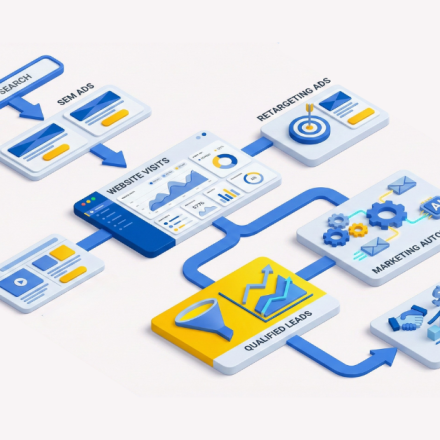
What Are the Three Pillars of B2B Demand Generation?

1. Search Engine Marketing (SEM): Capturing High-Intent Traffic
SEM remains the frontline of B2B demand generation, intercepting decision-makers actively seeking solutions. When a procurement officer searches for “bulk IT hardware supplier” or an IT director looks for “TAA-compliant laptops,” your business needs to be visible at that critical moment.
Why SEM Matters:
The numbers tell a compelling story. Research consistently shows that organic search drives more qualified leads than paid advertising, with some studies indicating SEO generates more sales than PPC for B2B companies. The top organic result receives nearly 40% of clicks, making that coveted first position incredibly valuable.
But here’s the thing: you can’t rely on organic rankings alone. Paid search provides immediate visibility while you build organic authority. The key is finding the right balance based on your budget and timeline.
Key SEM Tactics:
- Paid Search (PPC): Target high-intent keywords that signal buying readiness. Don’t waste budget on broad informational terms. Focus on searches like “enterprise network security solutions” or “government-compliant data storage.”
- Organic SEO: Build sustainable visibility through content marketing, technical optimization, and authority building. B2B SaaS companies typically see 700%+ ROI from SEO within three years, though it takes patience.
- Long-Tail Keywords: Instead of competing for expensive generic terms, target specific use cases. “Healthcare-compliant patient data storage for small clinics” attracts far more qualified prospects than just “data storage.”
For VARs Specifically:
Value-Added Resellers face unique challenges. You’re competing against direct manufacturers and massive marketplaces like Amazon Business. Your competitive advantage isn’t product availability. It’s expertise, service, and specialization.

Pro Tip:
Focus your SEM efforts on highlighting what you do beyond simply selling products: deployment services, compliance consultation, custom configuration, extended warranties, and ongoing technical support. Target keywords that reflect these differentiators.
2. Retargeting: Staying Visible Through Long Sales Cycles
Let’s be realistic about B2B buying behavior. A decision-maker visits your site, browses a few product pages, maybe downloads a spec sheet, then disappears for three weeks. They’re not ignoring you. They’re just navigating a complex approval process involving multiple stakeholders, budget discussions, and competing priorities.
This is where retargeting becomes essential. It keeps your brand visible while prospects work through their internal buying processes.
Why Retargeting Works in B2B:
Research shows that B2B retargeting significantly outperforms B2C in both click-through rates and conversions. This makes sense—business purchases involve deliberate research and multiple touchpoints, not impulse decisions. Retargeted visitors are also substantially more likely to convert than first-time visitors.
Think about it from the buyer’s perspective. They’ve already shown interest in your solutions. Retargeting simply reminds them you exist when they’re ready to move forward.
Effective Retargeting Strategies:
- Behavioral Segmentation: Not all visitors deserve the same messaging. Someone who viewed pricing deserves different ads than someone who only read a single blog post. Segment your audiences based on pages visited, time spent, and actions taken.
- Progressive Messaging: Start with general awareness ads, move to specific use cases and differentiators, then progress to social proof and conversion-focused calls-to-action. Don’t hit someone with a demo request ad the day after their first site visit.
- Frequency Capping: Nobody wants to feel stalked by ads. Limit how often the same person sees your retargeting ads to maintain a positive brand impression.
- Multi-Platform Approach: Use Google Display Network for broad reach, LinkedIn for B2B decision-maker targeting, and even YouTube for video retargeting if you have compelling visual content.
The Cookie Challenge:
Here’s the uncomfortable truth: traditional retargeting relies on third-party cookies, which are disappearing fast. Safari and Firefox already block them by default. Chrome keeps delaying its phase-out, but it’s coming.
This means you need to start building first-party data strategies now. Capture email addresses through valuable content offers, use your CRM for email-based nurturing, and explore contextual targeting that doesn’t rely on cookies.
3. Marketing Automation: Nurturing at Scale
Marketing automation is where the magic really happens. It’s the system that orchestrates personalized engagement across your entire demand generation funnel without requiring your team to manually send individual emails or make every follow-up call.
The Power of Automation:
Most B2B companies now depend on automation to manage complex marketing processes. It makes sense: when you’re nurturing hundreds or thousands of prospects simultaneously through multi-month sales cycles, manual processes simply don’t scale.
The ROI speaks for itself. Companies typically see $5+ returned for every dollar invested in marketing automation, with most achieving positive ROI within the first year.
Core Automation Capabilities:
- Lead Scoring: Not every prospect deserves immediate sales attention. Automation assigns point values to behaviors and characteristics: website visits, content downloads, email opens, company size, job title, industry. As prospects accumulate points through engagement, they cross thresholds triggering either continued nurturing or sales handoff.
- Behavioral Email Sequences: Someone downloads your compliance checklist? Automatically send them a case study three days later, then a webinar invitation a week after that. But make it smart—if they visit your pricing page in the meantime, shift them to a high-intent sequence immediately.
- Account-Based Marketing Workflows: For high-value target accounts, automation coordinates personalized engagement across multiple channels and stakeholders. Your CFO contacts get ROI calculators, technical buyers receive architecture guides, and executives see strategic case studies.
- Multi-Touch Attribution: Finally understand which marketing activities actually drive pipeline. Automation platforms track the entire customer journey, showing you whether that whitepaper or that webinar or that conference really influenced the deal.
Marketing Automation for VARs:
VARs benefit particularly from automation’s ability to handle complex scenarios: custom pricing for different customer segments, inventory alerts when products come back in stock, automated quote generation, and integration with distributor systems for real-time availability.
The key is connecting your eCommerce platform, CRM, and distributor integrations so information flows seamlessly. When a prospect downloads your government compliance guide, your automation should know whether they’re eligible for GSA pricing and route them accordingly.
Why Are Traditional Tactics Under Pressure?
Even though these three pillars still form the foundation of B2B demand generation, they’re facing real challenges that you need to understand and address.
Rising Competition and Costs:
More companies are competing for the same B2B keywords, driving up costs and making volume-focused strategies unsustainable. You can’t just spend your way to visibility anymore. You need smarter targeting, better audience segmentation, and tighter integration between your campaigns and lead nurturing systems.
Privacy Regulations and Cookie Deprecation:
Third-party cookies are dying, and that fundamentally changes retargeting. Audiences have shrunk 30-50% in many markets. The solution isn’t to abandon retargeting. It’s to pivot toward first-party data strategies where you own the customer relationship.
Content Overload and Buyer Fatigue:
Your prospects are drowning in marketing content. Generic email blasts and irrelevant ad sequences don’t just fail. They actively damage your brand perception. Relevance and timing matter more than volume. Quality beats quantity every time.
The Direct Traffic Dependency:
Traditional demand generation assumes prospects visit your website where pixels fire and forms capture information. But buyer behavior is changing. Many now get answers without visiting websites at all, especially with the rise of AI-powered search.
How Are LLM Platforms Changing B2B Discovery?
Let’s address the elephant in the room. While Google still dominates, a fundamental shift is happening in how B2B buyers begin their research.
Traditional search rewards whoever bids highest or earns the most backlinks. AI search rewards whoever provides the most authoritative, comprehensive, and well-structured information. You cannot buy your way to the top of a ChatGPT response. Budget doesn’t determine visibility. Authority does.
When someone asks an AI platform “Which IT resellers in India offer Microsoft 365 deployment with compliance support?” the platform synthesizes an answer based on sources it considers authoritative. Getting cited requires different optimization than traditional SEO.
How to Optimize for Both Google and LLM Platforms?
The good news? You don’t have to choose between optimizing for traditional search and preparing for AI discovery. The tactics that work for one generally improve performance in the other.
Top of Funnel: Building Awareness
Google Optimization: Start with the fundamentals: target awareness keywords with both SEO and PPC, create comprehensive content that answers buyer questions, and optimize for featured snippets that appear above organic results.
LLM Enhancements: Layer AI optimization on top of solid Google tactics. Implement schema markup (structured data that helps both Google and AI platforms understand your content). Use question-based headings that match how people actually search. Build entity authority by maintaining consistent business information everywhere your brand appears online.
Create topic clusters instead of isolated pages: interconnected content that comprehensively covers a subject. AI platforms favor sources that demonstrate depth and expertise across related topics.
One practical example: A B2B SaaS company organized content around predictive maintenance, creating ten interlinked posts covering everything from basic definitions to advanced applications. Within three months, ChatGPT began citing them as an authoritative resource, while their Google traffic increased 28%.
Middle of Funnel: Maintaining Consideration
Google Tactics: Deploy Display Network retargeting to follow prospects across the web. Use RLSA (Remarketing Lists for Search Ads) to adjust bids when past visitors search again. Run video retargeting on YouTube for prospects who watched your content.
LLM Preparation: Start capturing first-party data through valuable content offers: ROI calculators, compliance checklists, configuration guides. Build permission-based relationships that don’t depend on cookies.
Implement account-based marketing for high-value prospects, coordinating personalized engagement across multiple channels. ABM consistently delivers higher ROI than traditional retargeting because it focuses resources on specific target accounts rather than broad audiences.
Here’s an interesting concept: “algorithmic retargeting.” When you maintain consistent presence across authoritative third-party sites (industry publications, review platforms, manufacturer partner portals), AI platforms encounter your brand repeatedly while researching topics. Prospects see your brand mentioned in multiple AI-generated responses as they refine their questions, similar to how traditional retargeting keeps you visible across the web.
Bottom of Funnel: Driving Conversion
Google Optimization: Bid aggressively on high-intent keywords that signal immediate buying interest—searches including “pricing,” “demo,” “buy,” or your specific company name. Trigger marketing automation workflows based on site actions like pricing page visits or demo requests.
AI Integration: Track referral sources to identify when prospects arrive from AI platforms versus traditional search. These visitors deserve different treatment—they’ve typically done deeper research and arrive with more specific questions.
Enhance lead scoring to recognize high-intent signals specific to AI-influenced journeys. Someone who visits after seeing your brand mentioned in multiple ChatGPT responses shows stronger intent than random search visitors.
Use AI-powered personalization within your own marketing automation to create experiences that mirror the helpful, context-aware interactions prospects experienced during their AI-assisted research.
What’s the Recommended Strategy?
Here’s the practical reality: You need to balance investment between proven channels and emerging opportunities.
Resource Allocation Guide:
Dedicate 60-70% of your demand generation resources to Google search optimization (both SEO and PPC) and proven traditional tactics. These drive pipeline today and will continue to for the foreseeable future. Google maintains nearly 90% market share and sends the vast majority of B2B traffic.
Allocate 20-30% to LLM optimization and structured content development. This builds capabilities for an evolving landscape without betting everything on emerging channels.
Reserve 10-20% for testing, experimentation, and exploring new platforms. This lets you spot opportunities early without overcommitting to unproven channels.
As LLM adoption grows and you see results from optimization efforts, gradually shift resources—but never abandon Google search given its continued dominance. The businesses winning today maintain strong traditional demand generation while progressively building AI readiness.
Transform Your Demand Generation with VARStreet
VARStreet’s B2B eCommerce platform provides the technology foundation for modern demand generation across traditional and emerging channels.
Key Capabilities:
- Technical SEO and mobile-responsive design for Google visibility
- Structured product data with schema markup for AI platforms
- Custom catalogs and account-specific pricing for personalization
- Seamless CRM and marketing automation integration
- Real-time inventory from 50+ distributors
- Enterprise procurement tools (PunchOut, EDI)
Ready to modernize your demand generation? Visit VARStreet to schedule a demo.
FAQs
Should I focus on Google or LLM optimization?
Focus on both, but prioritize Google since it sends 345x more traffic. Allocate 60-70% to proven Google tactics and 20-30% to LLM preparation. Content optimized for AI typically performs better in traditional search too.
Do Google Ads still work for B2B?
Yes. Organic SEO delivers higher long-term ROI, but paid search provides immediate visibility for high-intent keywords. Focus on quality over volume and integrate PPC with your nurturing systems.
What is entity-based SEO?
Establishing your brand as a recognized entity in knowledge graphs through consistent business information, structured data markup, and authoritative third-party presence. This drives visibility in both Google features and AI citations.
Is retargeting dying with cookie deprecation?
It’s evolving, not dying. Build first-party data strategies through valuable content offers and use Account-Based Marketing for high-value prospects. The principles remain sound even as technical implementation changes.
How do I get cited in ChatGPT or Perplexity?
Create comprehensive content with schema markup, question-based headings, and specific facts. Build entity recognition through consistent presence across authoritative sites. Expect 4-8 months before seeing consistent citations.
What schema markup matters most for B2B?
Organization schema (entity info), Product schema (catalog data), FAQ schema (Q&A content), and HowTo schema (guides). These help both Google and AI platforms understand your content.
Can smaller B2B companies compete in AI search?
Yes. AI search prioritizes content quality and expertise regardless of company size. Well-researched content from smaller specialists often outperforms generic content from larger brands.
How should VARs differentiate in demand generation?
Emphasize technical expertise, compliance consulting, deployment services, and ongoing support. Target long-tail keywords reflecting these services rather than competing on generic product terms
What's a realistic timeline for LLM optimization results?
Plan for 2-3 months for implementation, 3-6 months for improved traditional search performance, and 4-8 months for consistent AI citations. Results compound as authority establishes.
How do I measure success across both platforms?
Track traditional metrics (rankings, conversions, retargeting performance) plus new measurements like AI citation frequency, first-party data growth, and multi-touch attribution showing AI-influenced buyer journeys.
How should VARs approach demand generation?
Emphasize value-added services (technical expertise, compliance support, deployment) over product specs. Focus SEM on long-tail keywords like “healthcare-compliant network infrastructure.” Highlight certifications (TAA, ITAR, NIST) in both Google and LLM-optimized content.
What is a realistic timeline for LLM optimization results?
Initial implementation takes 2-3 months. Improved Google performance appears in 3-6 months. Consistent LLM citations typically require 4-8 months.
How do I measure LLM optimization ROI?
Track AI citation frequency, entity authority scores, first-party data growth, attribution patterns showing AI-influenced journeys, and content cluster performance. Tools like LLMrefs monitor brand visibility in LLM outputs.
Rahul Saini
Rahul Saini is a content strategist who uses writing as a tool for perspective, influence, and direction. He has built his craft around understanding how stories guide teams, shape culture, and drive meaningful business outcomes. Rahul works at the crossroads of strategy and storytelling, helping leaders articulate vision, refine ideas, and communicate with clarity and purpose. Known for his thoughtful leadership style and calm, structured approach, he turns complex themes into grounded insights that inspire action and support strong decision-making. His work combines creative thinking with strategic discipline and gives brands and leadership teams narratives that truly stand up. Editorial Policy
Read More