B2B eCommerce Platform Comparison: VARStreet vs. Other Platforms
Table of Content
- What Should an IT Reseller Expect From a B2B eCommerce Platform?
- Standard B2B eCommerce Platforms vs. VARStreet
- Where Standard B2B eCommerce Platforms Can Leave Gaps for IT Resellers
- What Makes VARStreet Different for IT Resellers?
- How the VARStreet Workflow Works
- When Should You Choose a Standard B2B eCommerce Platform?
- When Does VARStreet Make More Sense for an IT Reseller?
- How to Compare B2B eCommerce Platforms for Your Business
- How VARStreet Supports Online and Rep-Assisted Sales
- Match the Platform to Your Sales Process
- FAQs
An online store can give your customers a way to place orders without fixing the work that happens behind the store.
For an IT reseller, a B2B eCommerce operation often involves more than displaying products and accepting orders. Your team may also need to pull products and pricing from multiple distributors, manage customer-specific pricing, build quotes, track opportunities, and move approved orders into procurement. That makes platform selection an operational decision, not just an eCommerce decision.
The need for digital buying is also growing. McKinsey’s 2026 Global B2B Pulse Survey found that 71% of B2B companies now offer eCommerce, with roughly one-third of their revenue coming through digital channels.
For an IT reseller, the question is what sits behind that online buying experience. A standard B2B eCommerce platform may handle the storefront and ordering experience, while the rest of your sales and procurement workflow may depend on separate systems. VARStreet takes a different approach by bringing eCommerce together with product catalogs, distributor connections, quoting, CRM, and procurement.
This comparison looks at those differences and where each approach fits.
Want to see how an eCommerce platform can connect your product catalog, distributor pricing, quoting, CRM, and procurement in one workflow? Book a demo to see how it can fit your sales process.
Key Takeaways:
- Look beyond the storefront: Compare how each platform handles catalogs, pricing, quoting, and procurement.
- Check distributor compatibility: IT resellers need practical ways to manage products, pricing, and availability from multiple distributors.
- Compare customer-specific controls: Check whether you can assign products and pricing by customer account.
- Map the order workflow: See what happens after a customer places an order or accepts a quote.
- Match the platform to your setup: A standard platform may fit if your other systems already handle sales and procurement. VARStreet brings these functions together.
What Should an IT Reseller Expect From a B2B eCommerce Platform?
For an IT reseller, an eCommerce platform needs to handle more than the customer-facing store. Your requirements usually extend into product data, distributor pricing, sales, quoting, and order processing.
Before comparing platforms, check whether the platform can support these parts of your workflow:
- Product catalogs: Import and manage large IT product catalogs with accurate product data.
- Distributor pricing and availability: Access current cost and inventory information without relying on manual checks.
- Customer-specific pricing: Show different products, prices, or discounts based on the customer account.
- Online ordering: Let customers log in, browse assigned products, and place orders.
- Quoting: Give sales reps a way to build and manage quotes when a purchase needs more than a standard online order.
- CRM: Keep customer and sales opportunity data connected to the buying process.
- Procurement: Move approved quotes or online orders into the purchasing workflow without re-entering the same information.
- Integrations: Connect with the accounting, CRM, PSA, ERP, and distributor systems your team already uses.
VARStreet integrates with systems including QuickBooks, NetSuite, Microsoft Dynamics, SAP, Salesforce, Autotask, and ConnectWise, with custom integrations also available.
The key question is how many of these functions the platform handles directly and how many require separate tools or integrations. That difference becomes important when you compare a standard B2B eCommerce platform with a platform built around the IT reseller workflow.
Standard B2B eCommerce Platforms vs. VARStreet
The main difference comes down to what sits behind the storefront.
A standard B2B eCommerce platform typically focuses on the online buying experience, although capabilities vary by platform. It can manage products, customer accounts, pricing, carts, checkout, and orders. Other parts of an IT reseller’s workflow may need separate software or integrations.
VARStreet brings those functions into the same platform as the eCommerce store. It combines catalog management, distributor connections, customer-specific pricing, quoting, CRM, procurement, and online ordering.
VARStreet connects to numerous distributors and provides access to enormous product list with pricing and inventory data.
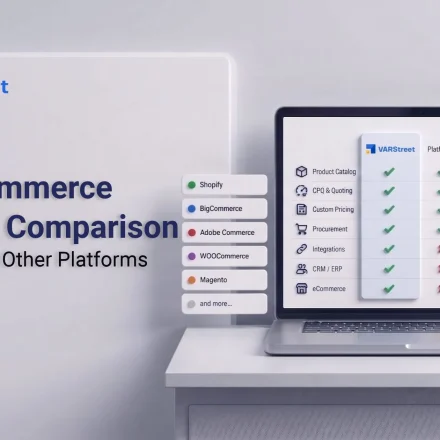
| Capability | Standard B2B eCommerce Platform | VARStreet |
|---|---|---|
| Online storefront | Yes, with capabilities varying by platform | B2B storefront with templates, storefront builder, and SEO controls |
| Payments, tax, and shipping | Depends on platform, configuration, and integrations | Payment gateway integrations, tax configuration, and shipping/fulfillment options |
| Customer-specific pricing | Depends on platform and setup | Yes, including contract pricing and customer-specific catalogs |
| Large IT distributor catalogs | May require integrations or separate catalog tools | 50+ distributor catalogs, normalized and supported through integrations |
| Distributor pricing and availability | May require integrations or separate systems depending on the platform | Real-time pricing and availability from major distributors, with daily updates for other distributors |
| Product content | Depends on platform and setup | Rich product content from Etilize and Icecat without manual editing |
| Quoting | Often requires another tool or integration | Built in |
| CRM | May be separate or integrated, depending on the platform | CRM included with the platform |
| Procurement | May be separate or integrated, depending on the platform | Built in |
| Integrations | Depends on platform and available connections | Integrates with accounting, ERP, CRM, and PSA systems, including QuickBooks, NetSuite, Microsoft Dynamics, SAP Business One, and ConnectWise |
| Sales-to-procurement workflow | May involve multiple systems | Connected within the platform |
| PunchOut | May require a separate integration or connector, depending on the platform | All the eCommerce stores are PunchOut ready |
For an IT reseller, the distinction is less about whether both options can run an online store. It is about how much of the work around that store stays connected. VARStreet’s platform is designed to connect eCommerce with the sales and procurement processes that IT resellers already use.
Where Standard B2B eCommerce Platforms Can Leave Gaps for IT Resellers
A standard B2B eCommerce platform can cover the storefront well. The gaps often appear in the work around it.
For an IT reseller, some of these areas may require additional configuration, integrations, or separate systems, depending on the platform:
- Distributor catalog management: Check how the platform imports and updates product data from the distributors you use.
- Pricing and availability: How often does the platform refresh pricing and availability data, and which distributors provide the data?
- Customer-specific pricing: Check whether the platform supports the pricing rules and product access you use for different customer accounts.
- Quoting: Check whether quoting is built in or needs to connect with a separate quoting or CPQ system.
- Order handoffs: Check how online orders move from eCommerce into CRM, accounting, procurement, and distributor purchasing.
These gaps do not mean a standard platform cannot work for an IT reseller. They depend on how your existing systems are set up and how much of the sales and procurement process you want your eCommerce platform to handle.
For resellers that want these workflows connected, the platform’s architecture becomes an important part of the comparison.
What Makes VARStreet Different for IT Resellers?
VARStreet combines B2B eCommerce with the tools IT resellers use to manage products, customers, sales, and purchasing.
VARStreet’s storefront also includes tools for building and managing the online buying experience, including storefront templates, a storefront builder, and SEO capabilities. The platform also supports payment gateway integrations, tax configuration, and shipping and freight options, so resellers can manage more of the operational requirements behind the storefront in the same platform.
The platform brings together product catalogs, distributor connections, customer-specific pricing, CRM, quoting, procurement, and online ordering. Its aggregated catalog brings products from 50+ distributors into one searchable source, so resellers can compare cost and availability across distributors and use the same product data in quotes, storefronts and PunchOut catalogs, without managing separate distributor feeds or portals.
VARStreet aggregates more than 7 million products from 50+ distributors, with real-time pricing and availability from major distributors and daily updates across the rest of the catalog. This addresses a common challenge for IT resellers: keeping product information current across large catalogs and multiple distributors without managing each feed separately.
Customer-specific catalogs, contract pricing, and pricing controls for B2B and B2G customers let resellers control which products and prices each account can see and buy. Sales reps can also create quotes within the same platform instead of moving to a separate quoting system. VARStreet also includes CRM as part of the platform, so resellers do not need a separate CRM subscription just to connect customer and sales data with their eCommerce workflow.
User’s feedback:
“We initially chose Varstreet to build our eCommerce store, but over time, we’ve expanded our use of its back-office features.”
How the VARStreet Workflow Works
Here is what that connected workflow can look like for an IT reseller:
Distributor data → Product catalog → Customer pricing → Quote or online order → Quote acceptance → Order → Purchase order → Distributor → Invoice

- Products enter the catalog: Product information from connected distributors becomes available to your sales and eCommerce teams.
- Customers see their assigned products and prices: Customers log in to the B2B store and see the catalog and pricing set for their account.
- Sales reps handle quotes when needed: A customer can work with a sales rep when the purchase involves custom pricing, configurations, bundles, or a larger deal.
- The customer accepts the quote: The customer reviews and accepts the quote, converting the approved quote into an order without re-entering the quote details.
- The order moves into procurement and invoicing: The approved order is converted into a purchase order (PO) for the distributor, then moves through the reseller’s order and invoicing workflow.
VARStreet connects eCommerce, quoting, and procurement in the same platform workflow.
When Should You Choose a Standard B2B eCommerce Platform?
A standard B2B eCommerce platform can fit an IT reseller when the main requirement is an online buying channel and the rest of the sales process is already handled by systems that connect with the platform.
It may be a practical fit if:
- Your online store has a relatively focused product catalog.
- Your existing systems already manage distributor data and pricing, or your chosen eCommerce platform can connect with them.
- Your sales reps already use a separate quoting or CPQ tool that fits into your wider workflow.
- CRM and procurement are already connected to your eCommerce platform.
- You mainly need customers to browse products, view their prices, and place orders.
- Your team is comfortable managing integrations between these systems.
In this setup, the eCommerce platform does not need to manage every part of the sales process. It needs to work reliably with the systems that already do.
The comparison becomes more relevant when you want your eCommerce store, distributor catalogs, quoting, CRM, and procurement to work together.
When Does VARStreet Make More Sense for an IT Reseller?
VARStreet is designed for resellers that need their eCommerce operation to work alongside sales and procurement.
It can fit your workflow if you:
- Sell products sourced from multiple IT distributors.
- Support customers using procurement systems through PunchOut.
- Manage large product catalogs and frequent price or inventory changes.
- Give different customers different products or pricing.
- Build quotes regularly instead of relying only on online checkout.
- Need online orders and sales-assisted orders to follow a connected process.
- Want quoting, CRM, eCommerce, and procurement in one platform.
- Need distributor connections without building each catalog connection separately.
VARStreet’s platform supports 50+ distributor connections and more than 7 million products, along with customer-specific catalogs and pricing. It also connects eCommerce with quoting, CRM, and procurement.
The right fit depends on how your team operates today. If your store is only one part of a larger IT sales workflow, it is worth comparing the systems behind the storefront as well as the storefront itself.
How to Compare B2B eCommerce Platforms for Your Business
Before choosing a platform, map the work your team needs the platform to handle. For an IT reseller, the comparison should go beyond storefront features.
Use these questions to compare your options:
- Distributor catalogs: Does the platform connect to the distributors you buy from, or will you need an integration?
- Product data: How are product details, specifications, and images imported and updated?
- Pricing and inventory: Can your team access current distributor pricing and availability directly, or does this require an integration?
- Customer pricing: Can you assign different pricing and product selections to individual accounts?
- Quoting: Can sales reps build quotes within the same platform, or does quoting require another system?
- Procurement: What happens after a customer accepts a quote or submits an order?
- PunchOut: Does the platform support PunchOut connections so customers can access your catalog and move purchases through their procurement system?
- CRM: Can sales and customer information move between eCommerce and CRM without duplicate entry?
- Integrations: Which accounting, ERP, PSA, CRM, and distributor systems does the platform support?
- Order workflow: How many manual steps are needed between customer order, internal processing, and distributor purchase?
This approach helps you compare platforms based on your actual sales and procurement workflow, rather than choosing based only on storefront features.

How VARStreet Supports Online and Rep-Assisted Sales
Not every IT purchase should follow the same path.
A customer may use your online store to reorder laptops, monitors, or accessories they buy regularly. A larger purchase may need a sales rep to recommend products, build a configuration, negotiate pricing, or prepare a quote.
VARStreet supports both paths within the same platform. Customers can place online orders through the B2B store, while sales reps can manage quotes and customer information through the sales workflow.
This means you can use eCommerce for routine purchases without creating a separate process for sales-assisted orders. The distinction is in how the customer buys, not in having completely separate systems for each sales channel.
Match the Platform to Your Sales Process
For an IT reseller, comparing B2B eCommerce platforms only by storefront features can leave out the work that happens before and after an order.
Look at how each platform handles distributor catalogs, pricing, customer accounts, quoting, CRM, online orders, and procurement. A standard platform may fit if these functions are already covered by your existing systems. VARStreet brings these workflows together with B2B eCommerce in one platform.
The practical choice comes down to your current setup. Map your order process from product sourcing to procurement, identify where your team still moves data manually, and then compare platforms against those steps.
See How VARStreet Fits Your Sales Workflow
If your current eCommerce store still requires separate tools for distributor catalogs, quoting, CRM, or procurement, it may be worth looking at a platform that connects these workflows.
Book a demo to see how VARStreet’s B2B eCommerce platform can fit your IT reseller sales process.

FAQs
What is the difference between a standard B2B eCommerce platform and VARStreet?
A standard B2B eCommerce platform mainly supports the online buying experience. VARStreet combines eCommerce with distributor catalogs, pricing, quoting, CRM, and procurement for IT resellers.
How does VARStreet handle customer-specific pricing?
VARStreet lets resellers create customer-specific catalogs and pricing, so different customers can see the products and prices assigned to their accounts.
Can VARStreet connect online orders with procurement?
Yes. VARStreet connects its B2B eCommerce store with procurement, allowing online orders to move into the reseller’s purchasing workflow.
Is VARStreet suitable for IT resellers using multiple distributors?
Yes. VARStreet supports connections with 50+ distributors and provides access to more than 7 million products, along with distributor pricing and inventory information. Pricing and availability data is available in real time from major distributors and refreshed daily for other distributors, with VARStreet maintaining the distributor feeds.
Can a B2B eCommerce platform manage IT distributor catalogs?
It depends on the platform. Some require separate integrations or catalog management tools. VARStreet includes an aggregated IT product catalog and distributor connections as part of its platform.
Nikhil Joshi
Nikhil is a B2B content specialist who helps SaaS and enterprise software companies bridge the gap between complex technology and human value. Specializing in the VAR and IT reseller ecosystem, he creates practical, credible content that resonates with both technical experts and executive decision-makers. By mapping industry insights to the modern buyer journey, Nikhil turns digital transformation concepts into clear, actionable stories that build trust and drive growth.Editorial Policy
Read More