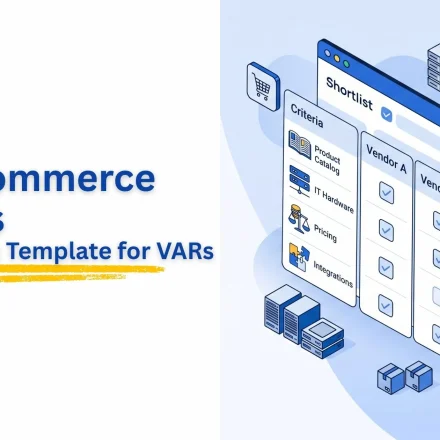
B2B eCommerce RFP Template for IT VARs: What the RFP Should Actually Ask
Table of Content
- What Is a B2B eCommerce RFP and Why IT VARs Need One
- Why IT VAR Requirements Are Different
- What Your RFP Should Include: 5 Requirements for IT VARs
- How to Score the RFP Responses: The 6-Criterion Matrix
- What a Strong Vendor Response Looks Like
- Three Questions That Narrow Any Shortlist
- How VARStreet Fits These Requirements
- FAQs

A B2B eCommerce RFP template for VARs is not a standard vendor checklist. It is a targeted document that asks the architecture questions where platform answers actually differ. This guide covers the five requirements to include, how to score the responses, and three questions that narrow any shortlist.
Key Takeaways:
- Standard eCommerce RFPs were built for manufacturers. The five requirements that reveal real platform fit for IT VARs aren’t on them.
- One question separates every platform: is distributor pricing pulled live at the moment of request, or from a file loaded last night? The answer matters more than any feature comparison.
- A good RFP forces every vendor to answer the same questions in writing. That’s when real differences show up. Not in the demo.
- VARs who replatform 12 to 18 months after launch almost always skipped one requirement. PunchOut is the most common miss.
- Three questions at the end of this guide will narrow your shortlist in ten minutes. Run them before any vendor demo.
What Is a B2B eCommerce RFP and Why IT VARs Need One
When an IT VAR ends up on the wrong platform, the evaluation usually looks fine. The demo went well. The requirements list confirmed every box. The problem showed up six months later. The distributor integration needed a custom build nobody had planned for. The RFP hadn’t asked the right questions.
A Request for Proposal (RFP) is how you prevent this. You send it to vendors before any demo. Each vendor has to answer your specific requirements in writing. In a demo, every platform performs well. In writing, the real differences show. A vendor that can’t answer ‘how many PunchOut integrations have you completed?’ with a real number is telling you something the demo never will.
Standard eCommerce RFPs ask about features every platform has. An IT VAR eCommerce requirements checklist needs to ask the architecture questions that actually differ. The five sections below are what your RFP should include.
The process from start to shortlist
Here’s where each section of this guide fits:
- Step 1: Build your RFP using the five requirements below.
- Step 2: Send it to vendors. Give them 5 to 7 business days to respond in writing.
- Step 3: Score each response using the six-criterion matrix in this guide.
- Step 4: Run the three diagnostic questions to filter your shortlist.
- Step 5: Schedule demos only with vendors who cleared all five requirements.
What the RFP document should look like
- Cover section: your company name, the project scope and the response deadline.
- Requirements 1 to 5: the five sections below, with your vendor questions under each.
- Scoring criteria: attach the six-criterion matrix so vendors know how you’ll evaluate their answers.
- Response format note: tell vendors you need specific numbers, not general confirmations.
- Next steps: your shortlisting date, demo schedule and decision timeline.
Why IT VAR Requirements Are Different
Standard B2B eCommerce assumes you control your prices. You set the catalog, you set the rates, the buyer checks out. That works for a manufacturer. It doesn’t work for a VAR.
Your prices come from IT distributors. They shift with every tariff announcement, promotional window and stock movement. Your enterprise and government buyers use procurement systems like SAP Ariba or Oracle PeopleSoft. Without PunchOut, those buyers can’t place an order through your store at all. A standard checklist doesn’t cover any of this. It was written for businesses with different constraints.
Every platform on a standard shortlist will say yes to a generic checklist. The five architecture questions below are where the answers actually differ from one B2B eCommerce platform for IT resellers to the next.
If you’re an MSP, add these three questions to your RFP:
- When a service rate changes, does it update automatically across all active contracts, or does someone have to do it manually?
- Can service bundles be repriced by account tier without rebuilding the contract?
- Is recurring billing connected to the same pricing data as your storefront, or does it run from a separate rate card?
What Your RFP Should Include: 5 Requirements for IT VARs
For each requirement, ask vendors to respond with specific numbers. If the answer to any question is ‘yes, we support that,’ ask again. That’s not an answer.
Requirement 1: Real-Time Distributor Pricing via Live XML Feed
Ask your vendor:
- Do you have pre-built connections to the major IT distributors, without custom development for each?
- Is pricing pulled live at the exact moment a customer views a product, or from a file uploaded earlier?
- Can pricing and stock from all signed distributor agreements appear side by side in one interface, without separate logins?
- Does the platform recheck price and availability before an order is placed?
A daily file means your storefront price and your distributor’s actual price can diverge. You absorb that difference. It won’t show up as a pricing error. It shows up as thinner margin on deals where you expected better.
Requirement 2: PunchOut Catalog Support
Ask your vendor:
- How many PunchOut integrations have you completed, and with which procurement systems?
- What’s your typical go-live timeline for a new PunchOut connection?
- Do you support SAP Ariba, Oracle PeopleSoft, Coupa and Jaggaer natively?
- Can a buyer shop your full catalog from inside their own procurement system?
‘250 completed integrations, live within a week’ and ‘we support PunchOut’ are not the same answer. One means the feature exists. The other means it works.
Requirement 3: Configure, Price, Quote Inside the Same Platform
Ask your vendor:
- Does Configure, Price, Quote (CPQ) live inside the same platform as the storefront?
- Does it read from the same live distributor data as the store?
- When a distributor price changes, does it flow automatically to quotes in progress?
When CPQ runs in a separate tool, your rep reconciles pricing between two systems on every complex deal. That’s where margin disappears across a quarter.
Requirement 4: Login-Based Pricing and Contract Catalog Management
Ask your vendor:
- Can each buyer see their own negotiated pricing automatically on login, without manual overrides?
- Can GSA rates, enterprise tiers and standard pricing run on the same storefront for different accounts?
- Can contract catalogs be restricted by account so buyers only see what they’re entitled to?
If pricing isn’t applied automatically on login, someone on your team fixes rates manually on individual orders. It’s slow, it creates errors and it doesn’t scale.
Requirement 5: Total Integration Cost, Not Just Monthly Subscription
Ask your vendor:
- How many of my signed distributor agreements are pre-connected without custom development?
- What would a custom integration cost for any distributor not on your pre-connected list?
- What’s the ongoing maintenance cost if a distributor updates their data format?
A lower subscription with $60,000 in custom integration work costs more in year one than a higher subscription with 50+ distributors already connected. Compare total cost of operation, not the monthly line.
Before any demo: Write down your signed distributor agreements, your top 10 accounts that need procurement access and your most complex deal type. Those three things tell you which requirements matter most to your business.
How to Score the RFP Responses: The 6-Criterion Matrix
When responses come back, use this RFP scoring matrix for eCommerce platform comparison to score each vendor. Rate from 1 to 5.
- A 5 means the requirement is met natively, with no custom build.
- A 3 means configuration work.
- A 1 means a significant build that you fund and maintain.
The difference between a 1 and a 5 on criterion 1 alone is often $60,000 and three months.
| Criterion | The question | Why it matters for IT VARs |
|---|---|---|
| Real-time distributor integration | Live XML at request, or daily file? | Stale data means absorbed margin on every post-change order |
| Multi-distributor in one view | All signed distributor prices side by side? | Separate portals recreate the manual multi-tab quoting problem |
| CPQ same platform | CPQ reads from same live data as storefront? | Separate CPQ creates reconciliation gaps where margin slips |
| PunchOut support | How many integrations done? Typical timeline? | No PunchOut means government and enterprise accounts can’t buy |
| Login-based contract pricing | Each buyer sees their own rate, natively? | Manual overrides create errors and can’t scale |
| Quote-to-PO in one system | Approved quote converts to PO in one click? | A two-system gap is where silent margin erosion happens |
1 = Custom build required | 3 = Configuration work | 5 = Native, no custom dev
| Criterion | VARStreet | BigCommerce B2B | Shopify Plus | OroCommerce | VARCommerce | Adobe Commerce |
|---|---|---|---|---|---|---|
| 1. Real-time integration | 5: Live XML, 50+ pre-connected | 2: Custom dev per distributor | 2: Custom dev required | 2: Custom dev required | 3: VAR-aware, limited | 2: Custom dev required |
| 2. Multi-distributor view | 5: Side by side, one interface | 1: Separate per source | 1: Separate per source | 2: Custom build needed | 3: Partial capability | 2: Custom build needed |
| 3. CPQ same platform | 5: Unified, same live data | 2: Third-party app required | 2: Third-party app required | 3: Built in, not VAR-specific | 4: Same platform | 3: Separate config |
| 4. PunchOut support | 5: 250+ done, days to configure | 2: Custom project required | 1: Not native | 3: Longer timeline | 3: Available | 3: Longer timeline |
| 5. Login contract pricing | 5: Per account, native | 4: Config needed | 3: Limited depth | 4: Requires setup | 4: VAR-aware pricing | 4: Config needed |
| 6. Quote-to-PO | 5: One click, same live data | 2: Separate tool needed | 2: Separate tool | 3: PO separate from quoting | 4: Some gaps | 3: Integration needed |
Scores reflect native capability without custom development. Verify directly with each vendor for your specific agreements and account types.
What a Strong Vendor Response Looks Like
Most vendors answer the right questions the wrong way. Here’s the difference:
| Requirement | Weak answer | Strong answer |
|---|---|---|
| Distributor integration | ‘We integrate with all major distributors’ | ‘Live XML feed, 50+ distributors pre-connected at onboarding, no custom build needed.’ |
| PunchOut | ‘We support PunchOut’ | ‘250+ completed integrations, typical go-live under 7 days, references available’ |
| Login pricing | ‘We support B2B pricing tiers’ | ‘Per-account pricing on login, no manual overrides, we’ll show it live in the demo’ |
| CPQ | ‘We have quoting functionality’ | ‘CPQ is inside the same platform and reads from the same live data as the storefront’ |
Three Questions That Narrow Any Shortlist
Run these before the full matrix. A vendor that can’t answer all three with real numbers doesn’t need more of your time.
- Question 1: How many distributor agreements do you have pre-connected without custom development, and what’s the connection mechanism?
- Question 2: How many PunchOut integrations have you completed, with which systems and what’s the typical go-live timeline?
- Question 3: Can a rep see live pricing from all signed distributors side by side inside the store interface, without switching portals?
What this looks like in practice
A mid-sized VAR in the Southeast ran these three questions early in their evaluation. Their top-scoring candidate had won on design and general B2B features. Each of their three distributor agreements needed a separate custom integration. The total quote was $80,000. Build time was eight to twelve weeks. Their second-largest account needed PunchOut and the platform had no pre-built path.
With VARStreet, all three distributors were pre-connected at onboarding. The PunchOut went live within a week. The $80,000 project would have started before the first order shipped. The shortlist changed at question one.
How VARStreet Fits These Requirements
VARStreet scores 5 on all six criteria. Those criteria describe how it was built, not how it was adapted after the fact.
The distributor catalog is the foundation. 7 million SKUs from 50+ IT and office supply distributors are pre-connected at onboarding. Your distributor agreements are configured, not built from scratch. Pricing arrives via live XML at the moment of request. CPQ, the storefront and the procurement module all read from the same data source. Over 250 PunchOut connections to SAP Ariba, Oracle and Jaggaer are completed. New connections typically go live within days.
When a rep opens a quote, live pricing from every signed distributor is already there. They pick the better price without switching tabs. When a buyer logs in, their contract rate is applied automatically. When a quote is approved, one click converts it to a PO from the same data. The gap between the storefront price and the purchase order cost doesn’t exist.
Book a Demo to map your distributor agreements to the five requirements. Explore the VARStreet platform overview.
FAQs
What is a B2B eCommerce RFP template for VARs?
It’s a document you send to platform vendors that lists your specific IT VAR requirements and asks each one to respond in writing, so you compare real answers instead of demo performance.
What are the most commonly missed requirements in an IT VAR platform evaluation?
PunchOut support and the real mechanism behind distributor integration. Both look like checkboxes until you ask for specific integration counts and the actual technical architecture.
What's the difference between a capability question and an architecture question?
A capability question gets a yes from every vendor. An architecture question gets specific answers that differ across platforms and show your actual margin exposure on every order.
When does PunchOut become required for IT VARs?
The moment any account on your list uses SAP Ariba, Oracle PeopleSoft, Coupa or Jaggaer to issue purchase orders.
How do I find the best eCommerce solution for a VAR business when every demo looks the same?
Send the RFP before the demo. The best eCommerce solution for VAR business answers your architecture questions with specific numbers, not general feature confirmations.
Pragya Bhardwaj
Pragya Bhardwaj is a seasoned B2B content writer with a strong background in SaaS and digital commerce. She specializes in creating clear, engaging, and search-optimized content that helps businesses connect with their audiences and build authority online. With experience across blogs, whitepapers, eBooks and website copy, Pragya brings both strategy and storytelling to every piece she writes. Editorial Policy
Read More