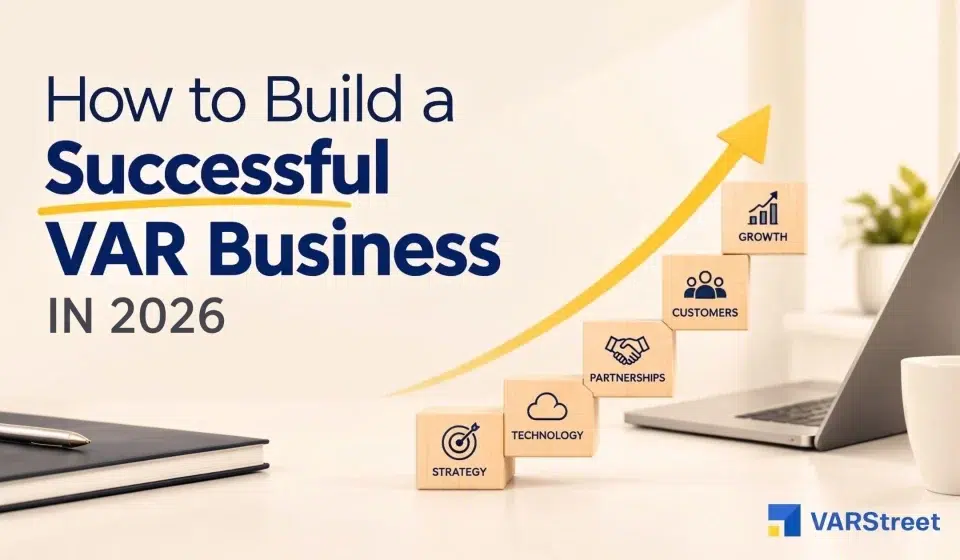

How to Build a Successful VAR Business
Table of Content
- Start With a Market You Can Serve Better Than Generalist Competitors
- Build a Product and Service Mix That Protects Margin
- Treat Distributor and OEM Relationships as Part of Your Operating Model
- Build a Sales Process That Can Scale Beyond Individual Reps
- Make Routine Purchases Easier for Customers
- Connect Sales, Procurement, and Fulfillment Before Growth Creates Bottlenecks
- Track the Metrics That Show Whether Your VAR Business Is Actually Getting Healthier
- Build a Business Stack Minimizing Complexity as You Grow
- VARStreet’s Contribution in Building a More Scalable VAR Business
- Conclusion
- FAQs
Building a successful VAR business in modern times is not simply about selling more products or adding more distributors. Most IT resellers can access products through TD SYNNEX, Ingram Micro, D&H, and Arrow Electronics. The challenge is turning those products into a profitable, repeatable operation.
A Gartner report reflects that more than 60% of B2B buyers prefer an overall rep-free buying experience. For VARs, that raises the pressure to make routine purchasing, quoting, and reordering easier without removing the sales expertise customers need for complex purchases.
As a VAR grows, so does the operational complexity: more products, customer-specific pricing, distributor portals, quotes, and handoffs between sales and procurement.
A successful VAR business is not just one that grows revenue. It is one that can grow without adding the same level of manual work and operational friction.
This guide covers the operating decisions that help US and Canadian VARs build a more scalable and profitable business.
Looking to build a more scalable VAR operation? See how VARStreet connects product sourcing, quoting, eCommerce, and order workflows in one platform. Book a demo Today!
Key Takeaways:
- The success of a VAR business does not depend just on a larger product catalog or sales team; it depends on repeatable operations.
- A focused market and product strategy can help VARs build stronger expertise and more profitable customer relationships.
- Distributor relationships directly affect product availability, pricing, and fulfillment flexibility.
- Scalable quoting, pricing, and procurement workflows help prevent operational complexity from growing with order volume.
- Connected systems for sales, sourcing, eCommerce, and order management can help VARs scale without adding unnecessary manual work.
Start With a Market You Can Serve Better Than Generalist Competitors
If you are planning to serve every type of customer, it becomes difficult for a VAR business to scale. Different industries often have different product requirements, buying processes, compliance needs, and service expectations.
Instead, you should focus on market areas where your team can build repeatable expertise and solution offerings. Choose a sector that you can serve best, such as
- Industry: Healthcare, education, government, or professional services
- Technology: Cybersecurity, networking, cloud, or workplace technology
- Customer type: SMBs, mid-market companies, or enterprise accounts
Before expanding into a particular market, ask a practical question: Can we serve this customer segment better and more efficiently than a generalist reseller?
The answer depends on more than product availability. You need reliable supplier access, sales expertise, repeatable solution bundles, and the operational capacity to support customers after the sale.
Build a Product and Service Mix That Protects Margin
Hardware resale can bring in revenue, but it can leave a VAR exposed when product margins tighten. Services can change that equation.
Depending on the customers you serve, the mix might include hardware and software resale alongside installation, configuration, managed services, technical support, renewals, or lifecycle management.
The important part is fit. Adding services simply because competitors offer them can create delivery problems of its own.
A networking VAR, for example, may be better off selling equipment together with configuration and deployment than treating the hardware sale as the end of the relationship.
Over time, this can increase the value of each account and reduce reliance on one-off product transactions.
Treat Distributor and OEM Relationships as Part of Your Operating Model
Distributor and OEM relationships affect much more than where you buy products. They influence what you can quote, how quickly you can respond to customers, and how reliably you can fulfill orders.
For North American VARs, working with distributors such as TD SYNNEX, Ingram Micro, D&H, and Arrow Electronics can provide access to broader product catalogs, availability data, vendor programs, and technical resources. But as the number of suppliers increases, multiple supplier relationships can also create more operational complexity if teams must check multiple portals for pricing, inventory, and product information. It is not required to work with the highest possible number of distributors. Build a supplier network that gives your business the right combination of:
- Product availability
- Competitive sourcing options
- Reliable fulfillment
- Relevant vendor programs
- Technical and sales support
As the business grows, sales teams should not have to manually switch between supplier portals every time they need to price or source a product. The stronger operating model gives teams visibility into the supplier options they need while keeping sourcing decisions connected to the sales workflow.
For a deeper look at how distributors can help VARs expand their business, explore our guide on building stronger distributor relationships.
Build a Sales Process That Can Scale Beyond Individual Reps
As your VAR business grows, your sales processes become dependent on the expertise of individual representatives. One rep has the knowledge to check with which distributor first; another has their own pricing approach. Even experienced sellers may rely on personal knowledge to build the right configuration or bundle. But this work model is suitable for small-scale businesses. It becomes a problem when the business adds more reps, customers, products, and quotes.
A scalable sales process should give teams a repeatable way to:
- Find and configure relevant products
- Build accurate quotes
- Apply pricing and approval rules
- Create solution bundles
- Manage quote follow-up
- Move approved quotes into the next stage of the order process
For complex IT deals, you always require experienced sales and technical input. But for routine parts of the process, it is not practical to depend entirely on what a particular rep remembers or how they prefer to work.
Make Routine Purchases Easier for Customers
VARs mostly focus on improving their internal sales processes, but they overlook friction on the customer side. For routine purchases, customers often do not want to email a sales representative, wait for a quote, and repeat the same buying process every time.
These transactions can be simplified by allowing customers to:
- Search approved products
- Place repeat orders
- View account-specific pricing
- Get relevant product information
- Buy regular items without waiting for manual assistance
This does not replace the role of sales teams. For complex configurations, solution design, and high-value purchases, customers may need the rep’s expertise, but not for regular purchases. Self-service works best for those repeat transactions.
Connect Sales, Procurement, and Fulfillment Before Growth Creates Bottlenecks
A quote may be accurate when it leaves the sales team, but problems can begin when that information has to be manually recreated for procurement and fulfillment.
As order volume grows, disconnected workflows can lead to:
- Incorrect products or quantities being ordered
- Duplicate data entry between sales and purchasing systems
- Delays while teams confirm supplier and customer information
- Pricing or configuration details getting lost during handoffs
- More administrative work for every approved order
A scalable VAR operation should allow information captured during the sales process to continue through the next stages of the workflow. Once a quote is approved, procurement should have access to the relevant products, quantities, customer details, and order information without relying on manual re-entry.
This becomes particularly important when sourcing products through distributors like TD SYNNEX, Ingram Micro, D&H, or Arrow Electronics, where procurement teams may need to act quickly on availability and pricing.
Track the Metrics That Show Whether Your VAR Business Is Actually Getting Healthier
Revenue growth is not the only criterion to measure the success of a VAR business. A company can close more deals while margins shrink, quote turnaround slows, and sales and operations teams take on more manual work. There are multiple factors attached to overall success.
Here are some of the key metrics to track that show both financial and operational performance, such as gross margin by product and service category, quote turnaround time, quote-to-order conversion rate, revenue and margin per customer, repeat purchase and renewal rates, order processing time, and revenue generated relative to operational workload.
All these metrics are vital to indicate where growth is creating friction.
For example, rising revenue combined with longer quote turnaround times may indicate that the sales process is becoming harder to manage. Similarly, higher order volume without improved margins may point to pricing or sourcing issues.
Build a Business Stack Minimizing Complexity as You Grow
As they grow, VARs often prefer to add new tools to solve individual problems. A CRM for sales, a separate quoting tool, distributor portals for sourcing, an eCommerce platform for customers, and additional systems for orders and reporting. As time passes, the issue changes; now they have to deal with managing too many disconnected workflows to get needed functionality.
So, don’t add another platform blindly. First, you need to look at whether your existing systems can support these core processes:
- Product and catalog management
- Customer and opportunity management
- Quoting and pricing
- B2B eCommerce and self-service ordering
- Distributor sourcing and procurement
- Order management and fulfillment workflows
- Reporting and operational visibility
The objective is not to run every part of the business from a single application at all costs. VARs may still rely on platforms such as ConnectWise, Autotask, QuickBooks, Salesforce, or HubSpot depending on their operating model.
The important question is whether information can move between the systems your teams use without creating duplicate data entry and disconnected processes.
A scalable technology stack should reduce the number of manual handoffs required to run the business, not add another layer of complexity as the VAR grows.
VARStreet’s Contribution in Building a More Scalable VAR Business
As a VAR business grows, managing product data, sales, customer purchasing, sourcing, and order workflows across separate systems creates unnecessary complexity. Here, the challenge is not to have the right tools. It is ensuring that the information and processes behind those tools work together.
VARStreet can help IT and office supplies VARs simplify their work by bringing key parts of their operations into a connected workflow. Such as:
- Product catalog and distributor access to help teams find and source relevant products
- CRM and quoting capabilities to manage opportunities and create customer quotes
- Pricing controls to support consistent pricing decisions
- B2B eCommerce to make product discovery and repeat purchasing easier for customers
- Procurement and order workflows to reduce manual handoffs after a quote is approved
For VARs working with distributor ecosystems such as TD SYNNEX, Ingram Micro, D&H, and Arrow Electronics, connecting product sourcing with sales and order workflows can reduce the need to manage information across multiple disconnected processes.
What VARStreet Customers Say:
“VARStreet has played a big role in helping us grow by over 50% this year. VARStreet saves time for every member of our staff.” — Collin Mitchell, Monster TechnologyThe result is not simply more automation. It is a more connected operating model that helps VARs handle growth without adding the same level of manual work and operational complexity.
Conclusion
A VAR business does not get stronger just by adding more products, distributors, customers, or salespeople. The real challenge comes when business picks up. Can your team manage more quotes, sourcing, pricing, orders, and fulfillment without slowing down?
This often depends on how the business runs each day. VARs should know which markets they serve best, where their profits come from, which distributors they can trust, and which purchases customers can handle themselves.
What happens after a sale is just as important. If every new customer leads to more spreadsheets, more portals to check, more manual pricing, and repeated data entry, growth can actually strain your business instead of making it stronger.
The focus is clear. Create a VAR business where growth brings in more revenue and capacity, not more complexity.
Ready to Build a More Scalable VAR Business?
VARStreet helps IT and office supplies VARs connect product sourcing, CRM, quoting, B2B eCommerce, pricing, procurement, and order workflows in a more unified operating model.
Book a demo with VARStreet to see how you can reduce operational complexity and build a business that is ready to scale.
FAQs
What makes a VAR business successful?
A successful VAR business is a combination of strong customer relationships and repeatable operations. In order to make their business successful, VARs have to manage sourcing, pricing, quoting, procurement, and customer purchases efficiently. Manual work should be reduced to grow the business successfully.
How can VARs improve profit margins?
VARs can improve margins with a mix of the right products and services. They need competitive sourcing options and consistent pricing controls. Reducing operational inefficiencies can further lower the cost of processing orders.
Should a VAR specialize in a specific market or technology?
When a VAR focuses on a particular market or technology, it can build deeper expertise and create repeatable solution offerings. The right approach depends on whether the business can reliably source, sell, and support the products and services required by that market.
How can a VAR business scale without adding too much overhead?
Some of the common ways to scale for a VAR are standardizing sales and procurement workflows, reducing duplicate data entry, making repeat purchases easier for customers, and connecting the systems used across product sourcing, quoting, and order management.
What technology does a modern VAR business need?
A modern VAR business needs capabilities for product and catalog management, CRM, quoting, pricing, B2B eCommerce, sourcing, procurement, order management, and reporting. The priority should be ensuring these workflows work together rather than adding separate tools for every function.
Chayanika Sen
Chayanika is a B2B Tech and SaaS content writer and strategist with 20 years of industry experience. She specializes in writing research-backed, data-driven, and actionable long-form content. She's also a trained Indian classical dancer and a passionate traveler. When not at work, you'll either find her performing on stage or exploring new places. Editorial Policy
Read More