How to Choose the Right Configure Price Quote Software for your Business?

Table of Content
Chances are, you’ve worked with customers who want personalized, detailed, and sometimes highly complex quotes. Delivering these quotes quickly and accurately isn’t easy. It can overwhelm even experienced sales teams. In a fast-moving, competitive market, your ability to respond efficiently can make or break a deal. Converting a prospect into a customer takes precision, speed, and confidence at every step.
That’s why more businesses are turning to Configure, Price, Quote (CPQ) software. This technology simplifies the quoting process, especially for companies offering multiple products, custom configurations, or dynamic pricing. A CPQ solution ensures your team delivers polished, accurate quotes faster.
Key Takeaways:
- Selecting CPQ software means evaluating how well it automates pricing rules and product configurations.
- Effective CPQ tools integrate with CRM and ERP to ensure consistent data flows and reduce duplication.
- Scalability and customization determine how a CPQ solution supports growth and deal complexity.
- Real-time price and contract conditions increase quote accuracy and reduce revisions.
- User experience and guided selling features shorten onboarding and improve adoption.
Why CPQ?
A CPQ platform helps your sales team work smarter. It automates the configuration of products or services, applies pricing rules, and generates ready-to-send quotes in a fraction of the time.
With CPQ software, your team can:
- Eliminate pricing errors
- Accelerate quote delivery
- Standardize discounts and approvals
- Improve the customer buying experience
If manual processes are slowing you down or if inconsistent pricing is causing friction, a CPQ tool can help you streamline quoting and close deals faster.
Read more about CPQ in our blog Configure Price Quote: Features and Benefits.
Signs Your Business Needs CPQ
You might need a CPQ solution if:
- Customers regularly request customized or complex product configurations
- Sales reps struggle with manual pricing or quoting errors
- Quoting is inconsistent or lacks standardized rules
- Approvals and revisions take too long
- You’re losing deals because of delays or inaccurate quotes
How to Choose the Right CPQ Software?
Every business is different, and not every CPQ platform fits the same way. A well-suited CPQ solution will blend smoothly into your tech stack and support your business operations. Consider your company’s size, product complexity, and system landscape. A compatible CPQ tool will easily align with your existing tools and enhance your current processes.
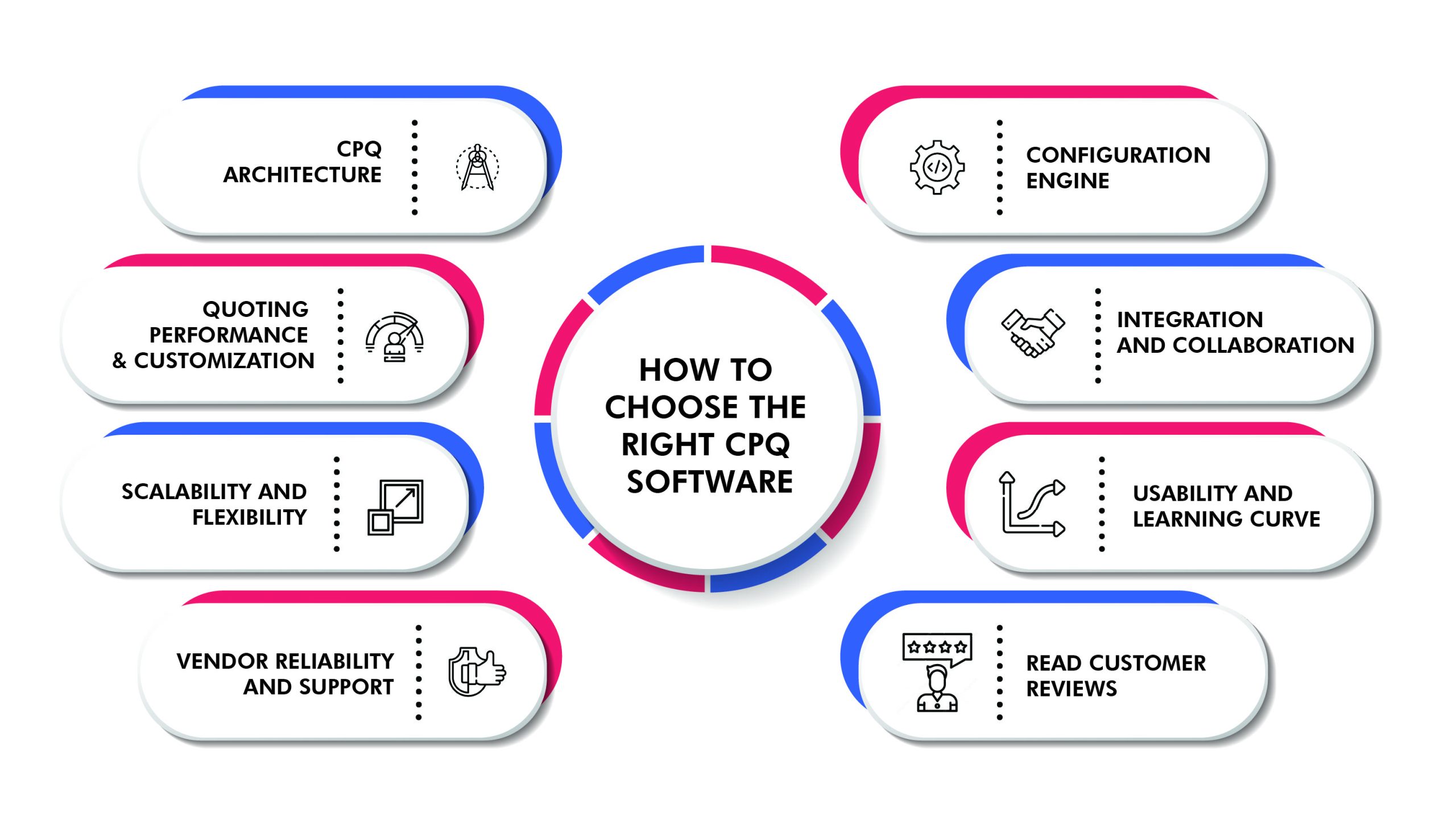
Here are eight key factors to evaluate:
1. CPQ Architecture: Native or Hybrid
CPQ platforms are typically either native or hybrid.
- Native CPQ is built specifically for a single CRM or ERP application. If your sales team already works within one CRM, a native solution can offer tight integration and a consistent user experience.
- Hybrid CPQ, due to its strong integration capabilities, streamlines data flow between ERP and CRM systems, providing sales teams a unified sales experience. This is ideal for businesses with teams using different tools across departments, locations, or regions. It eliminates the need for you to reinvest and re-implement different platforms in different regions, thus saving your time and money.
Choose an architecture that fits your IT environment and avoids unnecessary complexity.
2. Configuration Engine: Rules-Based or Constraint-Based
Product configuration is at the heart of any CPQ solution. It can be of two types. A “rule-based configuration engine” and a “constraints-based configuration engine”. While both of them have their respective advantages and disadvantages, it is crucial to understand and choose the one that best suits your business needs.
- Rules-Based Configuration: Great for simple product structures. You define rules manually, and the engine ensures sales reps follow them.
- Constraint-Based Configuration: Best if you sell products that are highly personalized and customized as per your customers’ needs. Complex systems require multiple rules to be written for the system to work efficiently. It allows greater flexibility and reduces the manual effort required to build configurations.
Select a configuration engine that matches your product range and the needs of your sales team.
3. Quoting Performance and Customization
As quotes grow in size and complexity, the CPQ software must keep up. Some systems struggle to handle more than a few thousand line items. Others slow down with large product catalogs.
When reviewing CPQ platforms, ask:
- How many line items can it handle efficiently?
- Can your team easily modify or revise quotes?
- Is the interface user-friendly and customizable?
Request a demo to see the system in action with real-world scenarios.
4. Integration and Collaboration
CPQ software should work well with your existing tools. A CPQ software with eCommerce integration can do wonders for a business. It can provide the same level of capabilities to the customers as it provides to the sales team.
But it is not true for all the CPQ solutions.
Different CPQ software solutions offer different levels of integration. And selecting the best-fit solution for our specific business needs is critical.

Points to consider when looking for an integrable CPQ system:
- The level of collaboration allowed between a buyer and the vendor.
- Transparency to the company when a client customizes a product.
- How prices for different products and elements are handled.

Pro Tip:
- Prioritize APIs and extensibility to future-proof integrations with emerging systems.
5. Scalability and Flexibility
Make sure the CPQ software won’t limit you down the road. It should be robust enough to handle complex configurations, large catalogs, and multi-tiered pricing structures as your business expands.
Startups may need basic features, while mid-size or enterprise-level companies often require advanced tools. The software should work well for any stage of business.
Also, if your company has multiple branches or divisions, the CPQ system should handle that too. Look for flexible options that can adjust to your structure and future needs.
Go for a cloud-based CPQ, as it is scalable as you grow and offers flexibility to access the CPQ platform anytime from anywhere.
Learn about the benefits of cloud platforms here.
Pro Tip:
- Benchmark CPQ platforms using complex bundle scenarios to stress-test logic and performance.
6. Usability and Learning Curve
A clean and simple user interface (UI) helps reps find what they need quickly. A well-designed UX guides users smoothly through the system, minimizing effort and making tasks easier to complete. If the system is too complex, it can slow your team down.
Also, check how much training is needed. The best CPQ tools are easy to learn and don’t require weeks of onboarding. A short learning curve helps your team start using the software faster and more confidently.
7. Vendor Reliability and Support
Investigate the company’s experience and whether it is respected in your industry. See if the vendor focuses on your industry because this can make a big difference in how well the software fits your needs. Also, check what kind of training and onboarding support is available.
A good vendor will help your team learn the system quickly. Make sure the support team is responsive and available at all hours through phone, chat, and email, especially if your business operates across different time zones. It also helps if they offer a customer success team to guide you even after the software is up and running.
8. Read Customer Reviews
G2, Capterra, and TrustRadius are excellent sources for finding honest user opinions and comparisons of different CPQ software options. These platforms share real user experiences and ratings. Give more weight to reviews from organizations similar to yours and ensure that the feedback is relevant and applicable. This helps you understand how the software performs in a similar business environment.
Case studies can show how the CPQ tool solved specific problems. If possible, ask the software provider to connect you with current users. Speaking directly with them can give you honest feedback and help you make a better decision.
Look for these important features in a CPQ to streamline your sales process:
- Guided selling
- Automatic price and profit margin calculations
- Easily manage quotes through a mobile-responsive interface
- One-click PDF and proposal generation
- Built-in approval workflows
- Support for different currencies and languages
Final Thoughts
The right CPQ solution helps your team work faster, sell smarter, and deliver a better customer experience. It brings structure to your quoting process, ensures accuracy, and removes bottlenecks that slow down deals. The right CPQ software not only eases the pain of the business but also of its clients.
Before choosing a platform, take time to review your current challenges and priorities. Match them to the capabilities offered by the CPQ tools you’re evaluating. A good CPQ solution should support your workflow, scale with your business, and deliver measurable value.
Ready to find a solution that aligns perfectly with your business needs? Explore VARStreet CPQ Software, a powerful platform designed to streamline your sales activity. Book a personalized demo today to see how VARStreet can transform your quoting process.
FAQs
How do I know if my business needs CPQ software?
If your sales team struggles with manual quoting, frequent pricing errors, or slow approval workflows, and you often deal with product configurations, then it’s time to consider a CPQ solution.
What’s the difference between native and hybrid CPQ architecture?
Native CPQ is built for a specific CRM or ERP system and offers tight integration. Hybrid CPQ works across multiple platforms, making it ideal for companies using different tools across departments or regions
Which is better: rules-based or constraint-based configuration engine?
Rules-based engines work well for simpler products with defined conditions. Constraint-based engines are ideal for complex, customizable products, offering more flexibility and automation.
Can I integrate CPQ software with my current eCommerce platform for smoother quoting?
Yes, but integration levels vary. The right CPQ solution should seamlessly connect with your eCommerce, ERP, CRM, and distributor systems to provide a unified quoting experience.
How do I evaluate the quoting performance of a CPQ tool?
Ask about how many line items it can handle, how customizable the quote templates are, and how fast it generates quotes even with large product catalogs. Seeing a live demo in action gives you valuable insight into how the software performs when used by sales reps.
How can I evaluate whether a CPQ solution is flexible and scalable for long-term business use?
Look for features such as multi-currency support, role-based access, branch-level customization, and compatibility with growing product catalogs or sales teams.
Is CPQ software easy to learn for new sales reps?
The best CPQ tools offer an intuitive interface, step-by-step guidance, and minimal training time. Look for platforms with user-friendly dashboards and a short learning curve.
How critical is the vendor’s customer service for smooth CPQ software use?
Very important. Strong vendor support ensures smooth onboarding, quick issue resolution, and continued success. Choose vendors offering 24/7 support, training resources, and customer success teams.
How can customer reviews and case studies help in choosing CPQ software?
Reviews and case studies offer real-world insights from businesses like yours. They reveal how the software performs under real conditions and what challenges it solves effectively.
Does CPQ Software support mobile quoting?
Yes, CPQ tools like VARStreet offer mobile access, allowing your sales team to create, edit, and send quotes on the go, perfect for remote or field-based sales operations.
Can a CPQ solution handle multiple discounting rules?
Yes, robust CPQ tools allow you to apply complex discounting rules based on volume, customer type, region, or promotions, while maintaining approval control and profitability.
Can CPQ software work for small businesses or only large enterprises?
CPQ software can be tailored to any business size. Many vendors, including VARStreet, offer scalable options suited to startups, mid-sized companies, and large enterprises.
Will a CPQ solution work for service-based businesses or just product sellers?
Many CPQ platforms support both. Service-based companies can configure labor, time, and service packages with the same precision as product bundles, using custom rules and rates.
Rahul Saini
Rahul Saini is a content strategist who uses writing as a tool for perspective, influence, and direction. He has built his craft around understanding how stories guide teams, shape culture, and drive meaningful business outcomes. Rahul works at the crossroads of strategy and storytelling, helping leaders articulate vision, refine ideas, and communicate with clarity and purpose. Known for his thoughtful leadership style and calm, structured approach, he turns complex themes into grounded insights that inspire action and support strong decision-making. His work combines creative thinking with strategic discipline and gives brands and leadership teams narratives that truly stand up. Editorial Policy
Read More