Table of Content
The answer you want to give to this question is data normalization.
In the era of big data, as the information available to businesses becomes infinite, it’s imperative to adapt proper mechanisms that provide structure to this data so that it remains easy to understand and provides valuable insights, no matter what day or month, or year it is.
In this article, we’ll discuss how data normalization achieves just that and what role it plays in catalog management.
What is Data Normalization?
Simply put, data normalization is the process of untangling and reorganizing data (mostly relational) so that teams can process, analyze, and draw insights from stored information comfortably.
The aim is to clean data of any redundancies, inconsistent information, anomalies, etc., and give it a cohesive structure that is easy to navigate and grasp.
Data collected over the years is bound to contain duplicate information in excess. These redundancies need to be struck out as they take up disk space and make an accurate analysis tricky.
Apart from that, conflicting data, i.e., data entries that have no relation to one another, are often grouped together. This gives rise to what we call ‘inconsistent dependencies’, which make it challenging for a user to find, categorize, and piece information together while attempting to analyze or read data.
For example, it makes no sense if customer details and employee performance reviews have been recorded in the same data file.
Data normalization seeks to file data in a structured way, such that all data entries of a particular file/table/catalog will have the same relationship to one other.
So How is Data Normalization Achieved?
Edgar F. Codd introduced the idea of data normalizationas a part of his relational model. It stipulates certain rules on the basis of which data is synthesized or restructured. Each rule is referred to as a ‘normal form’.
If data is organized adhering to the first rule, then that database is said to be in ‘first normal form’. Likewise, if it’s structured according to the first and second rules, then the database is said to be in ‘second normal form’, and so on and so forth.
In data normalization theory, there are six normal forms that can be achieved by businesses, though most applications need not go further than the ‘third normal form’, as it is considered the highest level necessary.
The first normal form

The first normal form (1NF) requires that every attribute (column) of a table should only hold unique values and not multiple ones. Also, each set of related data should be identified with a primary key.
Essentially 1NF’s objective is to ensure that all entries are separate and there is no repetition.
The second normal form
For the second normal form (2NF), the data must adhere to 1NF rules first. After that, values or attributes that apply to multiple data records or tables should have a separate table.
2NF further tries to eliminate duplication, as instead of adding multi-attribute value as a single entry in a number of tables, a distinct table should be created for that value. These tables should then be related through a foreign key.
The third normal form
After fulfilling all 2NF requirements, you need to eliminate all the fields that do not depend on the primary key. If you change the primary key, then subsequently, all the data in that entry must change.
Why Data Normalization is Crucial
Nobody collects and stores data only to archive it someday and never look through it again. The truth is, businesses hope to leverage their vast collection of knowledge bases in driving key growth decisions. This is why you must take data normalization seriously.
Let’s see some of the key benefits:
Tackle space issues
Data culture these days prompts businesses to record and safeguard whatever useful information they can get their hands on. Consequently, storage has become a concerning issue for most businesses. Year after year, as the need for data retention rises, storage spaces only seem to get smaller.
In fact, Statista reports suggest that in 2020, data storage demand exceeded its supply by almost double.
With data normalization, you can organize your data logically and remove redundancies, which will help free up a significant amount of space. Moreover, your database will no longer be heavy with unnecessary information, thereby enhancing its processing performance.
Once all your data is cleansed, your storage systems will run swiftly without any loading or performance lags.
Easier Data Management
Large-scale data collection means your business also needs to put in considerable effort in maintaining it. Since you’re constantly discovering and recording new information every day, data files usually don’t sit idle. There are modifications and additions to be made on a daily basis.
Particulars in a normalized data set can be updated and changed with ease, as you can find and decipher information effortlessly. Moreover, the normalized data is organized in such a way that making big, structural adjustments will also not be a hassle.
Efficient Analysis

It is a no-brainer that accurate and useful analysis can only be conducted if the data which is at the center of it can be observed, scrutinized, and decoded smoothly.
With data normalization, you’ll have inch-perfect data at your fingertips, and it’ll be much simpler to find answers and insights through a sea of data. You can convert your normal data into smart data, and draw actionable insights to guide important business strategies
Facilitating Segmentation
Data normalization makes it much simpler for your marketing teams to segment customers on the basis of different categories like title, job description, geographical location, etc.
Since all information is presented in an orderly manner, you can swiftly identify leads and group them into different segments. This is very important because if your marketers are able to segment customers with precision, they’ll be able to launch targeted campaigns that are tailored to attract different segments.
What is Product Data Normalization?
Now that you’ve successfully understood what data normalization is, it’ll be much easier to grasp product data normalization.
In the context of online buying and selling, product data normalization essentially facilitates and supports not just improved, but smart catalog management.
Normalizing your product catalog structureis crucial as it gives your product lists a cohesive format that houses no duplicate information and offers a sorted view of your products. This means you can manage your ever-expanding product-lines with ease, introducing modifications and new elements at cracking speed.
A well-defined product catalog will boost your site’s performance, reduce load times, and provide a better user experience to your customers.
Here are a few direct advantages of product data normalization for eCommerce businesses:
· Your product catalog structure will remain consistent throughout the website.
· You’ll be able to showcase more detailed and rich product contentto your customers.
· You can modify and expand your product database without letting redundancies, errors, and anomalies handicap your growth.
- You’ll be able to ensure that all field values like abbreviations, product units, attributes, etc. comply with standards, are accurate, and remain consistent throughout the store.
Product Data Normalization with VARstreet

VARstreet’s IT hardware product feed lists 7+ million hardware and office supply products from 45+ distributors.
VARstreet procures this product information from Etilize, Icecat, or HP content syndication, pulling whatever rich product content they can find along with all the necessary product details.
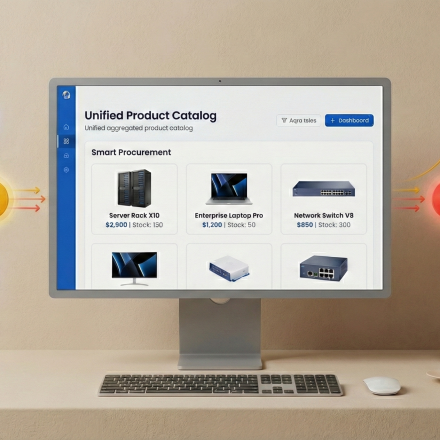
VARstreet then normalizes this extensive data, organizing it systematically in pre-stipulated categories and sub-categories so that you receive uniform and comprehensible information. This will enable you to scan through product information effortlessly and choose what you want to sell prudently.
The end-users will be able to comprehend your product catalogs with fluency. Moreover, VARstreet’s aggregated catalog will assist them with useful product searches and suggestions.
All in all, if you’re an IT hardware reseller looking for properly structured product information, then VARstreet’s immense catalog is definitely the perfect solution!
Don’t Postone Normalizing your Data
It’s clear that data culture will only flourish, and businesses will become increasingly dependent on data to support revolutionary business ideas and strategies.
You may not yet feel the urge to go through your archives and arrange everything in order, but a few years later, old data insights are exactly what you might need to grow your business.
Also, data normalization has the potential to improve your day-to-day business operations effectively, which is why structured data is not just a future requirement but the need of the hour.