Table of Content
- What Is a VAR Business Stack?
- The VAR Quote-to-Cash Workflow
- The Anatomy of a Modern VAR Business Stack
- Common VAR Cost Leaks and Their Financial Impact
- How the VAR Business Stack Directly Controls Costs
- Why Disconnected Tools Increase VAR Operating Costs
- How to Build a VAR Business Stack
- What an Integrated VAR Business Stack Looks Like in Practice
- How VARStreet Supports a Connected VAR Business Stack
- Conclusion: The Right Stack Can Protect Your Margins
- FAQs
What Is a VAR Business Stack?
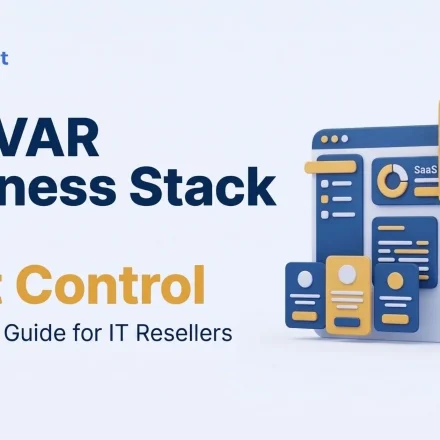
A VAR business stack is the combination of software systems an IT reseller uses to manage sales, quoting, product data, eCommerce, procurement, fulfillment, billing, services, and reporting. A connected stack allows data to move between these functions without repeated manual entry, helping resellers reduce operational costs and manage margins more effectively.
Many VARs think of their business stack as a collection of separate tools: a CRM for sales, a quoting platform, a procurement system, an accounting application, and perhaps a PSA for services.
For a margin-sensitive VAR, that connectivity matters because every unnecessary manual step creates another opportunity for cost, delay, or error.
The VAR Quote-to-Cash Workflow
A VAR business stack works best when information moves continuously from the first customer interaction through payment and renewal. Rather than treating sales, quoting, procurement, fulfillment, and billing as separate activities, resellers can view them as stages of one quote-to-cash workflow.
Lead → Opportunity → Quote → Approval → Sales Order → Purchase Order → Fulfillment → Invoice → Payment → Renewal
Each handoff can introduce delays, duplicate work, or errors when information has to be recreated manually. A connected stack allows customer, product, pricing, order, and billing information to move from one stage to the next without repeated data entry.
This workflow also helps VARs identify where operational costs occur. If employees repeatedly move data between systems at multiple stages of a transaction, those handoffs become clear targets for integration or automation
The Anatomy of a Modern VAR Business Stack

A VAR’s business stack is built from several essential components. Each plays a specific role, and each contributes directly to operational efficiency or inefficiency. Below is a deeper look at the systems that make up a modern stack, and how they shape the reseller’s economics.
1. CRM: The Visibility Engine of Sales-Driven Organizations
Sales are central to a VAR business, and CRM provides visibility across the sales cycle. A well-managed CRM helps teams track opportunities, customer interactions, renewals, and follow-ups in one place.
Without that visibility, VARs can lose track of:
- Which opportunities are active
- Which customers are due for renewal
- Which accounts are growing or shrinking
- Which prospects need follow-up
The cost is easy to overlook. Missed follow-ups can mean lost deals, while missed renewal dates can turn recurring revenue into one-time business. CRM therefore plays a role in protecting revenue, not just managing contacts.
2. Quoting Automation: The Largest Margin Leak in Most VARs
If CRM protects revenue, quoting automation can protect margin. Manual quoting creates several opportunities for errors that directly affect profitability.
Margins evaporate because of very small errors:
- A quote uses old distributor pricing.
- A discontinued SKU is included.
- A rep forgets to include freight or special terms.
- A customer receives a quote hours after a competitor has already responded.
Every mispriced quote, every slow response, every manual copy-paste increases operational cost and reduces profitability. In highly competitive reseller markets, speed-to-quote can determine the entire outcome of a deal. And accuracy in quoting affects not just the margin, but customer trust.
A modern VAR stack must include automated quoting tied directly to distributor feeds, customer-specific pricing, and approval workflows. Without it, margin erosion is inevitable.
3. eCommerce & Customer Portals: The Efficiency Layer
The rise of self-service buying has transformed reseller operations. Customers no longer want to email a rep for every reorder, price check, or quote request. They want a portal where contract pricing is visible, SKUs are searchable, and orders can be placed without waiting for a human response.
For VARs, this is not just a convenience feature. It is a cost-control mechanism.
Every order placed through a portal saves:
- Rep time
- Support time
- Administrative processing
- Follow-up effort
It also increases order accuracy and reduces the likelihood of disputes. Over time, portals shift the workload from internal teams to customers, freeing staff to focus on higher-value activities.
4. Procurement Systems: The True Cost Center (And Margin Protector)
Procurement mistakes are costly. Not because they look dramatic, but because they cascade quietly through the business.
Common procurement failures include:
- Submitting POs without checking stock,
- Ordering from a higher-priced distributor because pricing was not compared,
- Duplicating POs due to manual entry,
- Failing to track backorders properly.
These issues result in returns, delays, credit complications, and customer frustration. They also increase internal workload because every mistake requires emails, calls, credits, and re-processing to fix.
A modern procurement system integrates directly with distributor feeds, compares pricing in real time, validates SKUs, and ensures that orders flow smoothly from quote to PO. This is one of the most underrated cost-control levers in the reseller world.
5. Order Management: Stability Across the Entire Customer Lifecycle
Once an order is placed, the real operational challenge begins. Managing fulfillment, coordinating with distributors, tracking shipments, updating customers, and ensuring accuracy across multiple orders and vendors is complex.
A disjointed order management workflow leads to:
- Missed shipments
- Slow delivery times
- Higher support volume
- Customer dissatisfaction
An integrated order management system ensures predictability. It centralizes order status, synchronizes updates, and connects procurement, fulfillment, and billing. This stability protects both customer experience and internal efficiency.
6. Billing, Invoicing, and DSO Control: Where Cash Flow Lives or Dies
A VAR can be profitable on paper and still struggle financially. Cash flow determines survival, and cash flow is a function of invoicing.
Manual invoicing causes delays. Delays extend DSO. Extended DSO reduces liquidity. Reduced liquidity affects purchasing ability. The entire cycle becomes stressed.
Automated billing tightens this cycle, reduces the chance of missed charges, and ensures consistency. It also minimizes the labor needed for reconciliation and accounts receivable follow-up.
The right invoicing system is not an accounting choice. It is a cost-control mechanism.
7. PSA/Ticketing for MSP-leaning VARs
For VARs with a service component, service profitability depends on operational rigor. PSA systems track labor, SLAs, ticket volume, and contract performance. Without PSA visibility, service work becomes unprofitable because hours are lost to untracked labor.
Not all VARs need PSA, but those who do, cannot operate efficiently without it.
8. Reporting & Business Intelligence: The Margin-Discovery Layer
The final layer of the stack ties everything together. Reporting surfaces inefficiencies that would otherwise go unnoticed. BI tools identify:
- Inconsistent pricing
- Underperforming reps
- Bottlenecks in quoting or procurement
- Profitability by product line
- Cost patterns across fulfillment stages
Without reporting, a business cannot improve its processes. Cost control is not a one-time project; it is a continuous cycle of measurement and adjustment.
Common VAR Cost Leaks and Their Financial Impact
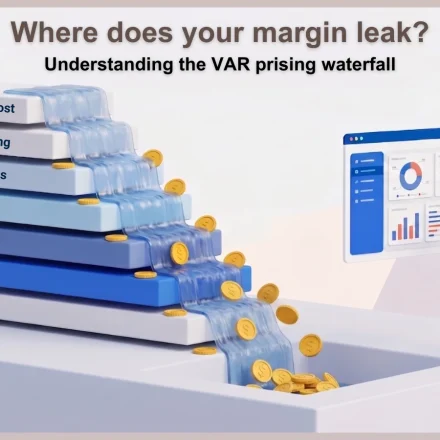
A VAR can lose margin without changing its pricing strategy or supplier costs. The leakage often happens between the major stages of a transaction.
Consider a typical deal. A salesperson spends time assembling a quote, operations recreates the order for procurement, procurement checks multiple distributor portals, fulfillment follows up on availability, and finance later prepares the invoice. None of these activities necessarily looks expensive in isolation. Together, they increase the cost of processing each transaction.
The same pattern appears across the customer lifecycle:
Before the sale: Slow responses, outdated pricing, and missed follow-ups can reduce the value of the sales pipeline.
During purchasing: Poor stock visibility, distributor selection, and PO errors can create unnecessary purchasing and rework costs.
During fulfillment: Manual status checks, shipment issues, and order corrections increase the cost of servicing customers.
After the sale: Delayed invoicing, collections, missed renewals, and contract tracking can affect cash flow and recurring revenue.
Across every stage: Repeated data entry and disconnected systems consume employee time that could otherwise support revenue-generating work.
The important point is that cost leakage is cumulative. A VAR processing 50 transactions a month may tolerate manual work that becomes expensive at 500 or 5,000 transactions. As volume grows, processes that once seemed manageable can become a significant part of the cost of doing business.

How to Build a VAR Business Stack
Building a VAR business stack should start with the way the business operates rather than with a list of software products. The goal is to identify where information needs to move, where employees are spending time on repetitive work, and which processes have the greatest financial impact.
1. Map the core workflows
Document how leads become opportunities, quotes become orders, orders become POs, and completed orders become invoices and renewals.
2. Identify manual handoffs
Look for places where employees copy information between CRM systems, spreadsheets, distributor portals, quoting tools, eCommerce platforms, accounting software, and other applications.
3. Measure the cost of those gaps
Track time spent on duplicate entry, quote preparation, PO creation, order corrections, invoice processing, reconciliation, and customer follow-ups.
4. Prioritize high-volume processes
Focus first on tasks that happen frequently or create high downstream costs. Automating a process performed hundreds of times each month can have a larger impact than fixing an occasional task.
5. Decide what to consolidate and what to integrate
Not every system needs to be replaced. Specialized applications can remain where they provide clear value, while core VAR workflows can be consolidated or connected.
6. Measure the results
Compare operational metrics before and after changes to determine whether the new stack is reducing processing time, errors, labor requirements, and other operating costs.
What an Integrated VAR Business Stack Looks Like in Practice
An integrated stack should make a transaction feel like one continuous process rather than a series of disconnected tasks.
For example, imagine a customer requesting a quote for several devices. The sales rep can access the customer’s account details, build the quote using current product information, and move the approved order into procurement without recreating the same data. The order can then progress through fulfillment, with its status visible to the teams responsible for delivery and billing.
The same connected workflow can continue after the sale. Customer history, renewal dates, and future opportunities remain accessible to the relevant teams, while management can use centralized data to understand how the business is performing.
The key benefit is continuity. Employees spend less time moving information between systems and more time acting on it. For a growing VAR, that can make it easier to handle increasing transaction volumes without adding unnecessary administrative work.
How VARStreet Supports a Connected VAR Business Stack
VARStreet gives IT resellers a centralized platform for managing the functions that keep their business running. Instead of relying on separate applications for each stage, VARs can access core capabilities through one connected ecosystem.
VARStreet includes:
- CRM: Manage customer relationships, prospects, and sales opportunities.
- Quoting: Build and manage quotes using product and pricing information.
- Catalog Management: Organize product catalogs and supplier data.
- eCommerce: Provide customers with an online purchasing experience.
- Procurement: Manage purchasing activities and supplier workflows.
- Order Management: Track orders throughout the fulfillment process.
- Billing: Manage billing activities alongside the transactions that generate them.
For VARs, having these capabilities within one platform can simplify day-to-day management and reduce the need to coordinate information across multiple applications. It also gives teams a common view of business activity, making it easier to manage operations as the company grows.
Conclusion: The Right Stack Can Protect Your Margins
For IT resellers, cost control is closely tied to how efficiently the business operates. Every unnecessary manual step, repeated task, or disconnected process adds time and creates another opportunity for an error or delay.
The answer is not necessarily to add more tools. It is to build a technology environment where the systems and processes your team relies on work together.
That is where VARStreet can make a difference. By bringing CRM, quoting, catalog management, eCommerce, procurement, order management, and billing together, VARStreet gives IT resellers a centralized foundation for managing their business.
If your current systems are creating unnecessary complexity as your business grows, explore VARStreet to see how a connected platform can support your sales and operational needs.