What is a Sales Quotation? Definition, Meaning, Creation & Presentation

Table of Content
- Are Sales Quotes Legally Binding?
- Sales Quote, Estimate, Proposal, and Invoice
- Purpose of a Quote
- Key Components of a Sales Quotation
- Types of Sales Quotations
- Things to Consider Before You Quote
- Quote Presentation
- Different Ways of Quote Creation
- Features of Quoting Software
- Follow up on the Quote
- Best Practices for Creating Effective Sales Quotes
- Common Mistakes to Avoid
- Measuring Quotation Effectiveness (KPIs)
- If the Sales Quote is Accepted?
- Conclusion
- FAQs
Those who are in sales will know how important quotes can be to the sales process. A sales quote that is created using the information provided by the potential buyer, mainly consists of a number of products/services along with the price list.
Are Sales Quotes Legally Binding?
Legal enforceability only comes into play once the buyer accepts the quote, usually through written confirmation or by issuing a purchase order. At that point, the quote may be converted into a legally binding sales order or contract, depending on the business arrangement. Until then, the sales quote remains a proposal and carries no legal obligation for either party.
Industry-wide average win rates (all sales, not only quoting) hover around 21%, meaning only about one in five prospects closes successfully (alore.io).
This sales performance statistic can be improved by adopting the right approach and tools that simplify the sales process.
Sales Quote, Estimate, Proposal, and Invoice
While often used interchangeably, a sales quote, estimate, proposal, and invoice have distinct meanings.
A sales quote presents fixed prices and terms for a defined period; an estimate provides an approximate cost that may vary; a sales proposal includes more detailed information, including the value proposition, especially for complex deals; and an invoice is a bill sent after the sale has been finalized.
Purpose of a Quote

The primary purpose of a sales quotation is to sell the products or services at the price quoted. This aim is to get a documented confirmation of what has been decided between you and your prospective buyer. With all the details provided upfront, the buyer can make decisions more quickly.
Often the quotation has to be sent to the purchasing department for processing the order. A sales quote acts as a confirmation tool for placing the order. It is often used for administrative purposes to keep a track of items that have been purchased by a specific customer. Sometimes quotes are needed for your customer’s ISO process.
Key Components of a Sales Quotation

1. Quotation number
Tracking and managing a sales quote becomes easier for both sides when it’s assigned a unique identification number. It ensures easy retrieval for audits, follow-ups, and internal record-keeping.
2. Issue date and expiry date
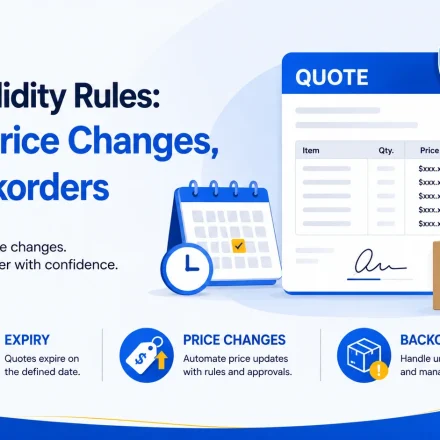
The issue date indicates when the quote was generated, while the expiry date defines how long the offer remains valid. It prompts quicker responses from buyers while stabilizing profit margins for the seller amidst price swings.
3. Customer and company information
This section includes names, addresses, contact details, and sometimes tax IDs for both the buyer and seller. It formalizes the document and ensures it’s directed to the right stakeholders.

4. Line items: Product/service name, SKU, quantity, unit price
Each item or service offered is listed clearly along with its SKU, quantity, and price per unit. This gives the buyer a transparent view of what’s being quoted and at what cost.
5. Discounts or promotions
Any special pricing, bulk discounts, or time-sensitive promotions are detailed here. Such additions convey greater value, encouraging buyers to act more confidently.
6. Applicable taxes
This section calculates relevant taxes based on the buyer’s region or jurisdiction. It ensures tax compliance and gives the buyer a complete picture of the total cost.
7. Shipping charges
When applicable, shipping charges are either fixed or approximated using current carrier pricing. It’s crucial to include this to avoid disputes or unexpected charges later.
8. Subtotal and grand total
By separating the subtotal (product cost only) from the grand total (product cost + taxes + shipping), the quote makes it easier for customers to grasp the full cost structure.

9. Payment terms (Net 30, advance, etc.)
Defines when and how the payment should be made, whether upfront, upon delivery, or within a specific credit period. Clear terms prevent confusion and ensure timely payments.
10. Delivery timeline
States how soon the product or service will be delivered after the quote is accepted. It sets buyer expectations and is often aligned with SLAs (Service Level Agreements).
11. Terms and conditions
This section outlines legal disclaimers, warranty details, return policies, and limitations of liability. It acts as a safety net for both the buyer and seller, and streamlines the transaction process.
12. Approval or signature section
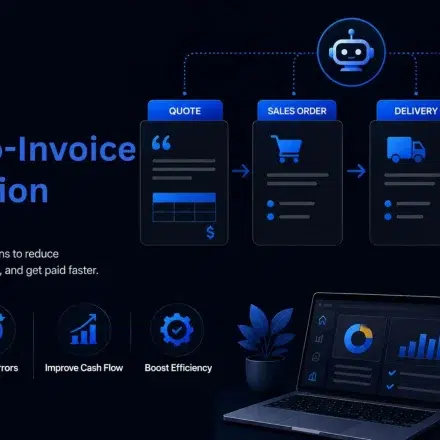
Some quotes require the buyer’s digital or physical signature to confirm approval. This formal acknowledgment can trigger the transition from quotation to sales order.
Types of Sales Quotations
You can classify them based on:
1. Based on Complexity
A. Simple (Single Product) Quotes: These quotes include pricing for a single product or service with minimal variables. They are quick to create and typically used in transactional, low-complexity sales.
B. Bundled or Configured Product Quotes: These involve multiple products sold as a package or with custom configurations (e.g., hardware + accessories). The pricing may include bundle discounts or interdependent product selections.
C. Custom/Complex Service Quotes: Tailored for unique customer needs, these quotes involve detailed scoping, variable pricing, and custom terms—which are common in professional services, IT implementations, or long-term contracts.
2. Based on Validity
A. Standard Fixed Quotes: These documents include a pre-set cost and usually expire after 30 days. The pricing remains unchanged within the quoted time frame.
B. Time-Limited Promotional Quotes: Offered as part of special deals or marketing campaigns, these quotes expire quickly (e.g., 24–72 hours) to encourage fast decision-making.
C. Volume-Based Pricing Quotes: These quotes offer tiered pricing based on the quantity ordered. Larger volumes typically result in discounted unit prices, incentivizing bulk purchases.
Things to Consider Before You Quote

The following considerations must be kept in mind before quoting.
- Understand the buyer’s exact requirements: Clarify the buyer’s needs through focused and open communication. Should the need arise, plan a call or meeting to collect full insights.
- Ensure clarity in what you’re quoting: Be precise about the products, services, quantities, and terms you plan to include in the sales quote.
- Evaluate feasibility before quoting: Assess whether you can deliver the products/services within the requested timeframe. Never quote unless you’re confident in your ability to fulfill the order.
- Avoid making false promises: Quoting inaccurately or overpromising may lead to breach of contract and legal issues once the quote is accepted.
- Price competitively yet sustainably: Quote a price that aligns with the buyer’s budget without compromising your profit margins. Ensure the quote reflects the true value of your offering.
- Benchmark against competitors: Research what others in your industry might quote for the same request to stay competitive.
- Protect your margins: Avoid quoting prices that undervalue your product or lead to unprofitable deals.
Quote Presentation
A well-presented sales quote can significantly influence your chances of winning the deal. Your quote reflects your company’s professionalism and brand image. Buyers often form first impressions about your company based on the quote’s structure and appearance.
Key guidelines to follow:
- Ensure your quote has a logical, organized structure that is easy to follow.
- Keep the format clear, simple, and easy to understand, yet visually appealing.
- Use a professional layout to make your brand stand out from competitors.
- A formal and polished look is achieved by using the company letterhead on all correspondence.
- Initiate your message with a tailored salutation that includes the recipient’s name.
- Convey to the customer for giving the privilege to provide the quote.
- Avoid spelling mistakes in product names or pricing errors, as these can damage credibility.
- Present product/service details in a tabular format for clarity and comparison.
- Clearly display sender and recipient names, along with their contact information, at the top of the template.
Different Ways of Quote Creation
There are two major ways of quote creation:
1. Manual Quoting Using Excel Spreadsheets
Traditionally, many business organizations have been using Excel spreadsheets for sales quote management. Startups and small businesses that have simple operations can use Excel sheets for the quoting process.
However, manual quoting on Excel has its own set of limitations. For instance, as business grows and quoting activity increases, it can become difficult to manage the quoting process with this old-fashioned method that is prone to errors. Excel is inefficient when it comes to creating complex configurations or handling a large number of RFQs.

2. Quote Creation Using Sales Quoting Software
Use of sales quoting software is the best practice when you have to deal with large number of sales quotes. It essentially automates sales quoting activities that are otherwise done manually.
It provides an accurate and a more efficient way to generate quotes and is considered an invaluable tool to improve the sales process.
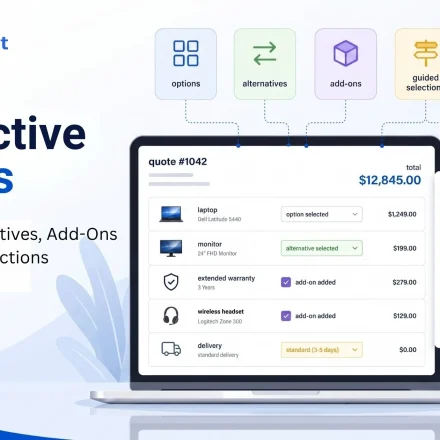
With this software tool, you can also send interactive quotes that have drop-down menus so that the buyers can choose the quantity and other options as per their needs. Moreover, the quotes created can be sent in various formats, including PDF and HTML formats.
Features of Quoting Software
Most sales quoting tools have features like an online mode of working, which further simplify, save your time, and money in the quoting process. With Web-based quoting software, you can create and send quotes from any device as long as it is connected to the Internet.
Mobile quoting apps are also designed which enable you to use your smartphones and tablets for managing quotes. Using these apps, you can create quotes on the spot for your buyers, thereby increasing your chances of winning the sale.
Follow up on the Quote
Sales quotation follow-up is considered to be one of the best strategies to close deals faster and generate more revenue. Many companies promote their products on various advertising channels in order to reach a prospective buyer.
Getting a potential customer can be an expensive proposition. Hence, one should never forget to follow up on the quotes.
After sending the quote, if there is no response within a stipulated period, follow up with your prospect 3-4 times to move the deal forward. A follow-up usually involves sending an email or making a phone call to the prospect. However, if the buyer is your existing customer, a follow-up is usually not needed.
Best Practices for Creating Effective Sales Quotes
1. Always double-check pricing and availability
Incorrect pricing or quoting out-of-stock items can lead to mistrust and lost deals. Always validate prices against your latest distributor data or pricing rules. Use API-integrated platforms to validate product availability in real time. A well-verified quote prevents costly errors and boosts credibility.
2. Use templates for consistency
Standardized templates make your quotes look professional and maintain brand uniformity across the sales team. Templates offer faster execution with fewer manual slip-ups. Ensure each template includes critical fields like product details, pricing, terms, and validity. A consistent format builds trust and helps buyers quickly understand the offer.
3. Keep the design clean and professional
Avoid cluttered layouts or overly complex formatting that distracts from important quote details. Use a minimalist design with clear headers, structured sections, and readable fonts. A well-organized quote reflects positively on your company’s image and makes the decision-making process easier for the customer.
4. Customize as per customer needs
Generic, one-size-fits-all quotes are less likely to convert. Tailor each quote by addressing the customer’s specific requirements, such as preferred products, volume discounts, or delivery locations. Personalized quotes show you understand the buyer’s pain points and are invested in solving them.
5. Add expiry dates to encourage faster decisions
Clearly mention a quote validity period to create a sense of urgency. This helps avoid delays in the sales cycle and protects your business from sudden changes in pricing or availability. It also prompts the buyer to take action within a defined window, speeding up conversions.
6. Use product images or spec sheets
Quotes become clearer and more self-explanatory when they include visuals like product images or tech spec downloads, cutting down on repeated client inquiries. They help the buyer verify features, specifications, and compatibility quickly. This is especially useful for technical or bundled products where visual confirmation aids decision-making.
7. Automate approvals for quick turnaround
Manual intervention during the approval stage can disrupt the flow of the quoting cycle, especially in large firms. Use quoting software that supports automated workflows based on pre-set pricing, discount, or margin rules. Faster approvals mean faster quotes, leading to a better customer experience and higher chances of closing deals.
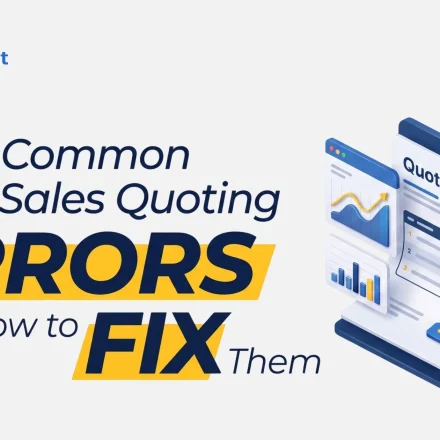
Common Mistakes to Avoid

Some common mistakes that must be avoided while quoting:
1. Omitting Taxes/Shipping Costs
Forgetting to include taxes or shipping charges can make your quote look incomplete or misleading. The customer might be surprised later when the final cost is higher than what was quoted. It risks breaking trust and postponing the transaction. Always make sure all extra charges are clearly mentioned upfront.
2. Quoting Outdated Prices
Using old or expired pricing can lead to serious issues, especially if supplier costs have changed. The quote might end up being unprofitable or have to be revised later, which looks unprofessional. Always double-check current product prices before sending the quote.
3. Sending Quotes Without Internal Approvals
Skipping the internal review process can lead to errors in pricing, discounts, or terms. If a salesperson sends an unapproved quote, it might go against company policies or profit margins. Having an approval workflow ensures that quotes are accurate and compliant.
4. Not Tracking Quote Status
If you don’t keep track of who opened or responded to your quote, you may miss valuable follow-up opportunities. A quote left unattended for days could go cold. Use tools or CRM systems to monitor the status and take timely actions.
5. Ignoring Follow-Ups After Sending the Quote
Sharing a quote opens the door to follow-ups and negotiations. Many deals are lost simply because the sales rep didn’t follow up. A polite reminder or call can show interest and answer any buyer questions, helping to move the deal forward.
Measuring Quotation Effectiveness (KPIs)
Keep an eye on the following KPIs to assess the effectiveness of your quotations:
1. Quote-to-Order Conversion Rate
This measures how many of your quotes actually turn into confirmed sales orders. A high conversion rate means your quotes are accurate, well-timed, and aligned with customer expectations. It helps you understand how effective your sales team is at closing deals after quoting.
2. Quote Approval Time
Determines how much time elapses between preparing a quote and obtaining internal approval before it’s sent to the buyer. A shorter approval time means your team can respond to customer requests faster, improving the chances of winning the deal. Delays in approval can lead to missed opportunities.
3. Average Time to Create a Quote
This tells you how much time your team spends generating a single quote. If it takes too long, it may signal inefficiencies or the need for automation. Quicker quote generation means faster responses, which can impress customers and speed up the sales cycle.
4. Quote Revision Frequency
This KPI measures how often quotes are sent back for changes or corrections. High revision frequency could mean pricing issues, lack of clarity, or changing customer needs. Limiting quote adjustments shows professionalism and enhances buyer trust, leading to quicker conversions.
5. Lost Quotes vs. Won Quotes
This compares the number of quotes that result in closed deals to those that don’t. It helps assess your quoting strategy, pricing accuracy, and overall competitiveness. Analysing lost quotes can uncover areas to improve and help win more in the future.