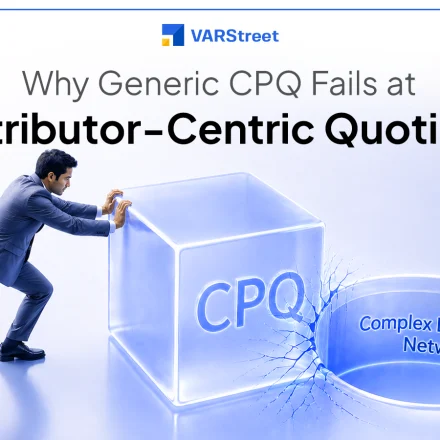
Why Generic CPQ Fails at Distributor-Centric Quoting?
Table of Content
Generic CPQ (Configure, Price, Quote) tools are designed to solve a real problem. They help sales reps configure complex products without errors, apply pricing rules and discount thresholds consistently, route quotes through approval workflows, and integrate with CRM and revenue systems. For businesses selling from a fixed internal catalog, this works well.
A VAR operates differently. Every quote runs against multiple distributors, each with its own pricing, inventory levels, and promotions running at the same time for the same item. A product available at $240 this morning may be $255 by afternoon if a promotion expires. The VAR has no control over this and no inventory buffer to absorb it.
Generic CPQ is built to optimize the selling process. Distributor-driven execution is a different problem entirely.
Key Takeaways:
- Generic CPQ optimizes the selling process. It does not optimize distributor-driven execution.
- VAR quoting is a sourcing decision as much as a pricing decision. Generic CPQ treats sourcing as outside the quote.
- Stale buy costs, unavailable inventory, and poor catalog mapping create margin leakage that generic tools cannot prevent.
- A distributor-centric quoting platform must connect live cost data, normalize catalogs, enforce margin rules, and carry quote data cleanly into procurement.
- The best quote is not the one sent fastest. It is the one that can be fulfilled cleanly without margin surprises or procurement rework.
Where Generic CPQ Breaks Down in VAR Workflows
The core promise of generic CPQ is faster quotes, fewer errors, and better margins. That is true within the boundaries of what the tool was designed for.
Those boundaries do not include a live distributor ecosystem.
These are predictable failure points that appear in almost every VAR operation using a generic quoting tool:
| Distributor-Centric Reality | What Generic CPQ Does | The Result |
|---|---|---|
| Buy costs change daily across distributors | Uses static or manually updated pricing | Quotes go out with stale costs; margin erodes at fulfillment |
| Same SKU available from multiple sources at different prices | No distributor comparison logic | Rep selects the wrong source; margin lost |
| Products require rich content to sell effectively | No content enrichment from distributor feeds | Reps cannot explain what they are quoting; buyer confusion |
| Inventory changes between the quote and approval | No live availability check | Quote approved on stock that no longer exists |
| Bundles span multiple distributors | Bundle logic tied to the internal catalog only | Complex configurations break or require manual rebuilding |
| A quote takes days or weeks to get approved | No re-pricing on approval | Costs have shifted; procurement rebuilds the quote from scratch |
| Hardware and services are quoted together | Services often outside the product model | Quote is incomplete; rep builds two separate documents |
| Special vendor pricing (HP Big Deal, Dell Premier) | No vendor portal integration | Special pricing missed; VAR loses margin or competitiveness |
The issue is not that generic CPQ performs poorly. It is that reseller quoting needs source-aware logic that generic CPQ was never built to handle.
Why VAR Quoting Changes the Problem Entirely
Quoting in a VAR business is not just pricing. Every quote is also a sourcing decision.
The same SKU can come from multiple distributors with different costs, stock levels, and delivery timelines. A rep is not just choosing a product. They are choosing where it comes from.
VAR quotes are built on inputs that keep moving:
- Costs shift during the day
- Inventory is not guaranteed between the quote and approval
- The same product appears under different part numbers across catalogs
Generic CPQ treats all of this as external. For a VAR, these inputs define whether the quote is accurate or not.
A quote built on yesterday’s cost data or unconfirmed stock does not hold when procurement tries to execute it. Without built-in sourcing logic in the quoting tool, quotes are rebuilt from scratch more often than they should be.
What a Distributor-Centric Quoting Platform Should Do
This is the checklist every VAR should use when evaluating a quoting platform. Generic tools will clear some of these. A platform built for distributor-driven quoting should clear all of them.
Catalog and Sourcing

- Connect to multiple distributors with live pricing and inventory feeds
- Aggregate and normalize duplicate products across distributor catalogs
- Map rich content, including images, specifications, and long descriptions, to products automatically
- Support special pricing programs from vendors, including HP Big Deal and similar schemes
- Allow direct import of quotes from distributor platforms into the quoting tool
Pricing and Margin
- Apply customer-specific and contract-specific pricing automatically
- Surface margin at the line item level during quote creation, not at reporting time
- Enforce margin thresholds with conditional approval routing
- Handle distributor promotions and source-specific economics in real time
Configuration and Bundling


- Support complex bundle configuration with parent/child structure
- Support product configuration rules for multi-component deals
- Allow services to be added alongside hardware in the same quote
- Enable VAR-specific product and service bundles in a custom catalog
Workflow and Integration
- Connect to vendor portals such as Dell Premier and Cisco CCW for direct quote import
- Carry quote data cleanly into purchase orders without manual re-entry
- Integrate with CRM so sales reps have full context on the go
- Support mobile quoting for field sales teams
Pro Tips:
Test any quoting platform with your most complex, realistic quote, not a demo scenario. If it cannot handle your most complicated bundle across three distributors with a services line item attached, it will not work for your business day to day.
How VAR-Specific Quotation Software Supports Distributor-Centric Quoting?
| Problem | Capability of Specialized Quoting Tools | Outcome |
|---|---|---|
| Stale buy costs from distributors | Real-time pricing feeds from multiple distributors | Quotes reflect actual cost at time of creation |
| Duplicate products across distributor catalogs | Aggregated catalog with normalization | Cleaner product selection, fewer sourcing errors |
| No rich content for millions of SKUs | Content partnerships with rich content providers like Etilize and Icecat | Reps can understand and sell products without manual research |
| Margin is not visible until reporting | Margin rules are built into the quote builder | Margin compliance is tracked at the point of creation |
| Slow or missed approvals | Conditional approval routing with discount thresholds | Approvals move faster; exceptions are visible before they stall deals |
| Quote and procurement are disconnected | Integrated sourcing and PO generation | Quote data carries into purchase orders with one click |
| Hardware and services in separate documents | The custom catalog supports services alongside distributor products | One complete quote covers the full deal |
| Special vendor pricing was not captured | HP Big Deal, Dell Premier, and Cisco CCW integrations | Special pricing available directly inside the quoting workflow |
| Distributor quote rebuild at procurement | Quote-to-PO continuity built into the platform | Procurement works from the same data that the sales rep quoted |
| No CRM visibility for field teams | Integrated CRM module with mobile access | Reps have full customer and quote context wherever they are |
Specialized quoting tools for VARs are not generic, as these platforms have been built around the reality that a VAR’s quote is simultaneously a pricing document, a sourcing decision, and the starting point for procurement.
Every module (quoting, catalog, procurement, and CRM) is connected because in a distributor-driven business, they have to be.
Pro Tips:
The clearest signal that a quoting platform was actually built for VARs is whether it treats distributor cost as a live input to every quote or as background data refreshed on a schedule. If your platform does the latter, your margin assumptions are always slightly behind the actual numbers.
Conclusion
Generic CPQ solves the seller’s configuration problem. The VAR’s sourcing problem is a different one.
When a quote is built against a live distributor ecosystem where costs shift daily, inventory is never guaranteed, and the same SKU comes from five sources at five prices, the quoting tool has to be built for that reality.
A platform that treats distributor data as a secondary input will keep producing quotes that are slightly off, and slightly off is enough to cost margin, lose deals, or send procurement back to square one.
Ready to see what distributor-centric quoting looks like in practice?
Book a demo with VARStreet
FAQs
What is distributor-centric quoting?
A quoting approach where live distributor pricing, inventory, and sourcing logic are built directly into the quote creation process rather than maintained separately.
How is it different from generic CPQ?
Generic CPQ is designed for businesses with fixed internal catalogs and stable costs. Distributor-centric quoting handles external supply, shifting costs, and multi-source comparison: problems generic CPQ treats as outside its scope.
Why do VARs need real-time distributor pricing in quoting?
Distributor prices change daily. A quote built on yesterday’s pricing can already be wrong by the time it reaches the buyer, creating margin risk at fulfillment.
What role does catalog normalization play in quoting accuracy?
The same product often appears under different part numbers across distributors. Without normalization, reps may select duplicate or mismatched items, creating sourcing errors and re-quote requests.
Can generic CPQ support multi-distributor reseller workflows?
Not effectively. Generic CPQ does not connect to live distributor feeds or handle availability changes between quote creation and approval, gaps that require workarounds and slow down quoting.
Why does quote-to-procurement continuity matter for VARs?
VAR quotes often take days or weeks to get approved. Without continuity, procurement rebuilds the quote from scratch when costs and inventory have already shifted.
Neha Kaku
Neha Kaku is a content writer and strategist specializing in B2B SaaS, cybersecurity, and martech. She writes blogs, website copy, landing pages, and long-form content that is built to rank, resonate, and convert. Trained in Biotechnology, she brings a structured, analytical approach to every brief, making her equally comfortable with technical depth and narrative clarity. Her work has helped brands earn top Google rankings, drive audience engagement, and communicate ideas that move the readers to the right action. Editorial Policy
Read More