Table of Content
15 Commonly Missed Quoting Fields That Turn into Invoice Disputes
Industry analysis indicates that up to 66% of invoices are affected by errors, frequently driven by process inefficiencies and a lack of automation.
The following are the missing quote details that create invoice issues:
1. Product & Scope Alignment
Field #1: Exact Products/Services
If the exact products or services are not clearly mentioned in the sales quote, customers may accept it based on assumptions.
Customers may assume certain items or services are included, even when they are not. The seller, however, invoices only for what they intended to provide.
The problem: Quotes often use vague terms like “laptop” or “IT support” without detailed descriptions.
Example dispute: A buyer might think “IT support” includes on-site visits. The seller may invoice only for basic remote support. When the invoice arrives, the details may not match the customer’s expectations.
Getting product details right in the quote is only half the job. The other half is making sure the buyer actually understands what they’re reading. Here’s how VARs can close that gap- Quote isn’t Clear Until Buyer Understands It.
VARStreet Solution: With the VARStreet eCommerce platform, every quote can also be viewed directly in the online store. Customers can open the quote online and review each item in detail. Since it is not always possible to include full product or service information in a quote document, the eCommerce view helps fill that gap. This makes it easier for customers to understand exactly what they are buying. Added clarity reduces confusion and helps prevent disputes later.
Field #2: Scope of Work
When a quote does not clearly explain what is included and what is not, customers often assume more deliverables are covered. They may expect services that were not actually priced in the quote.
Example dispute: The invoice may include charges for software setup and installation. However, the customer may believe these services were part of the original deal.
Best practice: A clearly defined scope of work in the quote sets the right expectations upfront. It also helps avoid misunderstandings later in the process. Always speak with the customer and confirm they understand the scope of work you have communicated.
Field #3: Product Acceptance Criteria
The customer may accept the quote, assuming one version of the product. But when the invoice arrives, or the product is delivered, they may feel it does not match expectations.
Example dispute: A buyer orders a business laptop with 16 GB RAM and a specific processor. Since these details were not clearly mentioned in the quote, the seller ships and invoices a basic configuration. It may include 8 GB RAM and a different processor. This mismatch leads to an invoice dispute.
2. Financial Accuracy
Field #4: Pricing Structure (Unit Price vs Extended Price)
The difference between unit price and extended price is often missing or poorly explained in quote documents.
If the quote does not clearly show how the final amount is calculated, customers are left guessing. They may feel unsure about what the invoice total should look like.
The confusion: In many cases, discounts are applied to the unit price. Sometimes discounts are applied to the total line value instead. However, this is not always clearly shown in the quote.
When the net unit price and extended price are not displayed consistently, confusion increases. This lack of clarity raises the chances of disputes once the invoice is issued.
Field #5: Currency
Currency is often not explicitly stated in quote documents. This can be a problem, especially when a business sells across multiple countries.
If the quote does not clearly mention the currency, customers may assume a different one. This assumption is often based on past transactions or their local market.
Why it matters: Exchange rates also change frequently. This often leads to disputes. Customers question why the invoice total does not match the quoted amount.
Field #6: Taxes
Many customers assume the quoted price is the final amount they will pay. This happens especially if taxes are not clearly mentioned. When tax is added later in the invoice, it comes as a surprise.
The complexity: Tax rates depend on factors like delivery location, local regulations, or the type of product being sold.
If the quote does not clearly state whether tax is included or excluded, customers may feel the pricing has changed after approval.
Field #7: Freight Charges
If freight costs are left out of quote documents, customers assume delivery is free or included in the product price.
However, freight charges can vary based on shipment size, weight, distance, carrier rates, and delivery location.
The disconnect: When these charges appear later in the invoice without being clearly defined in the quote, customers feel surprised. This happens even when the charges are legitimate.
Field #8: Discounts/Promotions
Discounts and promotions are often discussed during sales conversations. However, they are not always clearly documented in the quote.
Customers assume the discount will be applied to the final invoice.
Problems arise when:
- The invoice reflects standard pricing instead
- The discount was meant to be a one-time offer
Without clear details on the type, value, and validity of discounts or promotions, customers may feel overcharged. This misunderstanding often leads to avoidable invoice disputes.
3. Terms & Governance
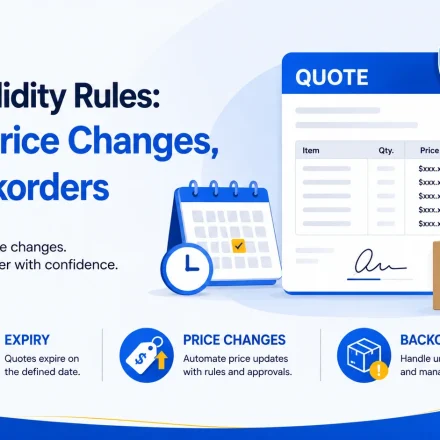
Field #9: Quote Expiry Date
If a quote does not clearly mention an expiry date, customers may assume the price is valid indefinitely.
When the invoice is later generated, prices may have changed. This can happen due to supplier cost updates, currency fluctuations, or revised taxes and fees.
The result: This mismatch between expectations and the final invoice often leads to disputes. Most of these issues could have been avoided by clearly stating how long the quote is valid.
Field #10: Payment Terms
When payment terms like Net 30, immediate payment, or credit card payment are not clearly mentioned, customers may expect different terms.
Customers may also assume different payment methods than what later appears on the invoice.
Example dispute: If staggered payments are not clearly stated, customers may think instalments are allowed. When the invoice is issued as a one-time full payment, it often comes as a surprise.
This gap between what the customer expected and what is billed frequently leads to an invoice dispute.
Field #11: Quote Reference Number
When multiple versions of a quote are shared, a customer may approve one version. Whereas the sales team can create the invoice from another version.
If the quote does not have a clear reference number, it becomes hard to confirm which prices were actually agreed upon.
The impact: This lack of clarity often leads to invoice disputes with customers saying they approved a different quote.
4. Fulfillment & Delivery Details
Field #12: Ship to Address
If the delivery location is not clearly mentioned, taxes may be calculated incorrectly. Shipping and freight charges may also change.
Common problems:
- Products get shipped to the wrong location
- Customers are charged the wrong tax
- Customers deny receiving the shipment altogether
All of this creates invoicing problems and disputes.
Field #13: Bill to Address
The ‘Bill To’ Address defines who is legally responsible for paying the invoice. It also determines where it should be billed.
If this field is missing, invoices may be sent to the wrong legal entity or department.
The consequence: This leads customers to delay or reject payment. They may claim the invoice does not belong to them. This is especially important for large enterprise customers.
Field #14: Quantity & Unit of Measure (UOM)
Quantity and Unit of Measure (UOM) are often overlooked in quote documents.
Confusion usually begins when: A quote mentions a quantity like “5” without explaining what it represents. It could mean 5 individual pieces, 5 boxes, or 5 packs.
The issue becomes worse when the UOM is missing entirely. Customers are then left to interpret what is actually being sold.
Example dispute: A quote uses a SKU that represents a single item. The invoice, however, may bill it as a pack, bundle, or larger unit instead.
Field #15: Delivery Timeline
Without a clear delivery date or timeline, customers expect the order to arrive sooner than it actually does.
Even if the pricing is correct, customers may delay payment because the delivery did not meet expectations.
Best practice: Adding a clear delivery timeline to the quote helps avoid confusion. It also reduces invoice disputes.
How Sales Quoting Software Prevents Disputes
Sales quoting software can be helpful to automate workflows, enabling users to create accurate invoices. Here’s how:
Mandatory Fields
The system does not allow a quote to move forward unless critical details are filled in. This prevents missing information from moving into the invoice.
Automated Tax & Freight Calculations
With sales quoting software like VARStreet, taxes and shipping charges are calculated automatically based on rules, location, and carrier logic. This reduces manual errors and ensures the invoice matches what was shown in the quote.
Contract-Linked Pricing
Prices and discounts are pulled directly from approved customer contracts or agreements. This ensures the quoted price is the same price the customer expects to see on the invoice.
Approval Workflows
Quotes that fall outside pricing rules or margin thresholds are reviewed before being sent. This prevents unauthorized discounts or special terms from reaching the customer.
Single Source of Truth
All quote, order, and invoice data live in one system. Sales, finance, and customers are always referring to the same information. This helps to reduce misunderstandings and disputes.
How VARStreet Creates Clarity Across Common Dispute Areas?

Conclusion: Fix Quoting, Get Paid Faster
If your team is spending too much time handling invoice disputes, the problem usually isn’t the invoice itself. It starts much earlier, at the quoting stage.
When quotes are clear and accurate, invoices don’t raise arguments. They simply match what the customer already agreed to.
Strong quoting builds trust. It also keeps payments moving without delays.
When you fix quoting, you don’t just reduce disputes. You get paid faster.
Ready to Stop Invoice Disputes Before They Start?
Still resolving invoice disputes after the deal is closed? The real fix lies in getting quotes right the first time.
Explore VARStreet Sales Quoting Software that brings structure, accuracy, and consistency to your quoting process.