CPQ Evaluation Scorecard: How to Choose the Right CPQ Software for Your VAR Business

Table of Content
Know Your Own Setup First
Before you look at a single vendor demo, you must have an honest conversation about your internal operations. A tool that works for a solo shop will fail a mid-market firm with five locations.
Team Structure and Quoting Logic
How do your deals actually get built? You may have inside sales reps who build complex configurations for field reps. Or perhaps every rep is an island and quotes independently. If your workflow involves a hand-off, the tool must support shared quote ownership and administrative oversight.
Number of Locations and Multi-Access
If you operate from multiple offices, you need a cloud-based solution that provides seamless multi-location access. You do not want your sales team throttled by a Virtual Private Network (VPN) or a laggy on-premise server when they are trying to close a deal from a client site.
Data Residency and Compliance
This is a deal-breaker for many organizations. If you operate in regions like India or parts of Europe, local laws may require your data to be hosted within the country. Confirm the vendor’s hosting setup early. If they cannot guarantee data residency in your specific region, stop the conversation immediately.
According to an IDC Cloud Pulse 2Q22 survey, 48% of global cloud customers say that data sovereignty and local compliance requirements significantly influence their IT architecture and technology decisions.
Company Size vs. Flexibility
Smaller VARs typically need high flexibility and the ability to customize workflows on the fly. Larger organizations may prioritize SOC 2 compliance and rigid security over customization. Know which side of that fence you sit on before you start your search.

Pillar 1: The Features Scorecard
The first pillar focuses on technical capabilities that directly impact your daily quote accuracy.
Distributor Connectivity and Multi-Distributor Quoting
For a VAR, sales quoting software is useless without real-time data. The tool must pull pricing and availability directly from your distributors. Your reps should be able to compare pricing from Ingram Micro, TD SYNNEX, and D&H Distributing on a single screen to source the most profitable option.
Guided Selling and Quote Templates
Guided selling prevents your reps from quoting discontinued or out-of-stock items. It ensures compatibility so a rep cannot sell a server without the required rails or power cables. Pair this with standardized quote templates to maintain branding consistency across deal types.
Approval Workflows and Mobile Access
Approvals should never happen over email. Your CPQ must configure workflows based on discount levels or deal size. If a rep goes below a 10% margin, the system should automatically ping the Sales Manager for sign-off. Mobile access is non-negotiable for field reps who need to edit quotes from their phone.
Customization and Security
Ask if vendors will modify the tool for your specific workflow. Check for SOC 2 or equivalent security certifications, critical for VARs handling sensitive government or enterprise data.
Pillar 2: The Implementation Scorecard
How you get the software running is just as important as what it does. A tool that takes 12 months to deploy is 12 months of lost Return on Investment (ROI).
Deployment Type and Timeline
Cloud-based solutions offer faster deployment and lower maintenance than on-premise systems. Ask for a realistic “go-live” date for a VAR of your size and request references from similar businesses to verify timeline claims.
Industry data suggests that typical CPQ implementations generally take several months to complete, with many projects falling in the 3-6 month range, depending on complexity and configuration needs.
Onboarding, Training, and Support
For CPQ software designed for VARs, onboarding should be collaborative. Your team needs to be shown how to link distributor credentials and build unique bundles. Avoid vendors that only provide documentation links, not hands-on training.
Integration with Your Current Stack
A CPQ must talk to your Customer Relationship Management (CRM), Enterprise Resource Planning (ERP), and accounting software. If a vendor says “we have an Application Programming Interface (API),” that often means you will pay a developer to build it. Look for pre-built connectors that work immediately.
Vendor Track Record
Choose a vendor with deep VAR and IT channel experience. A vendor that primarily sells to manufacturing will not understand why real-time distributor feeds are critical to your business.
Pillar 3: The Total Cost Scorecard
The sticker price of a CPQ is rarely what you actually pay. You must look at the Total Cost of Ownership.
Subscription Fees and User Tiers
Most CPQ software is priced per user. Model your costs based on expected headcount in 12 and 36 months. Some vendors offer lower entry prices but have aggressive price hikes as you add staff.
Setup, Training, and Integration Fees
Get one-time setup fees in writing upfront. Clarify if ongoing training for new hires is included or requires a separate support tier. Integration costs for distributor feeds are often hidden. Ensure you know if there is a per-distributor fee.
Customization and Support Tiers
If you need a feature added later, what is the process? Some vendors charge exorbitant hourly rates for changes. Check support tiers carefully. Is “Standard Support” just email ticketing with a 48-hour response? If you need phone support when the quote engine goes down, find out the premium cost.
Exit Terms
Check the exit terms. What are early termination penalties? More importantly, what happens to your data? Ensure you can export your quote history and customer data if you leave.
How to Weight Your Scorecard
Not every criterion carries the same weight for every business. You must prioritize based on your specific pain points.
The Weighted Rating Method
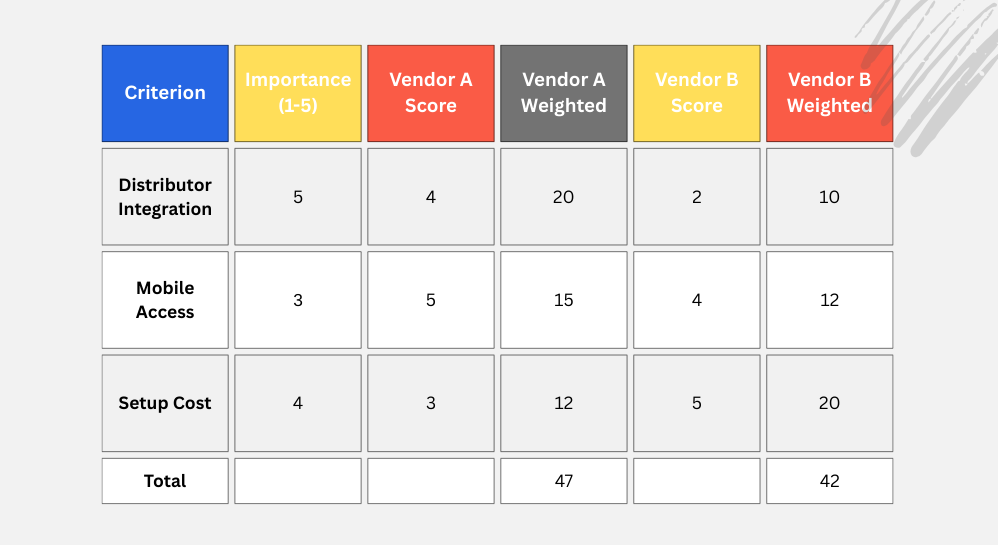
This simple framework helps you compare vendors objectively:
Rate Importance: Score each criterion 1-5 based on importance to your business (Data Residency: 5 in India, 1 in the US)
Rate Performance: Score each vendor 1-5 on how well they meet that criterion
Calculate: Multiply Importance × Performance for each criterion
Compare: Add up all weighted scores to identify the best fit
Critical Rule: Any criterion marked as essential eliminates a vendor immediately, regardless of total score. If you require SOC 2 compliance and a vendor does not have it, they are out.
Sample Scorecard
Internal Expert Insight
“The most common mistake I see is VARs getting distracted by flashy user interfaces,” explains Sarah, Product Manager at VARStreet. “A pretty quote that has the wrong price because the distributor feed failed is worse than no quote at all. Reliability over aesthetics is the rule for the channel.”
Turning Your Scorecard into a Decision
Choosing the right CPQ is critical for your sales operations. Use this scorecard to cut through the marketing fluff and focus on the technical and financial realities of your business.
The best CPQ for your VAR business fits your specific workflow, integrates with your distributors seamlessly, and scales with your growth. When you find a platform purpose-built for VAR complexities (real-time distributor feeds, approval workflows, and flexible pricing), you will know you have made the right choice.
Ready to evaluate CPQ options systematically? Start by listing your top 5 deal-breakers and top 5 nice-to-haves. Then request demos only from vendors who can address your deal-breakers on day one.
If you are looking for a reliable eCommerce platform that checks all the boxes for ideal CPQ, book a demo with VARStreet today.