Table of Content
- The B2B eCommerce Integration Landscape
- Why Integration Architecture Is Critical in B2B eCommerce?
- Core Systems in B2B eCommerce Integration Architecture
- End-to-End Data Flows in B2B eCommerce Integration
- Practical Implementation Scenarios
- Best Practices for B2B eCommerce Integration
- Conclusion: From Siloed Systems to Future-Ready Integration
- FAQs
The B2B eCommerce Integration Landscape
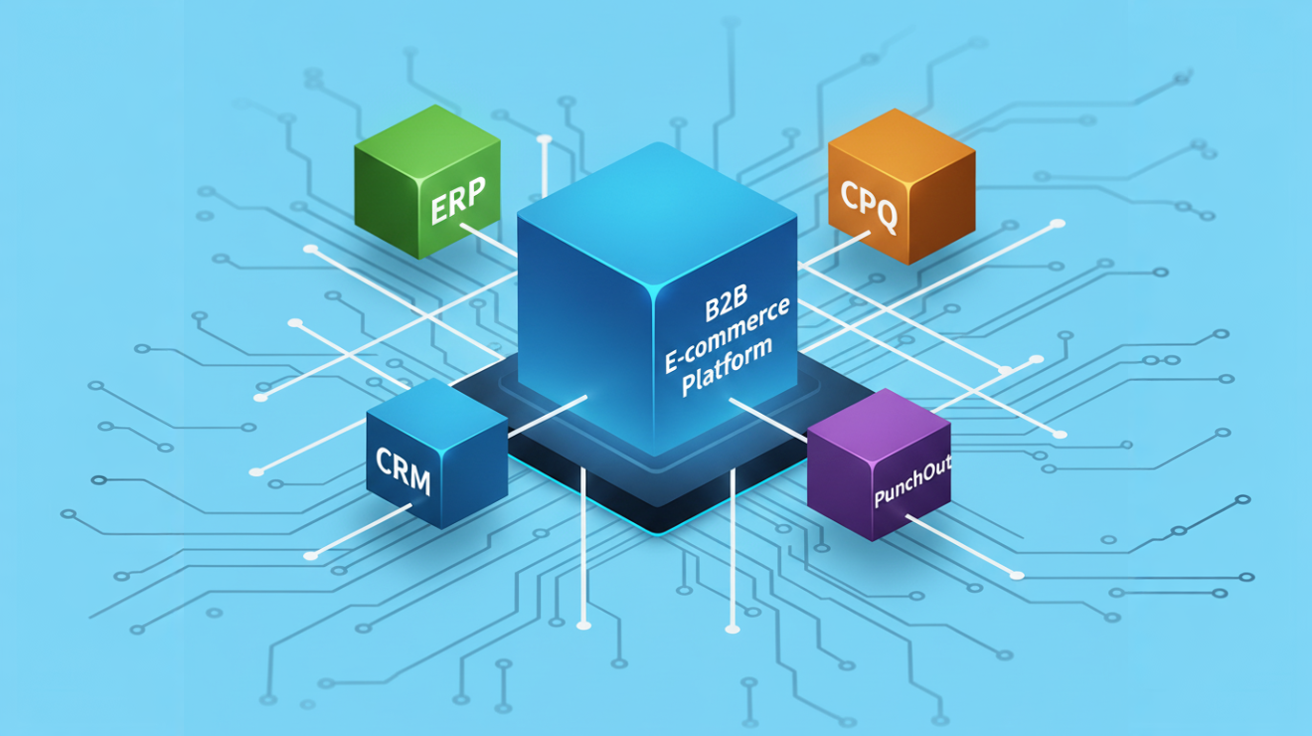
Modern B2B eCommerce goes far beyond a web storefront. Success depends on connecting every core business system: ERP for resource planning, CRM for customer relationships, CPQ for quote automation, and advanced PunchOut for direct procurement connectivity. The goal is simple but powerful: create a frictionless, accurate, and scalable flow of data from the first inquiry to final fulfillment, eliminating re-keying, lag, and costly errors.
Why Integration Architecture Is Critical in B2B eCommerce?
Unlike B2C, where most systems revolve around a storefront and payment gateway, B2B eCommerce requires multi-system orchestration. Without it, sellers and buyers face inefficiencies that erode value. Common challenges include:
- Pricing complexity: Enterprise contracts often override list prices. If ERP, CPQ, and storefront data aren’t in sync, buyers encounter outdated or incorrect pricing.
- Catalog fragmentation: Large sellers may manage millions of SKUs across multiple suppliers. Misaligned catalogs disrupt procurement and frustrate buyers.
- Approval-driven workflows: Buyers using platforms like Ariba, Coupa, Jaggaer, or Oracle iProcurement expect seamless PunchOut integration for compliance and approvals.
- Quote-to-cash delays: Sales teams rely on CPQ to configure deals, but if ERP data (inventory, tax, compliance) isn’t connected, quotes stall and deals slow down.

A connected integration architecture solves these issues by creating one continuous flow of information, from catalog to cash. This unified approach not only enhances buyer experience but also empowers sellers with speed, accuracy, and agility.
Core Systems in B2B eCommerce Integration Architecture
At the center of every successful B2B eCommerce integration are four core systems: ERP, CRM, CPQ, and PunchOut. Each plays a distinct role, but when connected, they create a single, seamless ecosystem that drives efficiency, accuracy, and growth.
1. ERP: The Operational and Financial Backbone
An ERP software serves as the core framework for organizational integration. It acts as the single source of truth for operational, financial, and compliance data. In a connected architecture, ERP manages:
- Inventory levels: visibility into on-hand, reserved, and committed stock
- Procurement and supplier management: sourcing, vendor relationships, and replenishment cycles
- Taxation and compliance: ensuring quotes and invoices align with local and global regulations
- Fulfillment and logistics: coordinating warehousing, shipping, and delivery tracking
- Accounts receivable/payable: automating invoicing, collections, and payments
In integration, the ERP feeds real-time data into CRM, CPQ, and PunchOut systems, ensuring buyers always see accurate stock, prices, and delivery timelines.
2. CRM: The Customer-Facing Hub
A Customer Relationship Management (CRM) system captures every interaction and opportunity across the buyer lifecycle. When combined with ERP and CPQ, it functions as a strong core for:
- Unified account and contract visibility: aligning sales with negotiated terms stored in ERP
- Pipeline connected to inventory: enabling reps to sell with confidence, backed by real-time availability and pricing
- Customer service excellence: offering instant access to order history, status, and invoicing
- Segmentation and personalization: tailoring account strategies and outreach based on customer behavior
Integration transforms CRM from a static database into a dynamic system that delivers insights and actionability across the enterprise.
3. CPQ: Configure, Price, Quote Automation
For industries with complex products, such as IT hardware, industrial equipment, or SaaS bundles, a Configure, Price, Quote (CPQ) system is critical. It eliminates errors and accelerates sales cycles by automating rules and workflows. Key capabilities include:
- Guided selling: ensuring only valid product configurations are quoted
- Dynamic pricing: pulling contract terms and discounts directly from ERP
- Quote approval workflows: streamlining internal reviews within CRM
- Faster sales cycles: automating repetitive quoting tasks for speed and accuracy
When connected with ERP and CRM, CPQ ensures that quotes are not only fast but also accurate, compliant, and profitable.
4. PunchOut: Direct Procurement Connectivity
Unlike static catalogs, PunchOut integration connects a supplier’s catalog directly into the buyer’s eProcurement platform (e.g., Ariba, Coupa, SAP SRM, Oracle iProcurement). This real-time bridge provides:
- Live product, pricing, and availability sync: no outdated spreadsheets or batch uploads
- Seamless buyer workflows: integrating with approval chains, budget checks, and compliance steps
- Automated order flow: sending purchase orders back into the supplier’s ERP for fulfillment
- Error reduction: minimizing mismatches between quotes, orders, and invoices
PunchOut ensures enterprises can transact within their preferred procurement systems while suppliers maintain real-time control over pricing and availability.
End-to-End Data Flows in B2B eCommerce Integration
The real value of B2B eCommerce integration comes from third-party connections with ERP, CRM, CPQ, and PunchOut into continuous end-to-end flows. These flows eliminate data silos, reduce errors, and provide both buyers and sellers with real-time visibility from catalog to cash.
1. Catalog, Price, and Stock Synchronization
The foundation of integration is ensuring all systems operate on a single version of the truth for products, pricing, and availability.
- ERP as the source of truth: manages product specs, negotiated pricing, stock levels, and procurement rules
- The synchronization of CRM and CPQ guarantees that quotes, opportunities, and pipeline deals always reflect the latest inventory and pricing.
- Storefront and PunchOut updates: deliver contract-specific catalogs to buyers in real time
- API or batch updates: real-time APIs work best for dynamic data (inventory, pricing), while batch updates may be sufficient for less volatile fields (product specs)
- Conflict resolution rules: define which system owns each data field (e.g., ERP for pricing, CRM for customer contracts)
This synchronization avoids discrepancies that frustrate buyers and stall deals.
2. Pricing Flow
B2B pricing is rarely static; it’s shaped by contracts, configurations, and negotiated terms. Integration ensures that every system applies pricing consistently:
- Base prices stored and managed in ERP
- Contract-specific adjustments applied from ERP or CRM data
- Configuration-driven pricing calculated in CPQ
- Negotiated rates appear in both PunchOut and buyer eProcurement systems, ensuring buyers always see accurate pricing across channels.
3. Quote-to-Cash Flow
The quote-to-cash process is where multiple systems must work together seamlessly to convert opportunities into revenue:
- Opportunity created in CRM: sales rep or account manager identifies buyer interest
- Configuration in CPQ: valid product combinations, dynamic pricing, and discounting rules applied
- Approval workflows in CRM: internal sign-offs and compliance checks completed
- Within ERP, orders are created and processed, covering fulfillment, tax, compliance, and accounting entries.
- Invoicing and payment updates: ERP syncs financial status back to CRM, giving sales teams full visibility into the customer lifecycle
With automation, this flow eliminates manual re-entry and reduces cycle times significantly.
4. Order Orchestration & Fulfillment
Order orchestration ensures that every order is processed correctly, exceptions are managed, and updates are shared across systems:
- CPQ produces the quote → CRM records the purchase intent → ERP manages fulfillment.
- Exception handling: e.g., denied credit, out-of-stock items, or tax mismatches are flagged and resolved automatically
- Real-time status updates: synced across ERP, CRM, CPQ, and PunchOut so both sellers and buyers have transparency on fulfillment progress
Orchestration systems can also layer in advanced logic such as routing orders to the right warehouse, prioritizing high-value buyers, or automating compliance workflows.
5) PunchOut and eProcurement Integration
PunchOut integration is where supplier and buyer systems directly connect to streamline enterprise procurement. PunchOut differs from a fixed hosted catalog by being session-driven and real-time, which enables buyers to:
- Launch a PunchOut session from their eProcurement platform (Ariba, Coupa, SAP SRM, Oracle iProcurement, etc.)
- Shop live in the supplier’s catalog with accurate pricing and availability
- Return the filled cart to the eProcurement workflow for approvals and purchase order generation
- Complete transactions with seamless order flow back into the supplier’s ERP for fulfillment
Key standards like cXML, OCI, and secure session tokens make this possible, while contract-based personalization ensures buyers see the right catalog for their region, budget, and negotiated terms.

Practical Implementation Scenarios
1. Case Study: Orchestrating VARStreet ERP, CRM, and CPQ via PunchOut
- E.g., a VAR uses VARStreet’s aggregated catalog for orders/inventory, VARStreet CRM for customer management, CPQ for quoting, and integrates with Ariba/Coupa/SAP PunchOut.
- Catalogs are refreshed each night within VARStreet, allowing quotes to reflect up-to-date prices.
- eProcurement pulls real-time product data via PunchOut, ensuring accurate contracts.
- Exception handling synchronizes order status and issue resolutions across all systems.
2. Handling Catalog/Price/Stock Updates for 100,000+ SKUs
- Use batch updates for nightly stock changes, with critical price or contract items updated in real time.
- Data validation cleans up historical errors, standardizes units, and flags anomalies for review.
3. Order Routing and Exception Handling
- Approvals, manual overrides, and compliance steps are routed to the right users (e.g., sales, finance) by orchestration logic.
- Each exception is documented, identified, and aligned with master systems for audit and regulatory compliance.
Best Practices for B2B eCommerce Integration
To build a scalable B2B eCommerce integration architecture, follow these proven practices:
- Sync in near real time: Keep inventory and pricing data always accurate; avoid batch mismatches.
- Define master data ownership: ERP for pricing, stock, invoicing; CRM software for customers and contracts.
- Align teams early: Involve IT, sales, finance, and procurement to reduce scope creep.
- Begin with enterprise buyers by launching PunchOut for high-value accounts, then expand gradually.
- Clean and validate data: Eliminate duplicates and outdated records before integration.
- Plan for growth: Design for evolving business models, compliance, and scale.
- Embed security & compliance: Meet GDPR, SOC 2, CCPA, PCI-DSS; maintain audit trails for quotes and contracts.
These practices ensure integrations are accurate, secure, and scalable, turning ERP, CRM, CPQ, and PunchOut into one connected ecosystem.