The Pricing Waterfall in VAR Quotes: How Margins Erode Between Distributor Cost and Deal Price?
Table of Content
- What a Pricing Waterfall Is and Why It’s Different for VARs
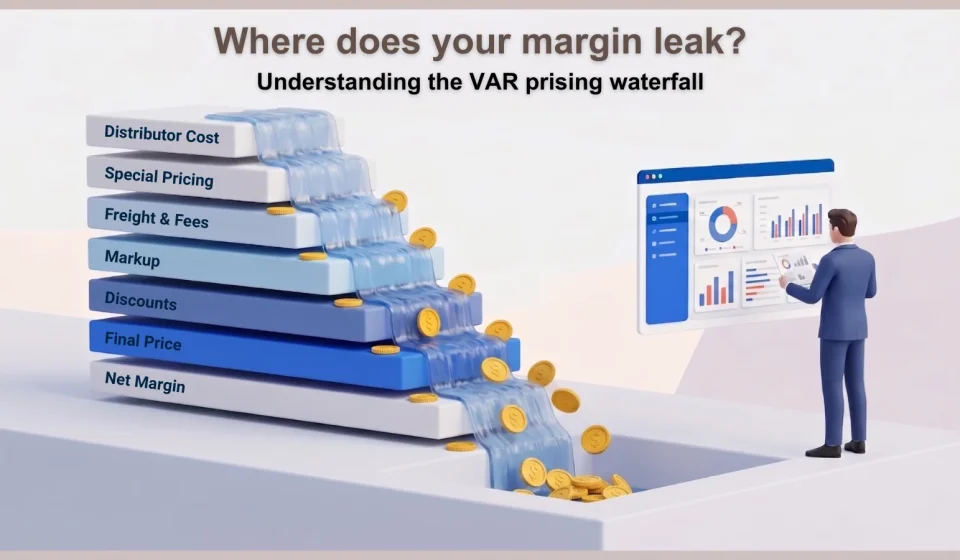
- The Six Layers of the Pricing Waterfall VAR
- A Worked Example: Laptop Bulk Deal
- Where Margin Leakage Hides and What It Looks Like in Your Data
- Why This Matters Specifically for VARs and MSPs
- How Quoting Software Makes the Full Pricing Waterfall VAR Visible
- FAQs
You’ve looked at the monthly numbers three times, and the story is the same. Deals are closing. Revenue is on track. But the margin at close is consistently lower than the margin on the quotes, not dramatically, just persistently. Two points here, three points there. You’ve ruled out the obvious explanations: the team isn’t closing bad deals, pricing isn’t wildly off, customers aren’t demanding discounts nobody is tracking. And yet the gap is there, month after month, with no clear line back to a cause.
The cause is structural. Distributor prices move daily, vendor rebates shift without surfacing at quote time, and deal pressure pushes reps to discount at the last moment. None of it shows as an error. It accumulates invisibly, layer by layer, across every quote your team sends.
What you’re looking at is waterfall leakage, a structural problem with how your quoting process handles the six layers between distributor cost and the number that reaches your customer. This article shows how each layer works, where margin leaks, and why making all six visible at the moment of quoting is the only way to stop it.
Key Takeaways:
- The pricing waterfall VAR has six layers. Most quoting tools show reps two. The other four are where the margin quietly disappears.
- Distributor cost is the most dangerous layer because it moves while your rep works. A price checked at 9 am is already a historical document by 11.
- Vendor rebates and SPAs that aren’t visible at quote time create phantom margin. Reps’ discount on deals the rebate would have won. The loss never gets flagged.
- Rep discounting is a symptom, not the root cause. Reps discount because they have no margin data to hold the number with. Visibility fixes this. Stricter policies don’t.
- The fix is structural, not behavioral. A quoting platform that surfaces all six layers at the moment of quoting does what discount policies cannot.
What a Pricing Waterfall Is and Why It’s Different for VARs
In standard B2B pricing, a waterfall starts from a fixed list price, runs through discounts, and arrives at net. For VARs (Value-Added Resellers), there is no fixed starting point and no base price you control. You start from distributor cost, a number the distributor sets and passes through, one that shifts with every price sync from Ingram Micro, TD Synnex, D&H or ScanSource based on inventory levels, vendor promotions, and contract tier. That base moves intra-day. The distributor pricing vs reseller margin gap widens every time a layer between cost and net price is invisible to the rep building the quote. Every layer you add after it either defends the margin or erodes it.
The problem is not that the layers are complex. When a rep sits down to build a quote, the tool they are using was never designed to show all of them. So they check the distributor price, apply a markup, and pick a discount. The registered SPA (Special Pricing Agreement) your vendor team logged last week, the category-specific margin floor your ops team set, and the contract tier that applies to this account are all invisible. Invisible layers don’t protect the margin. They leak it.
The Six Layers of the Pricing Waterfall VAR
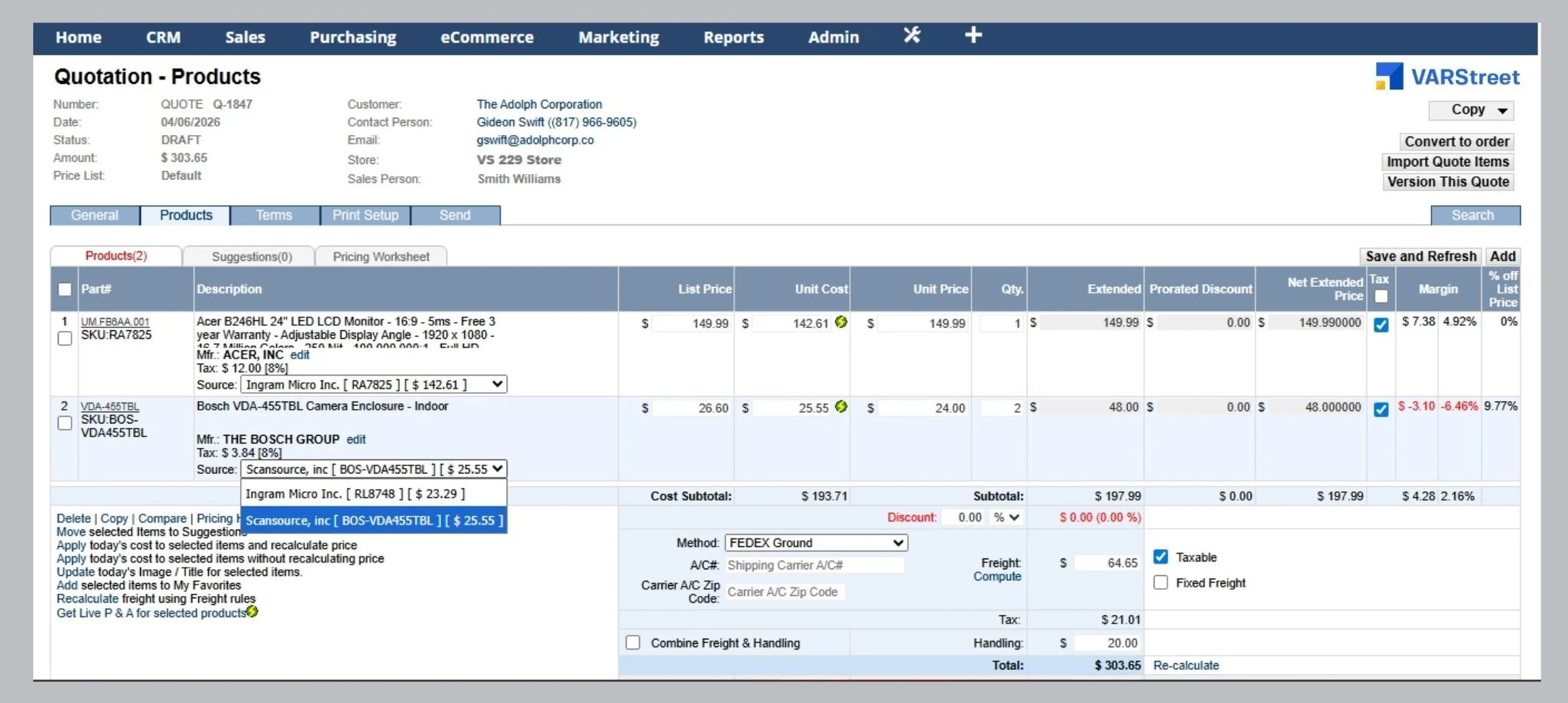
Six decisions happen between the distributor’s price file and the number your customer sees. Most of them are invisible to the rep building the quote. Here, you understand what each could cost when your quoting software does not surface it.
Layer 1- Distributor cost
What your VAR pays Ingram Micro, TD Synnex, D&H, or ScanSource. It moves intra-day. A quote built on pricing that is 48 hours old is already working from a wrong margin assumption, and that gap never gets logged as an error.
Layer 2- Vendor rebates and SPAs (Special Pricing Agreements)
Back-end rebates and deal-specific SPAs registered with vendors like Cisco, Dell, and HP sit entirely separate from the price file your quoting tool reads. When reps cannot see them, they discount on deals the rebate would have won at full margin. That is phantom margin, and it is already gone by the time the deal closes.
Layer 3- Internal markup
Hardware runs 5 to 15 percent, software 15 to 30 percent, and services 30 to 50 percent in North American VAR businesses. A flat rate across all three is one of the most consistent sources of margin leakage that IT resellers never trace back to a cause.
Layer 4- Sales rep discount
The most visible layer and the first one blamed. Rarely is the root cause. The only way to manage deal-based discounts effectively is to give reps full waterfall visibility before they quote, not a tighter policy after the deal closes.
Layer 5- Customer-specific pricing
Customer-specific pricing, contract rates, and volume tiers must apply from account records at quote time. The wrong tier on the wrong account either loses margin silently or creates a customer problem that is expensive to fix.
Layer 6- Final net price
The output of all five layers above. Every invisible or misapplied input from the cost-margin-discount-net VAR quote sequence carries its error here. The deal closes. The variance shows up later, untraceable.
While the rep discount is blamed first, Layers 1, 2, and 3 set the conditions that make the discount feel necessary. You must fix visibility at those upstream layers, and the discount rate falls without a single policy change.
A Worked Example: Laptop Bulk Deal
A customer wants 50 laptops. The distributor is Ingram Micro. A 3% Dell SPA is registered on this product line. Two reps quote the same deal. One can see the full waterfall. One cannot.

| Pricing Layer | Quoting Blind | Quoting with Full Visibility |
|---|---|---|
| Distributor cost per unit | $850.00 | $850.00 |
| Vendor SPA, 3% Dell rebate | Not applied. The rep is unaware that the SPA is active. | Applied. Effective cost: $824.50. |
| Internal markup, 8% | Applied to $850.00. Sell price: $918.00. | Applied to $824.50. Sell price: $890.46. |
| Sales rep discount | 6% applied. The customer pushed back, and the rep had no margin data to hold the number. | No discount needed. Lower effective cost has already made the price competitive. |
| Final selling price per unit | $862.92 | $890.46 |
| Net margin per unit | $12.92 → 1.5% | $65.96 → 7.4% |
| Total margin on 50 units | $646 | $3,298 |
Same deal. Same customer. Same distributor. Same product. The only variable is whether the rep could see the active SPA at the moment they built the quote. One deal returns $646. The other returns $3,298. The difference is not the rep’s talent. It is what their tool showed them.
If this deal looks familiar, the pattern is already in your data. Download the VAR Pricing Waterfall Audit, so you can track margin leakage across deals to identify where exactly you are losing margin.
Where Margin Leakage Hides and What It Looks Like in Your Data
Pricing waterfall leakage does not show up as an error. It shows up as deals underperforming by a point or two, accounts generating outliers nobody can explain, and quarters where revenue is fine but margin is not. The pattern is diagnostic. You just need to know which layer to look at.
Stale distributor cost
Margins running 1 to 3 percent below the quote with no single deal flagged – just a P&L trend nobody can trace. A live XML feed to your distributors fixes it: pricing pulled the moment the rep adds a product, not from a file synced the night before.
Invisible vendor rebates
Reps discounting at rates that look justified, but the deals were winnable at full margin. You only see it when you cross-reference closed deals against SPA registrations after the fact. Rebate tracking built into the quoting engine closes it – active SPAs surface at the line-item level so reps see effective cost, not invoice cost.
Flat markup across product types
Services and software closing at hardware-level margins, with line items that look normal in isolation. The pattern only appears when the margin is broken down by product category. Category-specific markup rules applied automatically- hardware, software, and services each on their own logic- remove the condition entirely.
Blind rep discounting
Discount rates are clustering at 5 to 8 percent across deals, regardless of actual margin position. Reps are not discounting because deals require it. They discount because they have nothing to hold the number with. Full waterfall visibility before the quote is sent changes this: discounting becomes a decision, not a reflex.
Last-minute deal adjustments
Deals that looked fine at the quote stage but closed thinner than expected because the price moved in negotiation, and nobody recalculated. That final discount sits on top of a margin position already compressed by earlier layers. A tool that recalculates waterfall impact in real time lets the rep see what the revised number does to net margin before agreeing to it.
Misapplied customer pricing
Specific accounts generating margin outliers or customer escalations, both tracing to the wrong pricing tier at quote time. Standard pricing to a contract account or contract pricing to a standard account. Tying customer pricing to account records and applying it automatically removes the dependency on memory entirely.
Why This Matters Specifically for VARs and MSPs
For a VAR quoting one-time hardware deals, an invisible waterfall layer costs you on that deal. For an MSP, the exposure is structurally different. Recurring service contracts are priced on margin assumptions set at signing and rarely revisited. When a distributor cost increase, an untracked SPA, or a flat markup error is baked into the original quote, it does not hurt once. It bills the same way every month until someone notices the drift. Building pricing discipline and margin floors into the quoting process before a contract is signed is the only way to stop it from compounding. A mispriced managed services agreement is not a quoting problem you fix after the fact. It is a pricing waterfall VAR problem you had to solve before the quote left the screen.
How Quoting Software Makes the Full Pricing Waterfall VAR Visible
Quoting tools available today easily connect to your signed distributors: Ingram Micro, TD Synnex, D&H, ScanSource, and others, covering millions of SKUs via live XML feed. Every layer of the waterfall is visible to the rep at the moment of quoting: live distributor cost, effective cost after rebates and SPAs, category-specific markup, full margin impact of any discount, and contract pricing from account records. When the quote converts to a PO, it draws from the same live data. The gap where discrepancies accumulate between quoting and ordering is closed.
Customers who use appropriate quoting software report cutting quoting and procurement time by nearly 50 percent because the verification steps that existed to catch waterfall errors are no longer needed. For VARs handling manufacturer deal pricing, direct connections to Dell Premier Portal and Cisco CCW mean those deals run through the same margin-visible workflow.
If margin leakage is happening silently across your quotes, fixing it starts with visibility. See how VARStreet sales quoting software built for VARs exposes every layer of your pricing waterfall in real time, so reps quote with confidence and margins hold at close.
FAQs
What is a pricing waterfall VAR in sales?
It is the sequence of six layers between distributor cost and final net price — distributor cost, vendor rebates and SPAs, internal markup, rep discount, customer pricing, and net price — where margin leaks silently at any layer your quoting tool does not surface.
How do vendor rebates and SPAs affect margin in VAR quotes?
They lower your effective cost below invoice price, but only if they appear in your quoting tool at quote time — when they don’t, reps discount on deals the vendor rebates pricing model would have won at full margin, and the loss never gets flagged.
Why does distributor pricing volatility cause margin leakage on fast-closing deals?
Distributor prices shift throughout the day, and the quote-to-PO gap runs from 24 hours to two weeks, meaning any price movement in that window turns the margin you quoted into unexplained variance at month-end.
What are typical IT hardware margins for VARs in North America?
Hardware runs 5 to 12 percent, office supply lines 3 to 8 percent, software 15 to 30 percent and services 30 to 50 percent — ranges that only hold when category-specific markup is applied correctly, not as a flat rate across all product types.
How does a CPQ or quoting tool prevent pricing waterfall VAR leakage?
CPQ pricing waterfall tools pull live distributor pricing at quote time, surface active SPAs at the line level, apply category markup automatically, show full margin before the quote is sent, and connect PO conversion to live pricing. If any of these are missing, the waterfall has gaps.
Pragya Bhardwaj
Pragya Bhardwaj is a seasoned B2B content writer with a strong background in SaaS and digital commerce. She specializes in creating clear, engaging, and search-optimized content that helps businesses connect with their audiences and build authority online. With experience across blogs, whitepapers, eBooks and website copy, Pragya brings both strategy and storytelling to every piece she writes. Editorial Policy
Read More