How to Increase Profit with Better Pricing for IT Resellers
Table of Content
Running an IT reselling business is tough. You face thin margins and fierce competition every day. Customers compare prices online in seconds. Vendors squeeze your margins. And competitors undercut your quotes constantly.
But here’s the good news. The difference between struggling and thriving often comes down to one thing: how you price your products.
Key Takeaways:
- Pricing is your biggest profit tool. Just 1% better pricing makes 11% more profit. This beats cutting costs or selling more.
- Different customers need different prices. One price for everyone is to lose money. Create tiers based on customer type and history.
- Discounts need a reason. Every discount should increase order size, speed up payment, or secure a long contract.
- Bundles are powerful. They can boost order size by 25-60%. They also stop price shopping and protect margins.
- Automate your pricing. Manual pricing causes mistakes and inconsistency. Automation protects profit and speeds up sales.
- Focus on order value, not just margin. 10% bigger orders with the same margin means much more profit.
- Give payment choices. Multiple payment options and smart terms close enterprise deals faster. They improve cash flow, too.
Small pricing improvements create massive profit gains. Even a slight improvement in your pricing strategy can have a bigger impact than cutting costs or selling more products. Yet most resellers ignore this opportunity. They use the same markups year after year while leaving money on the table.
Most IT resellers operate on 7-12% profit margins. When margins are this tight, every dollar counts. You can’t afford to get pricing wrong.
This guide shows you exactly how to use smart pricing strategies, tactical discounts, and order value optimization to increase your profits. You’ll learn practical techniques that top-performing IT resellers use every day. No complex theory. Just proven methods you can apply immediately.
What is Smart Pricing for IT Resellers?
Smart pricing means more than just adding markup to your costs. It means using the right price for each customer and situation.
Three Ways to Set Your Prices
1. Cost-Plus Pricing (The Old Way)
This is the basic method. You buy from a distributor and add a markup. It’s simple and safe. But it doesn’t give you much flexibility.
You should set different markups for different customers:
- Big companies (Enterprise)
- Small businesses (SMB)
- Government and schools
- Repeat buyers
2. Dynamic Pricing (The Smart Way)
This means changing prices based on what’s happening now. You adjust for:
- Supplier price changes
- What competitors charge
- How much stock you have
This works great for laptops, servers, and accessories. But you need software to do it automatically. Manual updates are too slow.
3. Contract Pricing (The Enterprise Way)
Big customers want fixed prices. You agree on prices ahead of time. These deals include:
- Service level agreements
- Minimum purchase amounts
- Maximum discount limits
This is a must for government and large company buyers.
How to Use Discounts Without Losing Money
Many IT resellers give discounts too easily. Don’t do this. Use discounts as tools to make more money, not less.
When to Give Discounts
End-of-Quarter Deals: Give discounts to close deals fast and hit your sales targets.
Vendor-Funded Savings: Some suppliers give you money to discount certain products. Use these deals.
Time-Limited Offers: Create urgency with “buy now” prices that expire soon.
The Golden Rule: Every discount should help your business. Don’t discount standard products without a good reason.
Volume Discounts Work
These discounts reward customers who buy more. They work great for:
- Keyboards and mice
- Cables and adapters
- Toner cartridges
- Memory modules
Example: Buy 5 items, get 5% off. Buy 10, get 10% off.
This makes customers order more at once. Your average order goes up.
Reward Your Best Customers
Create levels based on yearly spending:
- Bronze: $10,000-25,000 per year (5% discount)
- Silver: $25,000-50,000 per year (10% discount)
- Gold: $50,000+ per year (15% discount)
Top companies do yearly pricing reviews. This keeps customers coming back.
How Bundles Boost Your Sales
Bundles are powerful. They can increase how much each customer spends by 25-60%.
Ready-Made Bundles
Create packages for common needs:
- Laptop + warranty + bag
- Server + rack + cables + setup
- Firewall + security software + support
Customers see the total value. They don’t compare individual prices.
Custom Bundles by Industry
Make special packages for different businesses:
- Schools: Student laptops + charging carts + management software
- Retail stores: POS systems + receipt printers + cash drawers
- Offices: Workstations + monitors + docking stations
Smart Pairing Strategy
Pair low-profit items with high-profit add-ons:
- Printer (low profit) + toner cartridges (high profit)
- Router (low profit) + 3-year support (high profit)
- Monitor (low profit) + premium cables and stands (high profit)
This protects your total profit even when main items have thin margins.
Sell More with Cross-Sells and Upsells
Cross-Selling (Add Related Items)
When a customer buys one thing, suggest related products:
- Laptop → add docking station + antivirus
- Server → add backup drives + management software
- Switch → add network cables + mounting kit
This increases your average order by 15-40%.
Upselling (Move to Better Products)
Help customers choose better versions:
- 16GB RAM → 32GB RAM (better performance)
- Basic firewall → Next-Gen firewall (better security)
- 1-year license → 3-year license (save money overall)
Show the value. Explain why the upgrade helps them.
Upselling can increase orders by 10-30%.
Payment Options Matter
How customers pay affects your sales and cash flow.
Offer Multiple Payment Methods
Give customers choices:
- Credit and debit cards
- Bank transfers
- UPI payments
- Company credit accounts
- Buy now, pay later
- Purchase orders for approved customers
More options mean more sales.
Use Payment Terms Strategically
Early Payment Discounts Give 2-3% off for paying upfront. This helps your cash flow.
Extended Terms for Big Customers Allow 30, 45, or 60-day payment for qualified buyers. This closes enterprise deals faster.
Milestone Payments For big projects, collect payments at different stages. This reduces your risk.
Why AOV is Your Secret Profit Lever
Suppose your current AOV is $1,500 and you’re operating on a 10% net profit margin.
If you use strategies like bundling or automated cross-selling to increase that AOV by just 10%, look at what happens:
- Current AOV: $1,500
- New AOV (10% increase): $1,650
- Extra Revenue per 1,000 orders: $150,000
- Extra Bottom-Line Profit (at 10%): $15,000
The Reality Check: To get that same $15,000 in profit by “selling more,” you would have to find dozens of new customers, spend more on marketing, and double your sales team’s workload. By focusing on AOV, you’re making more money from the customers you already have.
Small, strategic improvements in your quoting workflow don’t just add up—they compound.
Old Way vs. New Way of Selling
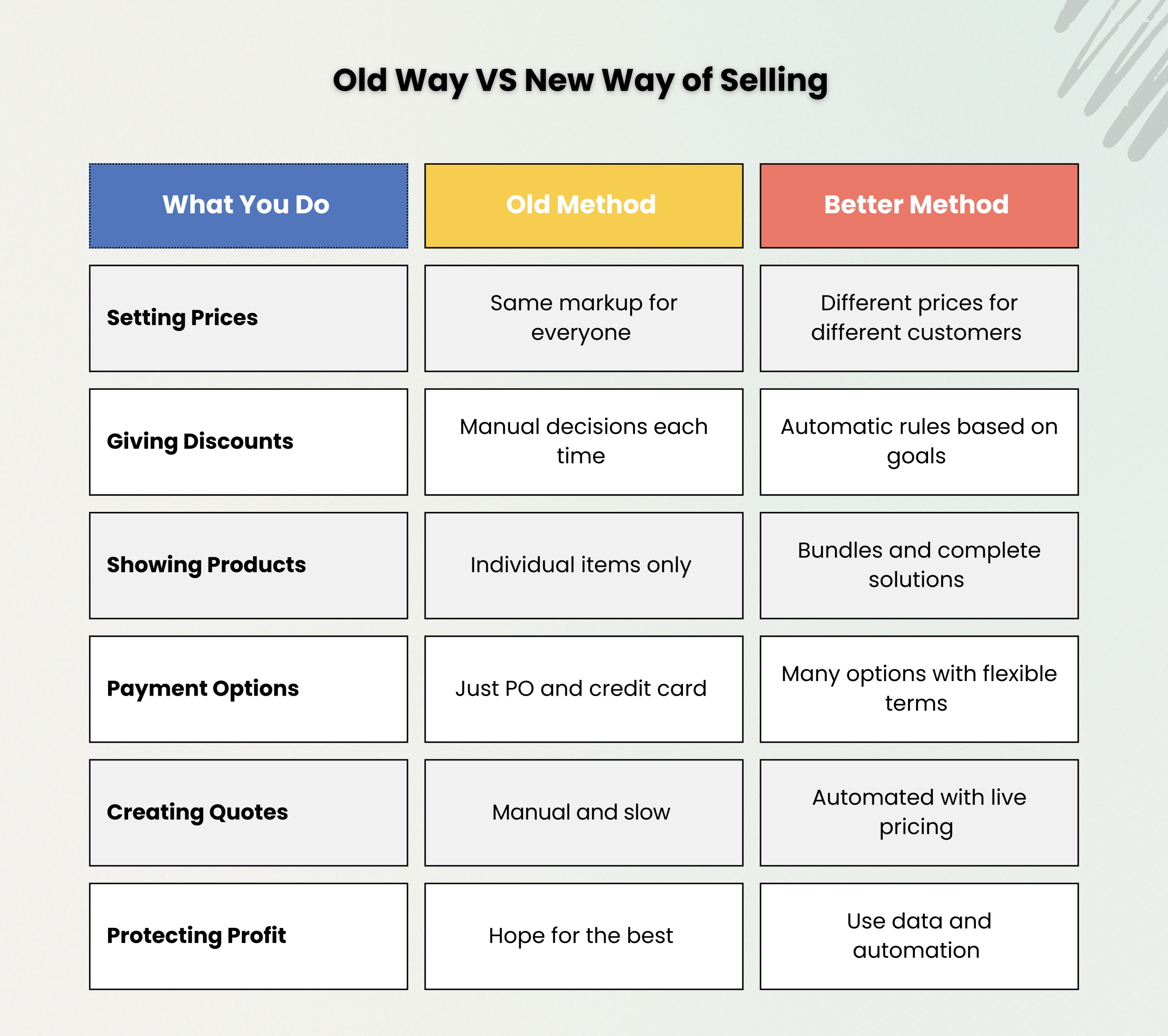

Pro Tips:
- Use tiered customer pricing (Bronze/Silver/Gold) based on annual spending to reward loyalty and increase retention
- Pair low-margin commodity items with high-margin add-ons to protect overall profitability on competitive products
- Automate pricing rules and discount thresholds to eliminate manual errors and maintain consistent margins across all quotes
Grow Your Business with VARStreet
Using smart pricing and discounts isn’t easy without the right tools. You need good software. This is where VARStreet helps.
VARStreet is a business management software made for IT resellers. It combines sales quotes, online stores, customer management, and purchasing in one place.
The platform has 7+ million products from 50+ suppliers. It gives you live pricing and product details. No more manual catalog updates. Your prices stay current automatically.
VARStreet’s quote system supports everything in this guide:
- Auto-create bundles with pricing
- Set different prices for customer levels
- Volume discount rules
- Contract pricing management
- Multiple payment options
- Live margin calculations
VARStreet customers grow their business by 50%+ each year. They cut out waste and make more from each sale. The platform handles complex tasks like enterprise catalogs and government requirements. You focus on strategy instead of paperwork.
Ready to improve your pricing and make more money? Schedule a demo with VARStreet today. See how business management software can transform your IT reselling business. Visit www.varstreetinc.com or contact the team. Join the resellers who trust VARStreet to power their growth.
FAQs
How do I use flexible pricing without losing trust?
Make pricing clear and fair. Base it on real factors like order size, payment timing, or contract length. Don’t change prices randomly. Explain why prices differ. Bigger orders get volume discounts. Early payment earns cash discounts. Customers understand this.
What discount range works for IT resellers?
Most successful resellers discount 5-15% on regular sales. Save bigger discounts (20-25%) for special deals that meet goals like high order value, upfront payment, or multi-year contracts.
How can I sell more without being pushy?
Can I charge different customers at different prices?
Yes, but have clear rules. Different prices for enterprises vs. small businesses are normal. Volume pricing is normal. Contract pricing is normal. Just have consistent rules for each group. Don’t make random decisions.
How often should I review my pricing?
Top companies review pricing once a year. But check the key numbers monthly. Look at win rates, margins, and competitor prices. Markets change fast. Stay responsive but not erratic.
What software do I need for this?
You need integrated systems for these tasks:
- Product catalog management
- Real-time pricing
- Quote creation
- Order processing
Spreadsheets don’t work well for this. They can’t scale or stay consistent across many products and customers.
Do volume discounts hurt my profit?
No, if done right. Volume discounts can boost order value by 20-50%. They improve profit through efficiency. Set thresholds that encourage bigger orders without killing margins. Calculate your break-even points first.
What's the difference between bundles and cross-sells?
Bundles package products together at one price. Cross-selling suggests add-ons during purchase. Both increase order value. Bundles simplify decisions and stop price shopping. Cross-selling gives more choices.
How do I protect profit on cheap commodity items?
Pair them with high-margin add-ons. Use attachment bundles. Or use commodity items as loss leaders to win business. Then cross-sell higher-margin products. Never compete only on price for standard items without a plan.
Do payment terms really affect sales?
Yes, absolutely. Enterprise deals often need payment flexibility. Offering milestone payments, extended terms for qualified buyers, or early-pay discounts can win deals. Many big buyers have specific payment processes you must work with.
How do I know if my pricing works?
Track these numbers:
- Average order value (AOV)
- Profit margin percentage
- Win rate on quotes
- How often you discount
- Cost to get new customers
- Customer lifetime value
Compare across customer groups and over time. Look for trends and opportunities.
What's the biggest pricing mistake?
Giving discounts too easily without a good reason. Many IT resellers discount just to close deals. This kills margins and trains customers to expect discounts. Use discounts as tools tied to business goals, not automatic giveaways.
Ask questions first. Learn what customers need and plan to do. Then show bundles and upgrades that solve their problems. Buyers expect helpful suggestions based on their needs.
Pragya Bhardwaj
Pragya Bhardwaj is a seasoned B2B content writer with a strong background in SaaS and digital commerce. She specializes in creating clear, engaging, and search-optimized content that helps businesses connect with their audiences and build authority online. With experience across blogs, whitepapers, eBooks and website copy, Pragya brings both strategy and storytelling to every piece she writes. Editorial Policy
Read More