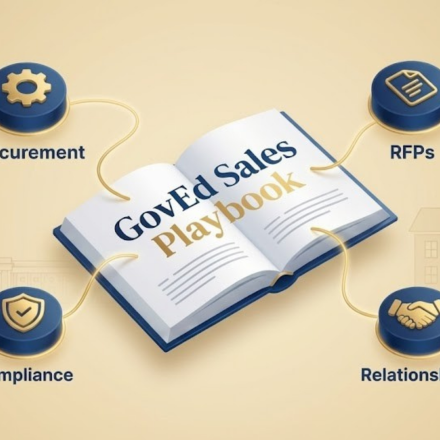
Why GovEd Selling Requires Its Own Playbook? Let’s Find Out!

Table of Content
- Understanding the GovEd Buyer Landscape
- The Public Sector Procurement Process
- The GovEd Sales Motion: A Modern, Repeatable Framework
- Tactical Components of the GovEd Selling Playbook
- Selling to Government vs Selling to Education
- Technology, Data, and Tools That Strengthen GovEd Selling
- Common Mistakes That Cause GovEd Deals to Fail
- Winning GovEd Requires Structure and Persistence
- FAQs
Government Buyers
- Government agencies operate through processes that are defined by law and policy. A government buyer must protect the public interest, reduce risk, and ensure that every step complies with regulations. Their priority is not just making the correct choice. Their priority is documenting that the choice was made correctly.
- A government buyer expects vendors to provide clarity, completeness, and proof. They value reliability and past performance. They want solutions that are stable, compliant, and low risk. Your ability to follow instructions, meet criteria, and present information cleanly often matters more than your ability to impress.
Education Buyers
- Education buyers include K12 districts and higher education institutions. Each has its own culture and structure.
- K12 districts often purchase through committees that include administrators, IT leaders, teachers, curriculum specialists, and procurement teams. Budgets may be grant-based or allocated yearly, which shapes timing.
- Higher education buyers operate more like independent entities. Departments may have autonomy, but final decisions are usually made by IT leadership, purchasing officers, budget authorities, and academic committees.
- Education buyers care about impact. They want to understand how a solution will support students, faculty, and outcomes, as well as institutional goals. They value stability, training plans, and long-term support.
The Psychology of Public Sector Buyers
Make your buyer’s justification easy to repeat. Public-sector buyers often need to explain their decisions to people who were not in the room. Give them language they can reuse. Summarize benefits in plain, defensible terms tied to mission outcomes, documented requirements, and measurable proof.
GovEd buyers typically share four characteristics.
- They avoid risk. Mistakes in public spending attract attention. Buyers choose vendors who help them feel safe.
- They rely on documentation. They need clear evidence, clear instructions, and a paper trail that meets procurement rules.
- They follow the process. Regardless of urgency, they cannot skip steps. Your role is to help them move through those steps smoothly.
- They align decisions with the mission. If you understand what the agency or institution cares about, you become a partner instead of a vendor.

The Public Sector Procurement Process
GovEd purchases follow a structured path. Understanding this path helps you position yourself early, rather than reacting when opportunities are already defined.
Pre Procurement Activities
Before an RFP is ever issued, agencies and institutions conduct internal research. They assess needs, explore possible solutions, evaluate budgets, and begin informal vendor discovery. This is where most deals are shaped. If you wait for the RFP, you will arrive too late.
The RFP and Competitive Bidding Stage
Once an RFP is released, the rules tighten. Requirements become mandatory. Formats must be followed. Evaluation criteria are fixed. A vendor who does not meet even one requirement can be removed from consideration. Winning at this stage depends on preparation and compliance rather than persuasion.
Contracting and Compliance
After evaluation, agencies negotiate terms, validate documentation, and finalize agreements. Public sector contracts often include specific reporting expectations, service levels, data protection commitments, and renewal structures. Vendors who manage this stage well often gain long-term relationships.
This comparison shows why GovEd selling requires a different mindset and a structured playbook rather than a generic sales process.
The GovEd Sales Motion: A Modern, Repeatable Framework
GovEd deals take time, structure, and patience. A seller who relies on improvisation will struggle. A seller who relies on a repeatable playbook will move through long cycles with confidence. Below is a framework used by high-performing public sector teams.
Stage 1: Intelligence Gathering
Before you speak to anyone or respond to anything, you need context. Agencies and institutions make their priorities public. Strategic plans, budget documents, program roadmaps, committee notes, and grant allocations all reveal what they intend to buy. Sellers who study these documents understand the buyer before the first conversation begins.
Intelligence gathering also includes monitoring upcoming projects, tracking competitive incumbents, and understanding how funding flows through state, federal, or district channels. This is the foundation of early positioning.
Stage 2: Relationship Mapping
GovEd purchases involve many people. Some influence. Some evaluate. Some approve. Some simply advise. You need a map of each group. You need to understand who will use the product, who will defend the purchase, who will check compliance, and who will sign. A relationship map helps you communicate the right message to each role without overstepping boundaries.
Stage 3: Compliance Qualification
Not every opportunity is worth pursuing. GovEd RFPs can be highly detailed, and many include mandatory requirements that you must meet. If you cannot meet them, you should not bid. A simple compliance checklist will save you weeks of work.
A solid qualification step includes technical requirements, legal expectations, pricing models, and service commitments. The goal is simple. Either you are eligible or you are not. If not, do not continue.
Stage 4: Pre RFP Engagement
This is where deals are truly won. Agencies and institutions often engage informally with vendors before the RFP becomes public. They gather ideas, explore best practices, and shape understanding. A seller who builds value during this period becomes a trusted resource, not a stranger responding to a public bid.
This is not about influencing decisions unfairly. It is about helping buyers understand what good solutions look like so they can design a thoughtful RFP.
Stage 5: Crafting a Winning RFP Response
When the RFP drops, discipline matters. Buyers expect structure and clarity. They expect instructions to be followed. They expect responses to be easy to read, easy to evaluate, and aligned with mandatory criteria.
Strong RFP responses focus on compliance first. Differentiation comes next. Use evidence, measurable impacts, references, case studies, and reliability. Avoid vague claims. Buyers do not want big promises. They want proof.
Stage 6: Post Submission Strategy
Most vendors treat submission as the finish line. High-performing sellers treat it as the midpoint. After submission, buyers often request clarifications, adjustments, or additional documents. Your goal is to stay responsive, simple, and supportive. This stage builds trust and can influence the final evaluation.

Tactical Components of the GovEd Selling Playbook
A strong playbook requires tactical tools that teams can use repeatedly.
Pre-Bid Intelligence Checklist
This checklist ensures you enter every opportunity informed. Review budget schedules, decision makers, upcoming initiatives, historical RFPs, and likely competitors. Good intelligence means fewer surprises later.
Bid or No Bid Framework
Not every RFP deserves a response. Evaluate the cost of bidding, the strength of your fit, the level of differentiation you can offer, and your probability of winning. If the odds are low, protect your resources and move on.
Creating a Compliant Proposal Template
A reusable proposal structure reduces risk and saves time. Include standard terms, certifications, past performance summaries, technical details, and company documentation. Build a library that your team can update easily.
Stakeholder Alignment Strategy
GovEd deals require coordination across sales, legal, operations, and finance. Before submitting anything, ensure internal alignment. This avoids late-stage confusion and reduces the risk of missing critical details in your proposal.
The Public Sector Discovery Framework
Discovery calls in GovEd look different from commercial sales calls. Buyers often cannot speak openly about future RFPs, but they can describe challenges, goals, obstacles, and constraints. Focus on uncovering mission alignment, process limitations, and proof requirements. This information helps you build proposals that feel tailored rather than generic.
Selling to Government vs Selling to Education
GovEd sales are often grouped, yet each segment behaves differently. Sellers must adapt their approach to whom they are speaking.
Government Sales Strategy
Government buyers follow strict procedures. They respond to organized information, predictable pricing, complete documentation, and proven outcomes. They expect vendors to help them move through procurement without friction.
Education Sales Strategy
Education buyers care about real-world impact on staff, students, and institutional outcomes. They want to understand the learning or operational value. They also expect training, onboarding, and long-term support. Emotional risk matters here. A poor implementation can disrupt classrooms or academic programs, so the bar for trust is high.
Technology, Data, and Tools That Strengthen GovEd Selling
GovEd sales teams benefit from systems that support long cycles and complex evaluation processes. These may include CRM workflows for committee-driven deals, RFP management tools, compliance documentation libraries, contract lifecycle systems, and reporting dashboards that track activity across multiple stakeholders.
A strong toolset does not replace the playbook. It reinforces it by reducing human error and keeping teams aligned during lengthy procurement cycles.
Common Mistakes That Cause GovEd Deals to Fail
GovEd sellers often lose deals long before the RFP is released. The most common mistakes include entering too late, misunderstanding mandatory requirements, submitting incomplete documents, ignoring institutional goals, and failing to coordinate internally.
These mistakes are avoidable. A disciplined playbook reduces risk and increases the consistency of your results.
Winning GovEd Requires Structure and Persistence
Public sector selling is not about charisma or shortcuts. It is a process-driven discipline. When you understand how buyers think and how procurement works, you build a foundation for long-term success.
Sellers who work with intention, clarity, and consistency rise above those who rely on improvisation. Use this playbook as your guide, and you will see meaningful improvements in how you qualify, engage, and win GovEd opportunities.
If you want your team to sell into government and education with confidence, structure, and predictability, start by giving them the right playbook. A clear process helps you qualify the right opportunities, position early, and respond to RFPs with accuracy instead of guesswork.
Put these principles into practice, refine your internal workflows, and build a system your team can rely on for every public sector cycle. The more disciplined your approach becomes, the more consistent your wins will be.