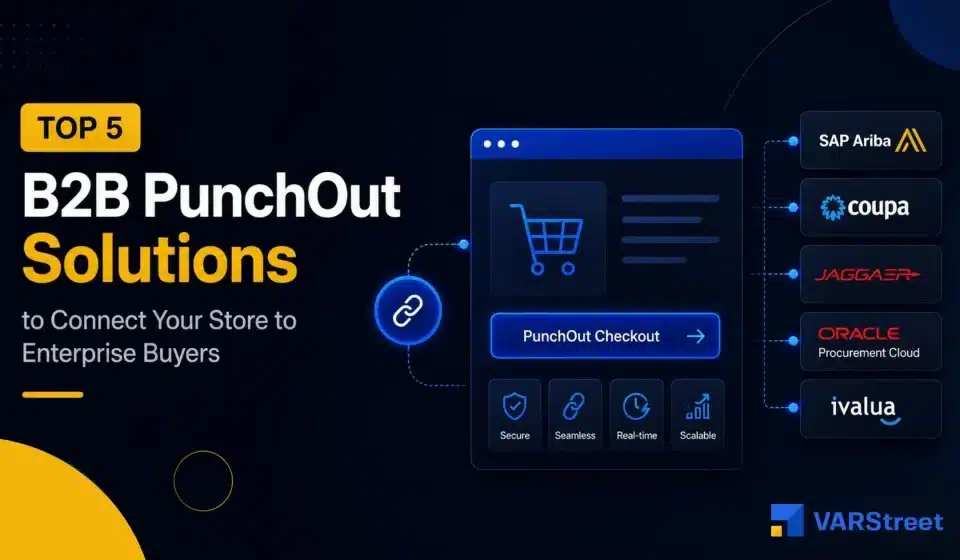
Top 5 B2B PunchOut Solutions to Connect Your Store to Enterprise Buyers
Table of Content
Winning an enterprise account is only part of the process. The real challenge begins when the buyer asks a simple question: can you connect to our procurement system?
For many IT VARs and MSPs, that question determines whether a deal moves forward or stalls. Large organizations using SAP Ariba, Coupa, Oracle or Jaggaer require suppliers to operate inside their eProcurement systems through PunchOut. Without it, even an established vendor can be blocked from the approved supplier list.
The challenge is not just enabling PunchOut. It is choosing the right solution. Some platforms only connect systems. Others also manage live distributor pricing, catalog updates and reseller-specific workflows that directly impact margins and order accuracy.
This guide compares five leading PunchOut solutions to help IT VARs and MSPs understand the differences and choose the option that best fits their business.
Key Takeaways:
- Enterprise buyers expect suppliers to support PunchOut as part of their procurement process.
- Not all PunchOut solutions are built the same, especially when it comes to pricing and distributor data handling.
- Inconsistent data between systems can affect both operational efficiency and the overall buying experience.
- Common PunchOut implementation challenges include catalog mapping, ERP synchronization, customer-specific pricing, testing and ongoing maintenance. Explore more in PunchOut Implementation Challenges and Best Practices for IT VARs.
- The right solution depends on whether you need simple connectivity or a platform built for pricing accuracy and scalability.
It is 10:30 am on a Tuesday.
Your sales rep forwards an email from a hospital network they have been working with for eight months. The deal is active. Seventy-five Dell workstations, networking equipment and a managed services contract are already scoped. The total value is close to $200,000.
There is only one condition.
Before any purchase order can move through their approval process, your company must be connected to their SAP Ariba system as an approved supplier. A PunchOut setup document is attached.
The question from your rep is simple: Do we support this?
For many IT VARs and MSPs, this is no longer an occasional request. It is a regular checkpoint in enterprise sales cycles. The ability to support PunchOut determines whether opportunities move forward or stall at procurement.
What follows is what your organization looks like to the buyer’s accounts payable team if that connection is not in place: disconnected, manual, and outside their purchasing workflow.
PunchOut is what changes that status. But the solution you choose determines what happens after the connection is made.
Why PunchOut Has Become a Hard Entry Requirement for Enterprise Accounts
Enterprise procurement teams do not negotiate on this.
When a company runs purchasing through SAP Ariba, Coupa, Oracle or Jaggaer, every approved supplier must connect to that system. Orders that arrive via email or phone get re-entered manually by someone on the buyer’s team. That creates data errors, approval gaps and compliance failures. Their fix is simple: only work with suppliers who are PunchOut-enabled.
The numbers confirm the shift.
A Gartner survey of 646 B2B buyers, conducted in August and September 2025, found 67% now prefer a rep-free buying experience. It’s no surprise, then, that more than half of B2B transactions worth $1 million or more now flow through digital self-service procurement channels. For IT VARs and MSPs, those channels include SAP Ariba, Coupa, Oracle, Jaggaer, and Workday.
Here is what the session looks like from the buyer’s side:
- Buyer logs into their eProcurement system
- Clicks your approved supplier link
- Lands in your store with their contract pricing already applied via Single Sign-On (SSO)
- Selects products and builds a cart
- Returns the cart as a purchase requisition
- Approvals, budget checks, and compliance run entirely inside their system
- Approved PO lands in your inbox
You never see a manual order. They never leave their system to check out.
Want a deeper look at how the PunchOut process works? Read our guide on PunchOut Catalog Integration: How It Works and Why You Need It to understand the complete buyer journey and integration process.
For VARs, there is a margin layer inside that flow that most generic PunchOut solutions miss. IT hardware prices move intraday. A unit at $724 on Monday can cost $738 by Thursday when the PO arrives. If your PunchOut session pulls prices from a static catalog file instead of a live distributor feed, what the buyer approved and what you actually pay can diverge on every order. For VARs with hardware margins of 5 to 15% per CompTIA channel data, that gap is not a rounding error.
If you do nothing else: Email your three largest enterprise accounts this week and ask one question: Which eProcurement system does your procurement team use? That answer narrows your solution options immediately.
5 PunchOut Solutions for VARs: What Each One Actually Covers
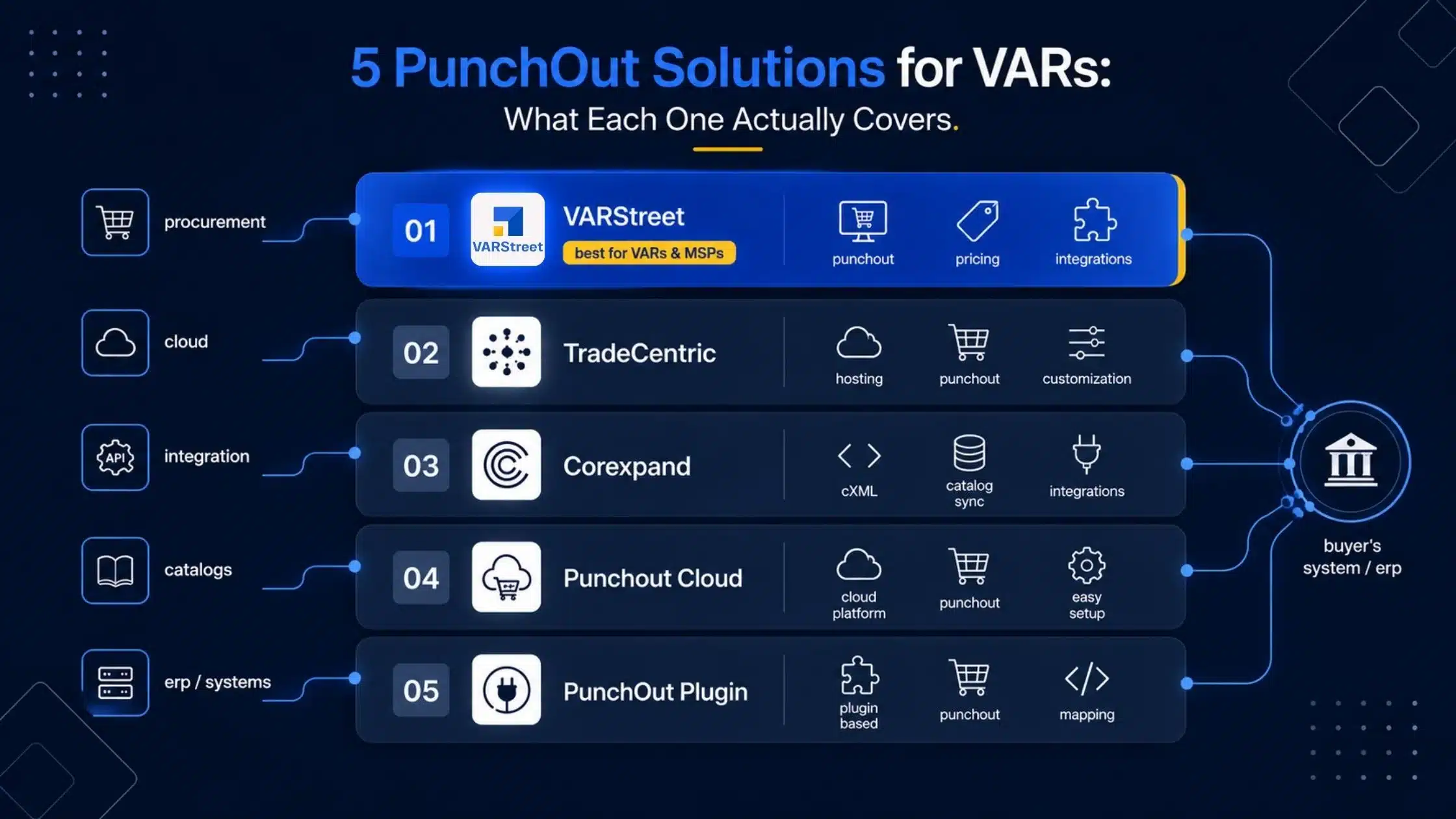
Not every PunchOut solution is designed with IT resellers in mind. This section breaks down five commonly used options and what they actually offer in real-world use.
Before we compare them, here is how these solutions were evaluated.
How We Evaluated These Solutions
Each platform was reviewed based on criteria that matter most to IT VARs and MSPs, including:
- Support for Level 1 and Level 2 PunchOut
- Ability to integrate with major eProcurement systems such as SAP Ariba, Coupa, Oracle, Jaggaer and Workday
- Handling of pricing accuracy and distributor data
- Support for multiple enterprise buyers and contract-based pricing
- Implementation effort and ongoing maintenance requirements
The goal is to highlight how each solution performs in practical enterprise procurement scenarios, not just on feature lists.
1. VARStreet
PunchOut is native to the VARStreet platform. Not a third-party add-on. Not a gateway bolted on after the fact.
What it covers:
- Level 1 and Level 2 PunchOut across SAP Ariba, Coupa, Oracle, Jaggaer, Workday, PeopleSoft, JD Edwards, ESM and Vinimaya
- Live pricing from 50+ IT and office supply distributors flows through every session automatically
- Customer-specific contract pricing is applied automatically on the SSO login
- One store instance supports multiple enterprise buyers with different pricing tiers
Distributor feeds include Ingram Micro, TD SYNNEX, D&H and ScanSource.
Best for: IT VARs and MSPs managing multiple enterprise buyers where contract pricing accuracy and live distributor feeds matter.
2. TradeCentric
TradeCentric is a standalone gateway connecting your existing eCommerce store to more than 220 eProcurement systems. Works alongside Magento, Shopify and BigCommerce.
What it covers:
- Broad eProcurement system compatibility across 220+ platforms
- Works with your current eCommerce platform without a switch
- Handles implementation and technical connection
The gap: TradeCentric transmits your catalog prices. It does not pull live distributor data. If your store shows a cached price, the buyer sees that cached price.
Best for: VARs on an existing eCommerce platform who need PunchOut connectivity without changing platforms.
3. Corexpand
Another gateway specialist. Covers Ariba, Coupa, Workday, Jaggaer, Oracle, SAP and iValua. Handles implementation and ongoing technical support.
What it covers:
- Seven major eProcurement platforms
- Ongoing integration management and technical support
- Mid-market enterprise account focus
The gap: Accurate only as far as your own catalog data is accurate. No live distributor feed.
Best for: VARs with clean, well-maintained catalog data who need reliable integration across multiple enterprise platforms.
4. Punchout Cloud
A Shopify app by PunchOut Catalogs LLC. Installs directly on your existing Shopify store. Supports cXML and OCI.
What it covers:
- Fast setup for Shopify-based stores
- cXML and OCI protocol support
- Single-account enterprise integration
The gap: Not suited for managing multiple enterprise buyers simultaneously or Level 2 PunchOut requirements.
Best for: Shopify-based VARs with one or two enterprise accounts and straightforward requirements.
5. PunchOut Plugin
Plugin-based PunchOut for WooCommerce, Magento, and NopCommerce. Supports cXML and OCI. Lower entry cost but more developer involvement for customization.
What it covers:
- Plugin integration for WooCommerce, Magento, and NopCommerce
- cXML and OCI support
- Single-account setup with lower entry cost
The gap: Works for one account. Less suited to scale across multiple enterprise buyers.
Best for: VARs on WooCommerce or Magento who need a minimum viable PunchOut for a single enterprise account.
Solution Comparison

| Solution | PunchOut type | Live distributor pricing | Key eProcurement platforms | Best for |
|---|---|---|---|---|
| VARStreet | Native, L1 and L2 | ✓, 50+ distributors | Ariba, Coupa, Oracle, Jaggaer, Workday, PeopleSoft, JD Edwards, ESM, Vinimaya | IT VARs and MSPs, multiple buyers, contract pricing accuracy |
| TradeCentric | Gateway | ✕ | 220+ systems | VARs on existing platforms needing connectivity |
| Corexpand | Gateway | ✕ | Ariba, Coupa, Workday, Jaggaer, Oracle, SAP, iValua | Mid-market enterprise, multiple platforms |
| Punchout Cloud | Plugin (Shopify) | ✕ | Ariba, Coupa, Jaggaer, Oracle | Shopify VARs, 1-2 enterprise accounts |
| PunchOut Plugin | Plugin (WooCommerce, Magento) | ✕ | Ariba, Oracle, Jaggaer, Coupa | WooCommerce or Magento, single-account |
Pro Tip:
Match your top enterprise account’s procurement system with the table above. Then check your current eCommerce platform. These two inputs will quickly indicate whether a plugin is sufficient or whether you need a more integrated PunchOut approach.
If you are still evaluating options, read our B2B eCommerce RFP Template for IT VARs to ensure you are asking the right questions before selecting a solution.
The One Question to Ask Before You Choose Any PunchOut Solution
Every solution in the table will open a PunchOut session. The difference shows up when the buyer submits the cart.
In enterprise procurement, PunchOut is connected to approval workflows, budgets, and compliance checks. When something changes between cart creation and purchase order approval, it does not just affect pricing. It also affects how smoothly the buying process runs.
Take a simple example.
A school district in Dallas using Jaggaer places an order for 75 HP laptops through a VAR’s PunchOut store. The buyer adds items at $768 per unit and submits the cart as a purchase requisition.
Two days later, the purchase order is approved. By that time, distributor pricing has moved to $782 per unit. The difference is $14 per unit across the order.
That creates a $1,050 gap that the VAR absorbs. But the impact is not only financial. It also creates extra coordination between sales and procurement teams, slows down order processing, and can lead to confusion when approved orders do not match current pricing. Over time, this can affect onboarding speed for new enterprise accounts, procurement efficiency, and overall customer satisfaction.
For MSPs, the same issue plays out over a longer period. A managed services contract with a hardware component that is slightly mispriced can continue for 12 to 24 months until renewal. During that time, it can lead to repeated billing adjustments, extra administrative work, and friction between teams managing the account, which eventually impacts customer experience.
The real issue is not the PunchOut session itself. It is what happens when pricing changes between the time a cart is built and the time a purchase order is approved.
That leads to one important question every business should ask before choosing a PunchOut solution:
“If my distributor changes the unit cost between when the buyer builds the cart and when the purchase order is approved, what price does the buyer’s PO reflect?”
A gateway-based model usually reflects pricing based on catalog sync or session timing. A live-feed-integrated platform reflects pricing closer to the actual time of purchase. These two approaches lead to very different outcomes.
For a deeper understanding of how pricing moves between eCommerce systems and procurement platforms, and where gaps typically appear, read ERP and eCommerce Sync: What to Sync vs Not Sync.
If you do nothing else, validate this scenario with any vendor you evaluate. The answer will quickly show how the platform behaves in real procurement conditions.
Where This Ends and VARStreet Begins
Every solution in this comparison helps buyers connect with your store through PunchOut. That’s the common ground.
Where they differ is in what they support beyond the connection. For some businesses, a standalone PunchOut integration is enough. For IT resellers and VARs, factors like distributor pricing, catalog updates, and procurement workflows often become just as important.
TradeCentric, Greenwing Technology, PunchOut2Go, OroCommerce, and VARStreet each address these needs differently. The right choice depends on how your business operates today and what you expect your commerce platform to support as you grow.
With more than two decades of experience in the IT channel, VARStreet has built its PunchOut capabilities around the day-to-day needs of technology resellers. For businesses looking for a solution that goes beyond enabling PunchOut, that experience is an advantage worth considering.
If you are also deciding whether to run B2B and B2C buyers from the same store, read One Store or Two: B2B vs B2C eCommerce Storefront Decision Guide for IT Resellers.
VARStreet was built to close that gap.
PunchOut is only one part of the procurement process. For IT resellers, the bigger advantage comes from connecting it with live pricing from IT and office supply distributors and connecting it to the VARStreet quoting software. By bringing these capabilities together in a single platform, VARStreet helps resellers support enterprise procurement while keeping pricing and sales workflows aligned.
Before and After
| What you do today | The problem it creates | What changes with VARStreet |
|---|---|---|
| Store not connected to the buyer’s eProcurement system | Not on their approved vendor list, regardless of pricing or relationship | Native PunchOut connects your store to Ariba, Coupa, Oracle, Jaggaer and more |
| Cart prices pulled from static catalog file | Prices drift between sessions and PO approval, margin absorbed silently | Live distributor feeds update pricing inside every session |
| A separate setup required for each new enterprise buyer | Each new account is a new integration project | One store instance supports multiple buyers with different pricing tiers |
Book a Demo to see how your enterprise accounts connect inside VARStreet.
FAQs
What do PunchOut solutions for VARs need to support to work with SAP Ariba?
You need cXML support and SAP Business Network registration. VARStreet handles the full Ariba configuration, so your team does not touch the setup.
Can I add PunchOut to my Shopify or WooCommerce store without switching platforms?
Yes, PunchOut Cloud works on Shopify and PunchOut Plugin works on WooCommerce and Magento, though neither pulls live distributor pricing, so both suit VARs with stable product costs.
What is the difference between Level 1 and Level 2 PunchOut for IT VARs?
Level 1 takes the buyer to your store to browse. Level 2 lets buyers search your catalog from inside their eProcurement system without navigating away. Enterprise procurement teams managing multiple suppliers typically require Level 2. VARStreet supports both.
Does PunchOut work for MSP recurring service contracts, not just hardware orders?
Yes, PunchOut supports services, subscriptions, and renewals alongside hardware, and for MSPs, the SSO login automatically applies their contracted rate rather than a standard list price.
Which eProcurement systems do IT VARs encounter most from enterprise accounts?
SAP Ariba dominates large enterprises, Coupa is common in the mid-market, Oracle covers government and healthcare, and Jaggaer is standard in higher education, so ask each account which system they use before you decide.
Pragya Bhardwaj
Pragya Bhardwaj is a seasoned B2B content writer with a strong background in SaaS and digital commerce. She specializes in creating clear, engaging, and search-optimized content that helps businesses connect with their audiences and build authority online. With experience across blogs, whitepapers, eBooks and website copy, Pragya brings both strategy and storytelling to every piece she writes. Editorial Policy
Read More