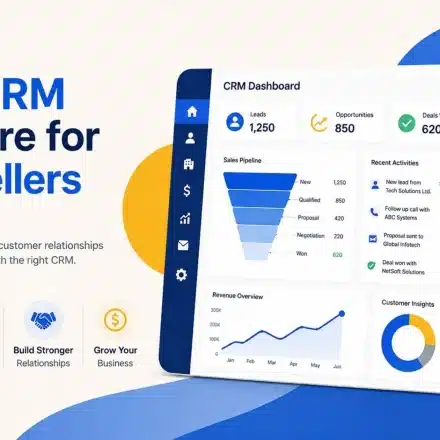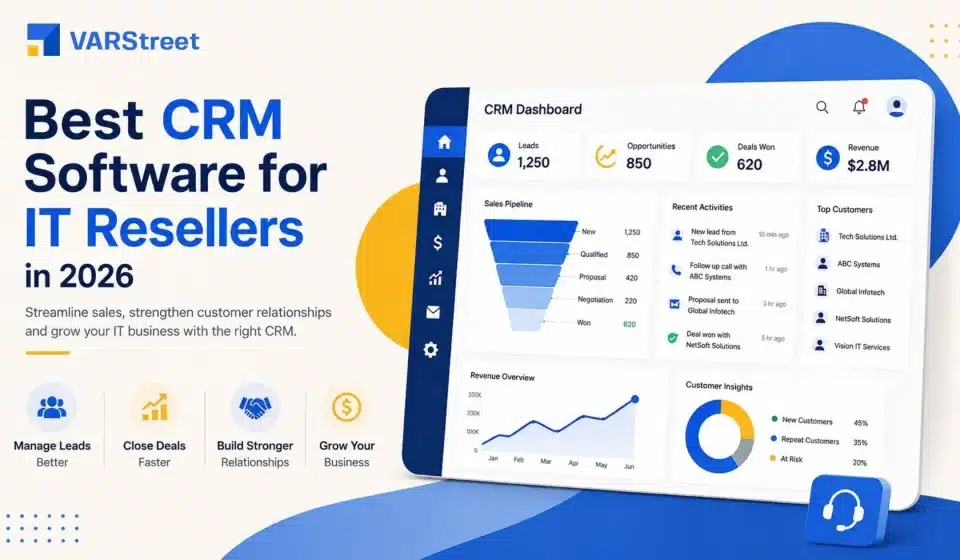

Top 5 CRM Software for IT Resellers in 2026
Table of Content
Your sales rep didn’t lose the deal because they lacked experience.
For an IT reseller, selecting the best CRM software involves more than just keeping track of transactions and managing contacts. It’s about finding a platform that fits the way your business operates.
Many VARs and MSPs still rely on multiple systems to manage customer relationships, distributor pricing, quoting, renewals, and service operations. Sales reps often switch between their CRM, distributor portals like TD SYNNEX and Ingram Micro, spreadsheets, and quoting tools just to move a deal forward. As your business grows, these disconnected workflows become harder to manage.
The challenge isn’t unique to IT resellers.
According to HubSpot’s sales research, 45% of sales professionals feel overwhelmed by the number of tools in their tech stack, highlighting how disconnected systems can create inefficiencies across the sales process. This makes it even more important to choose a CRM that supports your workflows instead of adding more complexity.
The challenge isn’t finding a CRM. It’s finding CRM software for IT resellers that supports distributor relationships, quoting, renewals, and channel-specific sales workflows without adding unnecessary complexity.
In this guide, we’ll compare five CRM platforms commonly used by VARs and MSPs and help you determine which one best fits your business.
Key Takeaways:
- Distributor pricing visibility matters as much as pipeline visibility for VAR sales teams.
- CRM and quoting workflows should work together, not in separate systems.
- Renewal tracking is critical for Microsoft, Cisco, and other subscription-based revenue streams.
- PSA integration can eliminate duplicate data entry and operational bottlenecks.
- Channel-native platforms often reduce the manual work that generic CRMs require through customization.
Not sure which CRM fits your VAR workflow? Explore VARStreet’s integrations and channel automation capabilities.
What IT Resellers Need from CRM Software That Generic Sales Teams Don’t
The best CRM software for IT resellers should support distributor relationships, quoting workflows, renewal management, and vendor programs.
You’re not selling SaaS subscriptions to a single buyer. You’re managing hardware and software deals that move through multiple distributors, have vendor-specific deal registration requirements, and increasingly include multi-year subscription renewals layered on top of project-based hardware cycles.
Your CRM needs to handle all of this and most generic ones weren’t built for it. Before comparing tools, align on what “fit” actually means for your business:
- Distributor pricing integration: Can the CRM pull live pricing from TD SYNNEX, Ingram Micro, D&H, or Arrow directly, or does your sales rep copy-paste from a distributor portal into a separate quoting tool?
- CPQ compatibility: Configure-price-quote for IT hardware isn’t the same as SaaS pricing. Product bundles, SKU-level margin tracking, and vendor-specific discounts all need to be handled at the line-item level.
- PSA connectivity: If your MSP practice runs on ConnectWise or Autotask, your CRM should pass opportunity data both ways without a manual export step in between.
- Subscription and renewal visibility: Microsoft 365, Cisco Enterprise Agreements, HPE GreenLake, and similar products need renewal pipelines that surface 90- and 60-day windows automatically.
- Deal registration per vendor program: Cisco, HP, Microsoft, and most major vendors come with their deal registration rules that help to protect your margin. Your CRM should track registration status per opportunity, not across a separate spreadsheet.
If your current tool can’t handle at least three of these five without custom development, the comparison below will help you find one that can.
Top 5 CRM Software for B2B Tech Sales
1. VARStreet: Built for the IT Channel, Not Adapted for It
VARStreet is not a horizontal CRM that happens to serve IT resellers. It was built specifically for VAR and MSP sales workflows, bringing CRM, quoting, and distributor catalog management into a single platform rather than depending on multiple disconnected tools.
As a B2B sales CRM for VARs, VARStreet helps teams manage opportunities, distributor relationships, and quoting from one place. This reduces the need to switch between CRM records, distributor portals, spreadsheets, and separate CPQ tools.
When a sales rep creates a sales opportunity in VARStreet, they can view real-time pricing and product availability from multiple distributors without switching between portals. They can then generate quotes, check profit margins, and route them for approvals within the same platform. This helps reduce manual work and speeds up the quote-to-order process.
Key features:
- Aggregated product catalog from 50+ distributors with real-time pricing and availability
- CPQ is integrated directly into the sales pipeline; no middleware or third-party quoting tool is required
- Margin visibility at the line-item level across hardware, software, and services
- B2B eCommerce storefront that connects to the same distributor catalog
- Vendor-specific deal registration tracking inside the opportunity record
- Renewal and subscription pipeline management for recurring revenue products
Pros
- It offers native distributor catalog integration
- Built-in quoting and CRM workflow
- Line-item margin visibility
Cons
- Pricing requires contacting sales
- Best suited for IT resellers rather than general B2B businesses
Best for: VARStreet can be the right choice for IT VARs and solution providers of any size who need quoting, catalog management, and pipeline management without building a custom integration stack.
Pricing: Contact VARStreet for custom pricing.
Bottom Line: If your biggest operational pain is the gap between your CRM and your distributor pricing, VARStreet closes it natively.
What customers say:
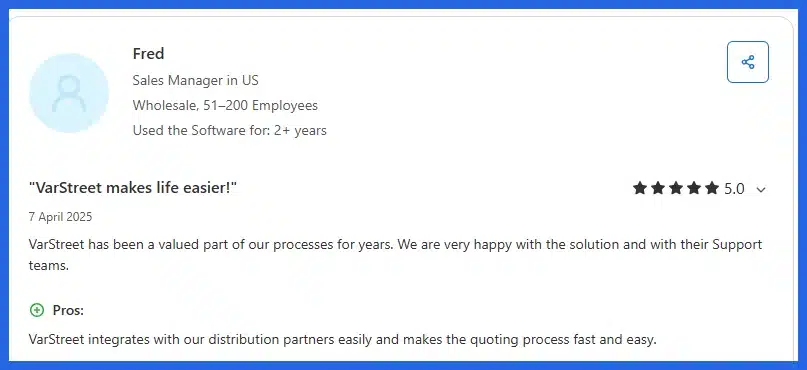
“VARStreet has been wonderful. It is a critical business application for our company and has helped our internal sales teams process orders more efficiently. It has streamlined the time it takes to quote a customer and process orders from sales orders to purchase orders. The VARStreet development team is always available to respond to our questions, and technical issues are resolved quickly. Our company knows that VARStreet is a partner we can count on.” – Jenny Ortiz, United Data Technologies
2. Salesforce: The Enterprise Standard with Genuine Channel Capability
Salesforce remains the enterprise standard for CRM. Large VARs and MSPs often choose Salesforce because of its flexibility, ecosystem, and ability to support highly customized workflows.
Key features:
- Sales Cloud PRM for deal registration, partner portals, and channel pipeline management
- AI-powered opportunity insights via Agentforce
- Channel Revenue Management for tracking incentives, inventory, and pricing across the full channel ecosystem
Pros
- Extremely customizable
- Large AppExchange ecosystem
- Strong reporting and analytics
Cons
- Requires implementation and ongoing administration
- Channel workflows often need additional products or integrations
Best for: Enterprise VARs with dedicated CRM administrators and complex sales operations.
Pricing: The cost of the Starter Suite is $25/User/Month, and the Pro Suite costs $100/User/Month.
Bottom Line: Salesforce has serious channel capability, but you need the team and budget to unlock it.
3. HubSpot CRM: Strong for MSPs Running Renewal and Marketing Pipelines
HubSpot has become one of the most popular CRM platforms because of its ease of use and fast deployment. For smaller VARs and growing MSPs, it provides strong pipeline management without requiring a large technical team. HubSpot can work well as a CRM for managed service providers focused on renewals and customer engagement.
Key features:
- Customizable deal pipelines that can map to hardware project cycles and subscription renewal windows simultaneously
- Email sequences and marketing automation for renewal outreach and new-product campaigns
- HubSpot CPQ for basic product quoting
- Free CRM tier is genuinely useful as a starting point before the full commercial stack
Pros
- Easy to deploy
- Excellent marketing automation
- Intuitive user experience
Cons
- Limited distributor workflow support
- Advanced quoting requires additional tools
Best for: MSPs and smaller VARs with fewer than 30 employees. HubSpot is a good choice for businesses that value pipeline visibility, renewal automation, and marketing tools more than advanced hardware quoting.
Pricing: Offers free CRM, along with multiple paid plans. Starter plan costs $20/seat/month, Professional $1,300/month (for 6 seats), and Enterprise $4,300/month (for 8 seats).
Bottom Line: HubSpot is the right CRM for MSPs who want to run organized renewal pipelines and outbound marketing without building a complex tech stack from day one.
4. Microsoft Dynamics 365 Sales: The Natural Home for Microsoft-Centric VARs
Microsoft Dynamics 365 Sales is a natural consideration for VARs and MSPs already invested in Microsoft technologies.
Its integration with Microsoft 365, Teams, Power BI, and Azure creates a connected experience for organizations operating primarily within the Microsoft ecosystem.
Key features:
- Native Microsoft Partner Center integration for CSP and MPN data, subscription status, and renewal visibility.
- Power Automate for building custom approval workflows, renewal alerts, and quote routing without code
- D365 Business Central integration for full ERP, inventory, procurement, and financial reporting in one Microsoft environment
- Copilot AI for meeting summaries, next-step recommendations, and email drafting inside Outlook and Teams
Pros
- Excellent Microsoft ecosystem integration
- Strong ERP connectivity
- Powerful automation through Power Automate
Cons
- Can be expensive
- Better suited for Microsoft-centric organizations
Best for: Microsoft-centric VARs and CSPs who want their CRM, M365, Partner Center data, and ERP in a single Microsoft-native environment.
Pricing: D365 Sales Professional plan costs $65/user/month, Enterprise plan costs $105/user/month, and Sales Premium costs $150/user/month.
Bottom Line: If Microsoft is the center of your business, both what you sell and how you run your operations, D365 Sales gives you a coherent platform that no other tool on this list matches.
5. Zoho CRM: The Cost-Effective Option for Budget-Conscious VARs
Zoho CRM also offers a broad feature set at a competitive price point. It appeals to smaller VARs and MSPs looking for sales automation without enterprise-level costs.
Key features for IT VAR:
- Customizable deal stages and product catalog management within the CRM
- Zoho CRM Plus bundles CRM, marketing, analytics, help desk, and project management through a single subscription
- Zoho Analytics helps you create custom dashboards to track sales performance, margins, and upcoming renewals.
- Integration with QuickBooks and Zoho Books for US and Canadian accounting compliance
Pros
- Offers affordable pricing
- Highly customizable platform
- Comes with good automation capabilities
Cons
- Requires customization for reseller workflows
- Distributor integrations rely on third-party tools
Best for: This is suitable for smaller VARs and emerging MSPs prioritizing affordability.
Pricing: Offers multiple paid plans, like Standard at $14/user/month. Professional plan at $23/user/month, and Enterprise at $40/user/month. It also offers a free plan.
Bottom Line: Zoho offers excellent value for the price. However, you’ll need to spend some time configuring it to support IT reseller workflows.
How To Evaluate These CRM Platforms
The CRM platforms in this guide are compared based on the capabilities that matter most to IT resellers and MSPs. Beyond standard CRM features, the comparison focuses on reseller-specific sales workflows, integrations, and long-term business requirements.
The key comparison criteria include:
- Distributor integrations
- CRM functionality
- Quoting and CPQ capabilities
- Renewal management
- PSA and ERP integrations
- Reporting and analytics
- Scalability
- Pricing
Ease of implementation
The table below summarizes how each platform performs across these key areas.
Tools at a glance
| Evaluation Criteria | VARStreet | Salesforce | HubSpot CRM | Microsoft Dynamics 365 Sales | Zoho CRM |
|---|---|---|---|---|---|
| Distributor Integrations | Native (50+ distributors) | Via middleware | Via third-party | Via middleware | Via third-party |
| CRM Functionality | Excellent | Excellent | Excellent | Excellent | Excellent |
| Quoting & CPQ | Native | Revenue Cloud | Basic CPQ | Business Central | Via Zoho ecosystem |
| Renewal Management | Built-in | Workflow automation | Strong | Native | Configurable |
| PSA & ERP Integrations | Via integrations | AppExchange | Via third-party | Native Microsoft ecosystem | Zoho Flow |
| Reporting & Analytics | Built-in dashboards | Advanced analytics | Strong analytics | Power BI | Zoho Analytics |
| Scalability | High | Very High | High | Very High | Medium |
| Ease of Implementation | Easy | Complex | Easy | Moderate | Moderate |
| Starting Price | Custom | $25/user/month | Free; paid plans from $20/user/month | $65/user/month | Free; paid plans from $14/user/month |
| Best For | IT VARs needing CRM, quoting, and distributor management in one platform | Enterprise VARs | MSPs and smaller VARs | Microsoft-centric VARs and CSPs | Budget-conscious VARs and MSPs |
Real-World Scenario
Consider a 12-person VAR in Texas selling networking, cybersecurity, and Microsoft licensing solutions.
The company uses HubSpot to manage sales opportunities. When a customer requests for a quote, sales reps have to manually log into the Ingram Micro and TD SYNNEX portals to check the current pricing of every individual product. After that they export data into spreadsheets and then they can generate a proposal.
These extra steps slow the team down. They also increase the chances of pricing errors and margin loss, especially as the number of quotes grows.
This is where channel-specific platforms differentiate themselves. Instead of stitching together multiple systems, they bring pricing, quoting, and CRM workflows into a unified process.
How to Evaluate CRM Software for Your VAR or MSP
You’re past the demo stage. Before you sign anything, you must ask your shortlisted vendors these specific questions to ensure their credibility:
- Does it natively integrate with TD SYNNEX, Ingram Micro, D&H, or Arrow? If not, who manages the integration, and what does that cost annually beyond the license fee?
- Can your team track deal registrations for vendors like Cisco, HP, and Microsoft inside the opportunity record? Or does that live in a separate spreadsheet?
- How does renewal visibility work for multi-year subscription products? Does the system automatically surface upcoming renewals at 90 and 60 days, or do reps set manual reminders?
- What does PSA integration with ConnectWise or Autotask look like? Is it native, or does it require a third-party connector like Zapier? Who owns the sync when it breaks?
- What is the realistic time to go live for a team of our size? Ask for a reference from a VAR or MSP at your headcount, not just a case study from their largest customer.
- What happens to our data if we need to migrate out in two years? Export format, timeline, and support for migration should be clear before you sign.
Conclusion
Choosing the right CRM software for IT resellers comes down to how effectively it connects your pipeline, distributor ecosystem, and quoting process.
If you’re a Microsoft-centric CSP or MPN partner, Dynamics 365 integrates well with the Microsoft ecosystem. If your MSP business relies heavily on subscription renewals and marketing automation, HubSpot is a strong option. Salesforce offers extensive customization for enterprise VARs, while Zoho CRM provides an affordable solution for smaller businesses with simpler requirements.
What all four platforms have in common is that they were built for broad sales teams and later adapted for the IT channel. As a result, many reseller-specific workflows, such as distributor integrations, quoting, and procurement, often require additional products, third-party integrations, or ongoing customization.
VARStreet takes a different approach. Built specifically for IT resellers and MSPs, it combines distributor catalogs, CRM, quoting, procurement, and B2B eCommerce into a single platform designed around real-world channel workflows. Unlike many solutions that require separate CRM and CPQ products, VARStreet includes CRM functionality within its InstaQuote platform, reducing the need for additional tools and helping teams work from one connected system.
For resellers looking to simplify operations, reduce manual work, and move from opportunity to order more efficiently, a channel-specific platform can deliver long-term value beyond traditional CRM capabilities. Instead of stitching together multiple systems, your team can manage customer relationships, quoting, distributor pricing, and procurement from a single platform built for the IT channel.
The right next step isn’t necessarily making a purchase. It involves determining where your present sales process is slowing down and whether your CRM is generating more work or assisting your team in selling more effectively.
Ready to see how VARStreet fits into your reseller workflow? Schedule a demo to explore how a channel-specific CRM can help streamline quoting, distributor management, and sales operations.
FAQs
What is the best CRM for IT resellers?
The best CRM for IT resellers depends on what your business needs. Salesforce is highly customizable, HubSpot is easy to use, Microsoft Dynamics works well with other Microsoft tools, and Zoho is budget-friendly. If you are, for example, an IT reseller and need built-in distributor pricing, quoting, and channel workflows, VARStreet is a strong choice.
Can I keep my existing CRM and still use VARStreet?
Yes. VARStreet integrates with popular CRM platforms, so you don’t necessarily have to replace your existing system. You can keep using your current CRM while using VARStreet for reseller-specific workflows such as distributor catalog management, quoting, procurement, and B2B eCommerce. This allows you to add channel-specific capabilities without disrupting your existing sales processes.
How important is PSA integration when choosing a CRM for an MSP?
It’s essential for most MSPs. A good PSA integration connects your sales and service teams, reduces manual work, and keeps customer information up to date.
How is CRM for B2B tech sales different from standard CRM?
A standard CRM focuses on managing contacts and sales opportunities. A CRM for B2B tech sales also supports distributor relationships, renewals, quoting, and other workflows that IT resellers rely on.
Does VARStreet have CRM functionality?
Yes. VARStreet has CRM features made for IT channel businesses. Along with managing customers and opportunities, it offers distributor integrations, quoting tools, procurement workflows, catalog access, and automation focused on channel needs; features that many VARs and MSPs look for.
Chayanika Sen
Chayanika is a B2B Tech and SaaS content writer and strategist with 20 years of industry experience. She specializes in writing research-backed, data-driven, and actionable long-form content. She's also a trained Indian classical dancer and a passionate traveler. When not at work, you'll either find her performing on stage or exploring new places. Editorial Policy
Read More