PunchOut vs. Hosted Catalogs: Which is Right for Your B2B Business?
Table of Content
Ever had a high-value customer ask, “Do you support PunchOut?” or request a “hosted catalog” for their procurement system?
It’s a common question, and it’s not just a technical preference, it’s a business necessity from their point of view. For your buyer, this request is driven by critical internal challenges. They are managing complex purchasing workflows, enforcing strict budgets across multiple departments, and ensuring every single purchase aligns with negotiated contracts. Their goal is control, compliance, and efficiency.
Key Takeaways:
- PunchOutcatalogs provide real-time procurement integration while hosted catalogs serve as centralized product repositories.
- PunchOutsupports dynamic pricing and inventory visibility within buyer systems.
- Hosted catalogs offer structured product lists for online browsing without procurement integration.
- The choice depends on buyer expectations, procurement maturity, andintegration ofreadiness.
- PunchOutis more suitable for enterprise workflows, while hosted catalogs fit smaller, self-serve use cases.
For them, integrating their suppliers directly into their eProcurement system isn’t just “nice to have”; it’s a mandatory requirement for any significant business relationship.
Understanding the “why” behind their request is the first step to becoming an indispensable partner and locking in those major contracts.
Decoding the eProcurement Ecosystem
Before we compare the two, it’s helpful to understand the environment where they operate. Think of it as three core components working together.
1. The Buyer’s eProcurement System
This is the buyer’s internal purchasing software (like SAP Ariba, Coupa, or Oracle). Its job is to control spending, automate approvals, and ensure employees buy the right products from the right suppliers at the right price.
2. The Supplier’s Catalog
This is your digital portfolio of products and services. It contains all the essential data: product descriptions, SKUs, pricing, and availability. The goal is to get this information into the buyer’s system effectively.
3. The Integration Layer
This serves as the connector between your catalog and the buyer’s platform. This bridge is what defines the difference between a static hosted catalog and a dynamic PunchOut solution.
The Classic Approach: Hosted (CIF) Catalogs
The original method for digital catalog integration relies on a standard called the Catalog Interchange Format (CIF).
CIF catalogs are static text files, typically delivered as CSV. It contains your product data- part numbers, descriptions, prices, etc. You send this file to your buyer, who then uploads and “hosts” it within their eProcurement system for their employees to use.
When Does a Hosted Catalog Make Sense?
CIF catalogs aren’t entirely obsolete. They can be a practical choice for sellers with a small, stable product line- think fewer than 1,000 items where prices and product details rarely change. In these simple scenarios, a CIF file offers a low-cost and straightforward initial setup.
The Limitations of the Hosted Model
For most modern B2B sellers dealing with dynamic market conditions, the CIF model presents significant liabilities.
1. The Static Data Problem
A CIF catalog is a snapshot frozen in time. The moment it’s uploaded, its data on pricing and inventory begins to age. For businesses with fluctuating prices or changing stock levels, a CIF catalog is almost guaranteed to be inaccurate shortly after it’s posted.
2. Inability to Handle Complexity
A seller’s value often lies in offering configurable products, service bundles, or solutions with multiple components. CIF files are flat lists and cannot represent these complex offerings, forcing these orders into a manual, offline process that defeats the purpose of eProcurement.
3. The Maintenance Burden
Updating a CIF catalog is a clunky, manual process for everyone. You have to generate a new file, send it to the buyer, and then wait for their team to upload and test it. This creates delays and administrative overhead for both you and your customer.
4. A Poor User Experience
Buyers are limited to the search functions of their own eProcurement platform, which are often basic. When they can’t find what they need, they may leave the system to search your public website, then manually re-enter the data—a frustrating process that invites errors.
The hidden cost of this friction is high. When an order is placed based on outdated CIF data, it triggers a cascade of expensive manual corrections, eroding customer trust and damaging the relationship.
The Modern Solution- PunchOut Catalogs
In response to the limitations of static files, the industry developed a far more powerful solution: the PunchOut catalog. This is the gold standard for modern B2B eProcurement integration.
A PunchOut catalog is a real-time, direct connection between a buyer’s eProcurement system and your live B2B eCommerce website. The buyer “punches out” from their system, shops on your full-featured website with their specific contract pricing, and then seamlessly transfers their shopping cart back into their system to create a requisition.
Read the blog—How PunchOut Catalog Implementation Benefits Small Sellers?
The PunchOut Workflow in Action
Here’s a step-by-step look at the buyer’s journey:

- Authentication: The buyer logs into their eProcurement system and clicks a link for your company. A secure request automatically logs them into a personalized version of your eCommerce store—no extra passwords needed.
- Shopping: The buyer browses your live website. They see their organization’s specific contract pricing and real-time inventory levels. They can use advanced search, filters, and product configurators, just as they would on a modern retail site.
- Cart Transfer: After adding items to their cart, they click a “Transfer Cart” or “Submit for Approval” button. This action packages the cart data and sends it securely back to their eProcurement system.
- Requisition & Approval: A purchase requisition is instantly and automatically created in their system, populated with the exact items and prices. This eliminates all manual data entry and sends the request through the company’s standard internal approval workflow.
- Purchase Order: Once approved, the system automatically generates a Purchase Order (PO) and sends it to you electronically for fulfillment.
This seamless process is typically enabled by a communication protocol called cXML (commerce eXtensible Markup Language) or OCI (Open Catalog Interface), which act as universal translators between the two systems.
To learn more about cXML PunchOut integration, read our blog- What is cXML and How does it Enable PunchOut Catalogs for Smarter B2B Automation?
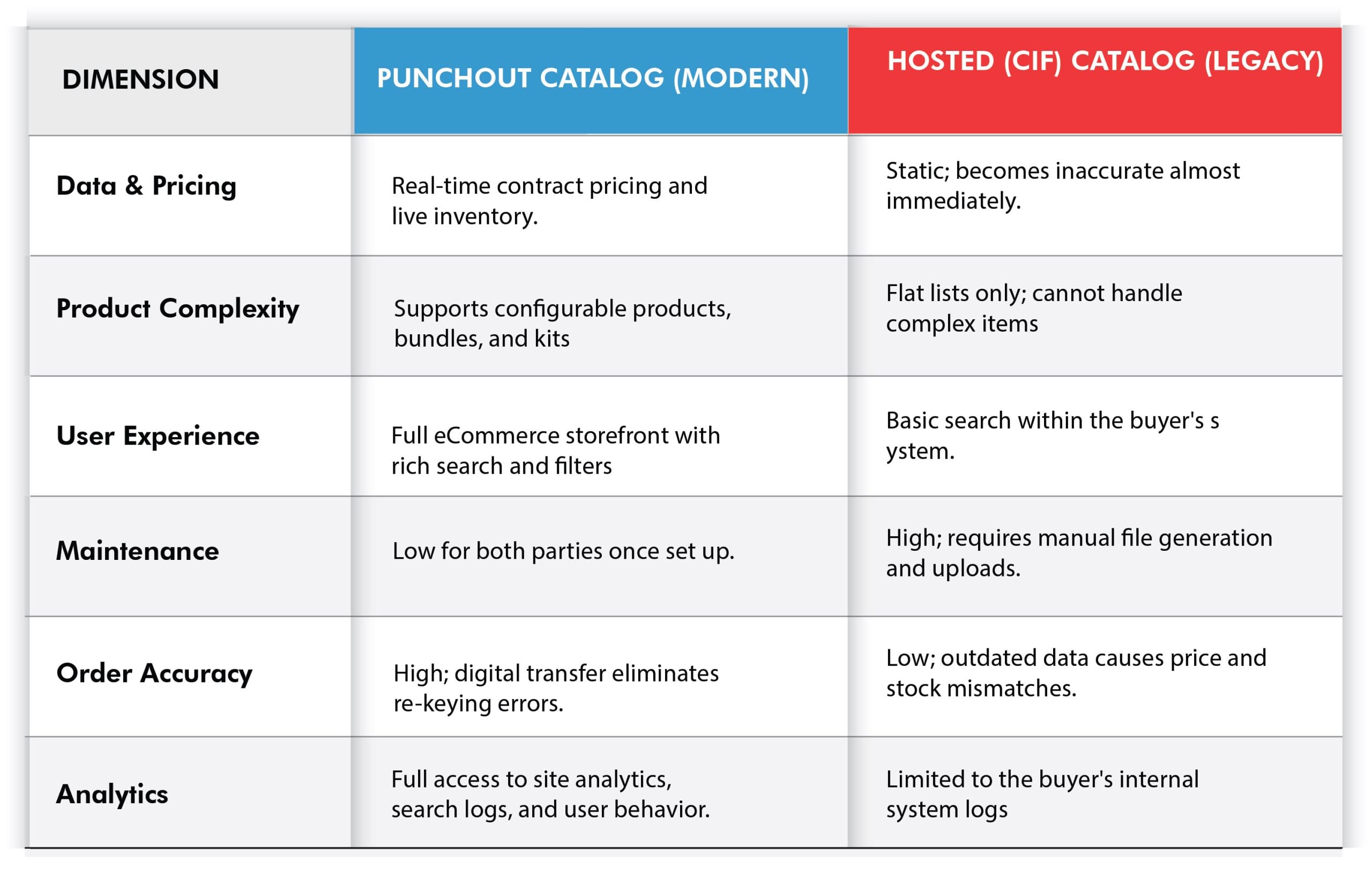
Head-to-Head: PunchOut vs. Hosted Catalogs
The choice between these technologies represents a choice between two different eras of B2B commerce.
Decision Matrix: When to Choose Which?
Use this simple matrix to guide your decision.
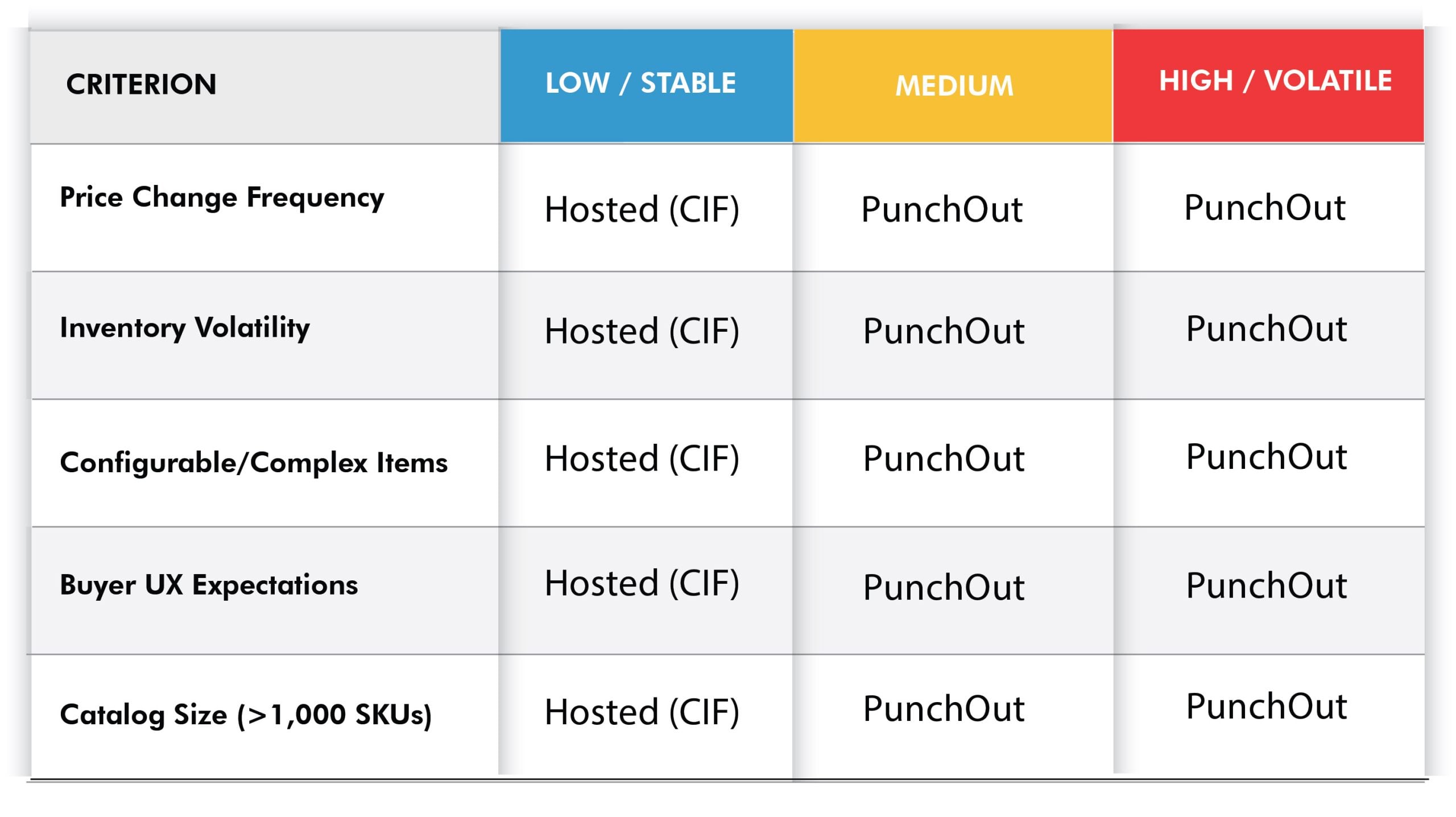
The Bottom Line: If multiple checks land in the “Medium” or “High” columns, PunchOut is the strategic choice for your business.

Pro Tips:
• Build a decision matrix that includes buyer size, procurement platform usage, and order volume.
A Special Focus: Considerations for VARs and IT Resellers
While the principles above apply to all B2B sellers, they are especially critical for Value-Added Resellers (VARs) and IT resellers. This sector faces a unique set of challenges that make hosted catalogs particularly ineffective.
1. Extreme Catalog Complexity
IT VARs often manage hundreds of thousands of SKUs with data feeds from over 50 different distributors. Prices and stock levels can fluctuate several times a day. A static CIF file is obsolete before it’s even fully uploaded.
2. Configurable Products
A core value proposition for VARs is selling complex, configurable solutions like custom servers, networking hardware, or software bundles. CIF catalogs cannot represent these Bills of Materials (BOMs), breaking the digital workflow.
3. Contract-Specific Pricing
VARs manage intricate pricing contracts for each enterprise or government client. PunchOut allows each buyer to log in and see their specific, negotiated catalog and pricing in real-time, ensuring 100% compliance.
For these reasons, PunchOut is not just an option for VARs-it is an operational necessity to serve enterprise clients effectively and compete for large-scale contracts.
Pro Tips:
• Consider hybrid strategies where hosted catalogs serve SME customers while PunchOut serves enterprise accounts.
Conclusion
The digital transformation of B2B commerce is here to stay. Your most valuable customers now require seamless, efficient, and compliant purchasing experiences that only direct eProcurement integration can provide.
The choice between the static, error-prone world of hosted catalogs and the dynamic, real-time power of PunchOut is a choice between stagnation and growth. Adopting PunchOut is a strategic investment in operational efficiency, customer loyalty, and your long-term competitive advantage. By aligning your business with the needs of modern buyers, you position yourself as a forward-thinking leader in the B2B marketplace.
Ready to turn buyer expectations into a competitive edge? VARStreet makes PunchOut integration, real-time pricing, and workflow automation straightforward and scalable.
Book a PunchOut Demo – See VARStreet in action with your use cases.
FAQs
What is the main difference between PunchOut and a hosted (CIF) catalog?
A PunchOut catalog provides a real-time connection to a supplier’s live eCommerce site, offering dynamic pricing, inventory, and a rich shopping experience. A hosted catalog is a static file uploaded into the buyer’s system, which quickly becomes outdated and cannot support complex products.
What are cXML and OCI?
cXML (commerce eXtensible Markup Language) and OCI (Open Catalog Interface) are the two primary communication protocols that allow a buyer’s procurement system to “talk” to a supplier’s eCommerce site during a PunchOut session. cXML is the most common standard, while OCI is primarily used for integrations with SAP systems.
How can we differentiate between Level 1 and Level 2 PunchOut?
Level 1 PunchOut is the standard process where a user clicks a link in their procurement system and is taken to the supplier’s eCommerce homepage. Level 2 PunchOut is a more advanced integration that allows users to search for supplier products from within their own procurement system’s search bar and then “punch out” directly to that specific product page on the supplier’s site, further streamlining the process.
Is PunchOut only for very large businesses?
While PunchOut is a firm requirement for most large enterprise and government buyers, the technology has become far more accessible, allowing small and mid-sized sellers to implement it to compete for and win these high-value contracts.
As a seller, do I need a large technical team to manage PunchOut?
No. When you partner with a full-service provider like VARStreet, their expert team handles all the heavy lifting. They manage the implementation, testing, and go-live process and provide ongoing support, acting as your technical arm throughout the entire lifecycle.
Does PunchOut support customer-specific pricing and contracts?
Absolutely. This is one of its greatest strengths. The PunchOut session is unique to each buyer, allowing you to display the specific product catalog and negotiated contract pricing that applies only to their account.
How does PunchOut improve order accuracy?
PunchOut eliminates manual data entry. The shopping cart is transferred digitally and automatically into a purchase requisition in the buyer’s system, removing the risk of human error from re-keying part numbers, quantities, or prices.
Can I have multiple PunchOut customers on a single eCommerce store?
Yes. A sophisticated platform like VARStreet is designed to support multiple PunchOut integrations on a single eCommerce storefront. Each customer can have a unique, personalized experience with their own specific catalog, pricing, and landing page based on their login credentials.
What is the ROI of implementing a PunchOut catalog?
The ROI is driven by several factors: significant reductions in order processing costs through automation; elimination of costs associated with fixing manual errors; increased revenue from winning and retaining large contracts that require PunchOut; and improved customer loyalty and lifetime value.
Is PunchOut secure?
Yes. The connection between the buyer’s procurement system and the supplier’s eCommerce site is established using secure internet protocols. Authentication is managed through a secure, single sign-on (SSO) process where credentials are validated and passed between the two trusted systems.
Pragya Bhardwaj
Pragya Bhardwaj is a seasoned B2B content writer with a strong background in SaaS and digital commerce. She specializes in creating clear, engaging, and search-optimized content that helps businesses connect with their audiences and build authority online. With experience across blogs, whitepapers, eBooks and website copy, Pragya brings both strategy and storytelling to every piece she writes. Editorial Policy
Read More