Table of Content
- Start With Reality: What Each System Is Actually Built For
- CRM: Owns the Relationship and the Sales Story
- CPQ: Owns the Offer, Pricing, and Quote
- Where VARStreet fits in the CPQ role?
- ERP: Owns Orders, Invoices, and Financial Reality
- PSA: Owns Delivery, Time, and Project Profitability
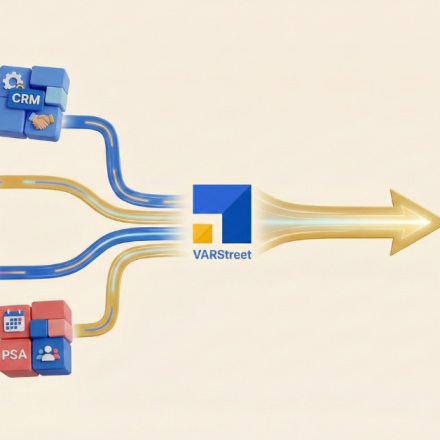
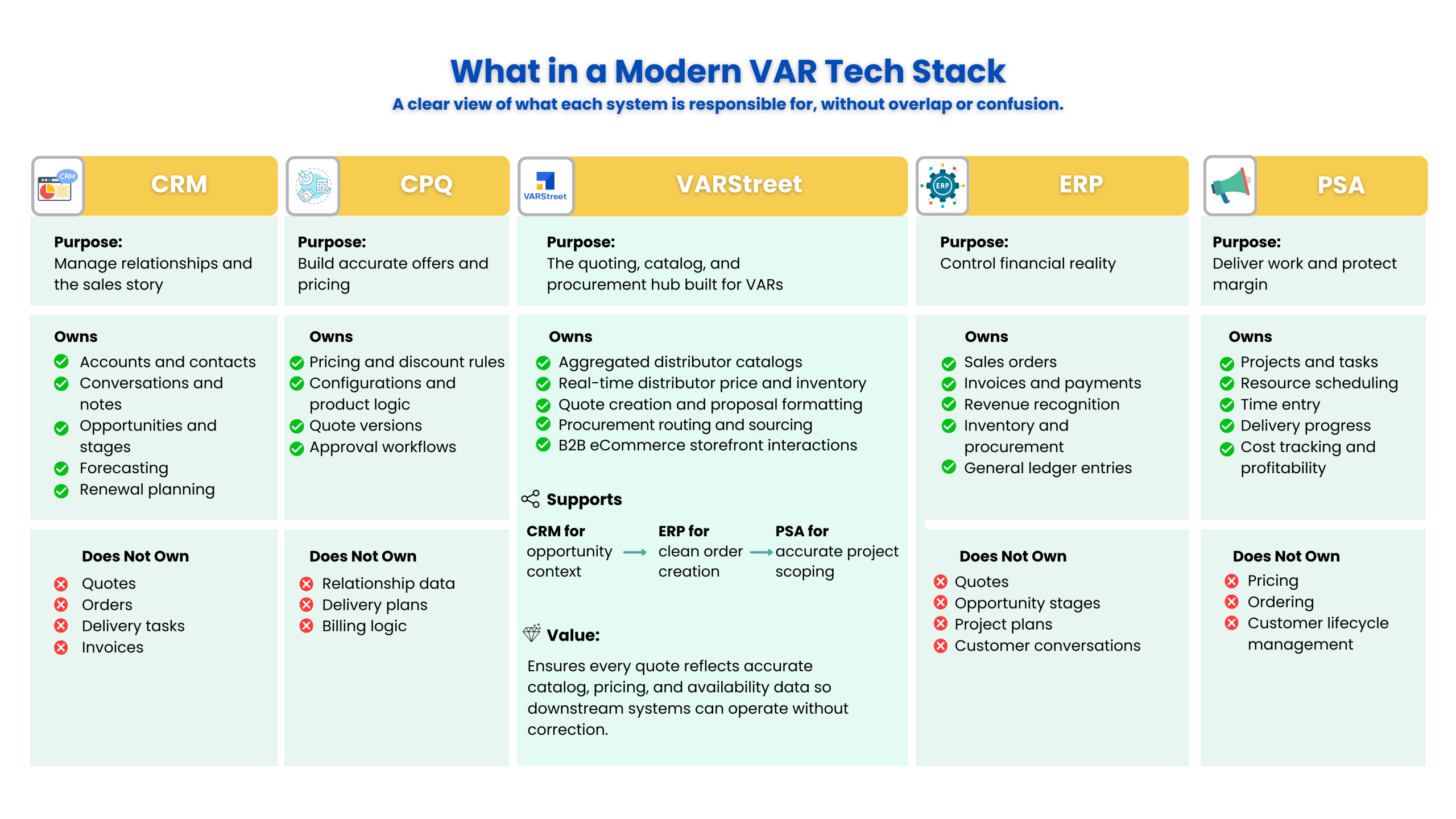
- How VARStreet Sits Between CRM, ERP, and PSA
- How to Reclaim Ownership Without Replacing Everything
- Final Thoughts
- FAQs
Pricing slips into CRM notes. Orders get edited directly in ERP. Delivery teams start projects from email threads instead of PSA. Quotes move in and out of spreadsheets even though a CPQ is in place. Each system presents a slightly different version of reality, and everyone spends time reconciling rather than selling or delivering.
The question underneath all this mess is very basic:
Who owns what?
Until that is answered, no amount of software, integration, or automation will fix the noise. This article breaks down ownership in practical terms, shows how CRM, ERP, PSA, and CPQ should work together, and explains where VARStreet fits into this stack for VARs and IT resellers.
Start With Reality: What Each System Is Actually Built For
Forget vendor jargon for a minute. A sensible approach to this topic is to examine what each system was designed to do.
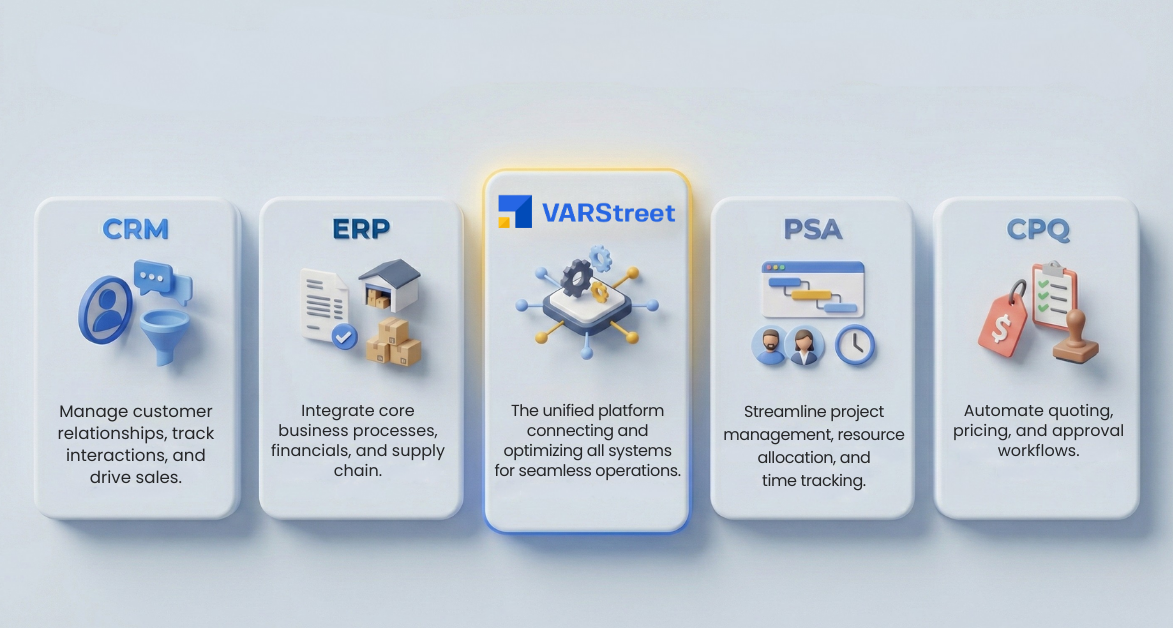
- CRM (Customer Relationship Management): The system for tracking people, accounts, conversations, and pipelines. It answers, “Who are we talking to, and where are we in the deal?”
- ERP (Enterprise Resource Planning): The system of record for orders, invoices, inventory, payments, and accounting. It answers, “What did we sell, ship, bill, and collect?”
- PSA (Professional Services Automation): The system for planning and delivering services or projects. It answers, “What work are we doing, who is doing it, and is it profitable?”
- CPQ (Configure Price Quote): The system for building accurate quotes, applying pricing rules, and managing approvals. It answers, “What exactly are we offering, at what price, and under which terms?”
- VARStreet: A unified business platform for VARs that brings together CPQ, eCommerce, CRM, aggregated distributor catalogs, and procurement in one place, and integrates with ERP, PSA, and accounting systems.
With those foundations cleared up, assigning ownership becomes easier.
CRM: Owns the Relationship and the Sales Story
CRM is where your sales and account teams live. If something helps you understand the customer or move a deal forward, it belongs here.
- Customer records: CRM holds accounts, contacts, and organizational details. This ensures that anyone can quickly see who the customer is, who the key decision-makers are, and how they are connected.
- Engagement history: Emails, meetings, call notes, and tasks live here. CRM gives a running log of everything that has happened to the customer so far.
- Pipeline and forecasting: Opportunities, stages, expected close dates, and forecast categories belong to CRM. It is the system that lets leadership understand what is likely to close and when.
- Renewals and account plans: Renewal dates, expansion ideas, and long-term account strategies are managed in CRM, so account managers have a clear plan of action.
- What CRM should not own: CRM should not own quotes, pricing logic, delivery status, invoices, or inventory. When those details creep in, the CRM becomes cluttered, and other systems receive incomplete or inconsistent information.
- Bottom line: CRM knows who you are selling to, why you are talking to them, and where the deal stands. It does not own what you sell or how it is billed.
CPQ: Owns the Offer, Pricing, and Quote
Once a customer says, “Show me numbers,” CRM is not enough. You need a structured way to build offers that are accurate, repeatable, and profitable. That is the job of a CPQ.
- Product and service configuration: The CPQ engine ensures only valid product and service combinations are sold. It enforces rules to prevent reps from creating impossible bundles or misconfigured solutions.
- Pricing and discount rules: List prices, contract prices, tiered discounts, and margin rules live in CPQ. This centralizes control and prevents everyone from inventing their own pricing in spreadsheets.
- Quote generation: CPQ generates professional quotes with clear line items, descriptions, and terms. It also tracks versions, so there is no confusion about which quote the customer accepted.
- Approval workflows: Requests for special pricing or lower margins can be routed for approval within CPQ, rather than handled informally via email or chat.
Where VARStreet fits in the CPQ role?
VARStreet acts as the CPQ and quoting hub specifically built for VARs. It combines:
- Aggregated distributor catalog and rich content
- Real-time distributor price and inventory
- Quoting and proposal generation
- B2B, B2C, and B2G eCommerce
- Sourcing and procurement automation
- Built-in CRM or integration with leading CRMs
VARStreet becomes the place where catalog, pricing, and quoting live. CRM stays focused on relationships. ERP stays focused on orders and finance. PSA stays focused on delivery.
Bottom line: CPQ, powered by VARStreet in a VAR environment, owns what you sell, how you configure it, and at what price.
ERP: Owns Orders, Invoices, and Financial Reality
Once the customer signs, the offer becomes a commitment. At that point, ERP takes the lead.
- Order creation and fulfillment: ERP converts approved quotes into sales orders. It applies tax rules, shipping logic, inventory allocations, and fulfillment steps. This is where the deal becomes something the business is legally and financially accountable for.
- Invoicing and payments: ERP issues invoices, records payments, manages credit notes, and handles collections. It tracks who owes what and when.
- Inventory and procurement: For product-based sales, ERP manages warehouse stock levels, purchase orders, and receipts. This ensures the business can fulfill its promises.
- Revenue recognition and accounting: ERP posts entries to the general ledger, handles revenue schedules, and supports audits. It is the system that finance trusts most.
- What ERP should not own: ERP should not own pipeline, quote logic, or project tasks. It consumes data from those systems to produce accurate orders and invoices.
- Bottom line: ERP owns what has been sold, how it is fulfilled, and how it appears in the books.
PSA: Owns Delivery, Time, and Project Profitability
If you sell services, managed contracts, or complex projects, a PSA platform is critical to delivering them cleanly.
- Project planning: PSA breaks work into projects, phases, tasks, and milestones. It gives a clear map of how delivery will happen.
- Resource scheduling: PSA assigns engineers, consultants, or technicians to work. It helps avoid overbooking and underutilization.
- Time and expense tracking: PSA captures billable and non-billable time and project-related expenses. These feed billing and margin reporting.
- Delivery status and reporting: PSA provides visibility into project health, progress against plan, and actual cost versus estimate.
- What PSA should not own: PSA should not be used to store quotes, manage pricing, or handle invoicing logic. It sends delivery data to ERP and renewal signals to CRM.
- Bottom line: PSA owns the work after the deal is signed: who is doing what, how long it takes, and whether it is profitable.
How VARStreet Sits Between CRM, ERP, and PSA
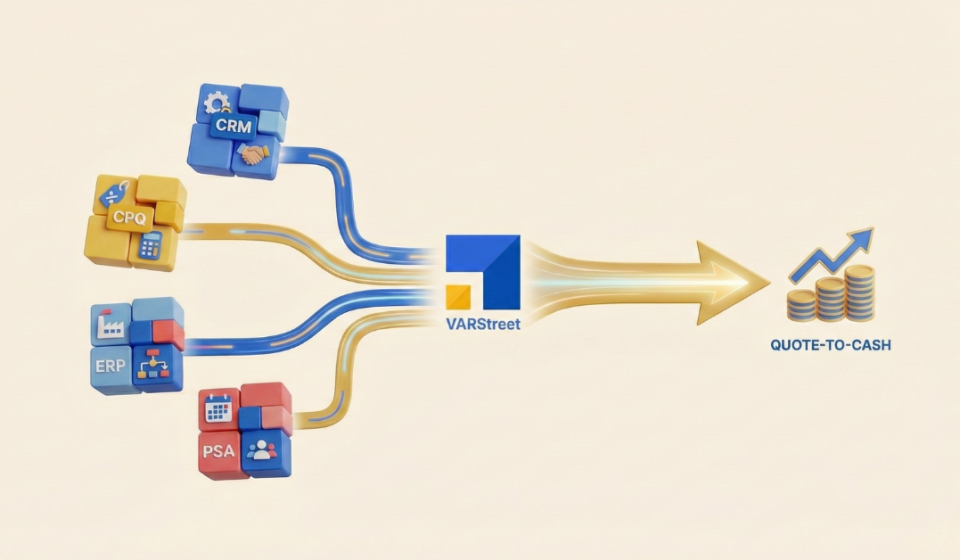
In a mature VAR setup, the flow looks like this:
Lead and opportunity in CRM
The customer record, stakeholders, and needs are captured in CRM. The opportunity is qualified, and scope discussions begin.
Quote in VARStreet
When it is time to present pricing, the sales team moves into VARStreet. They pull live distributor pricing, configure products and services, and generate a formal quote that references the CRM opportunity.
Approved quote to ERP
Once the customer approves, VARStreet pushes the confirmed quote into the ERP as a sales order. Order and financial logic remain within the ERP.
Service work into PSA
If the deal includes services, scope elements feed into the PSA, so projects and tasks can be created without retyping everything.
Billing from ERP, delivery updates from PSA
ERP handles invoices and payments. PSA tracks time, cost, and project progress.
Renewals and upsell opportunities in CRM
CRM pulls in order and delivery history, so account managers can plan renewals and expansion with a complete picture.
VARStreet does not replace CRM, ERP, or PSA. It makes their jobs easier by centralizing catalog, pricing, and quoting for VARs, then integrating tightly with existing systems.
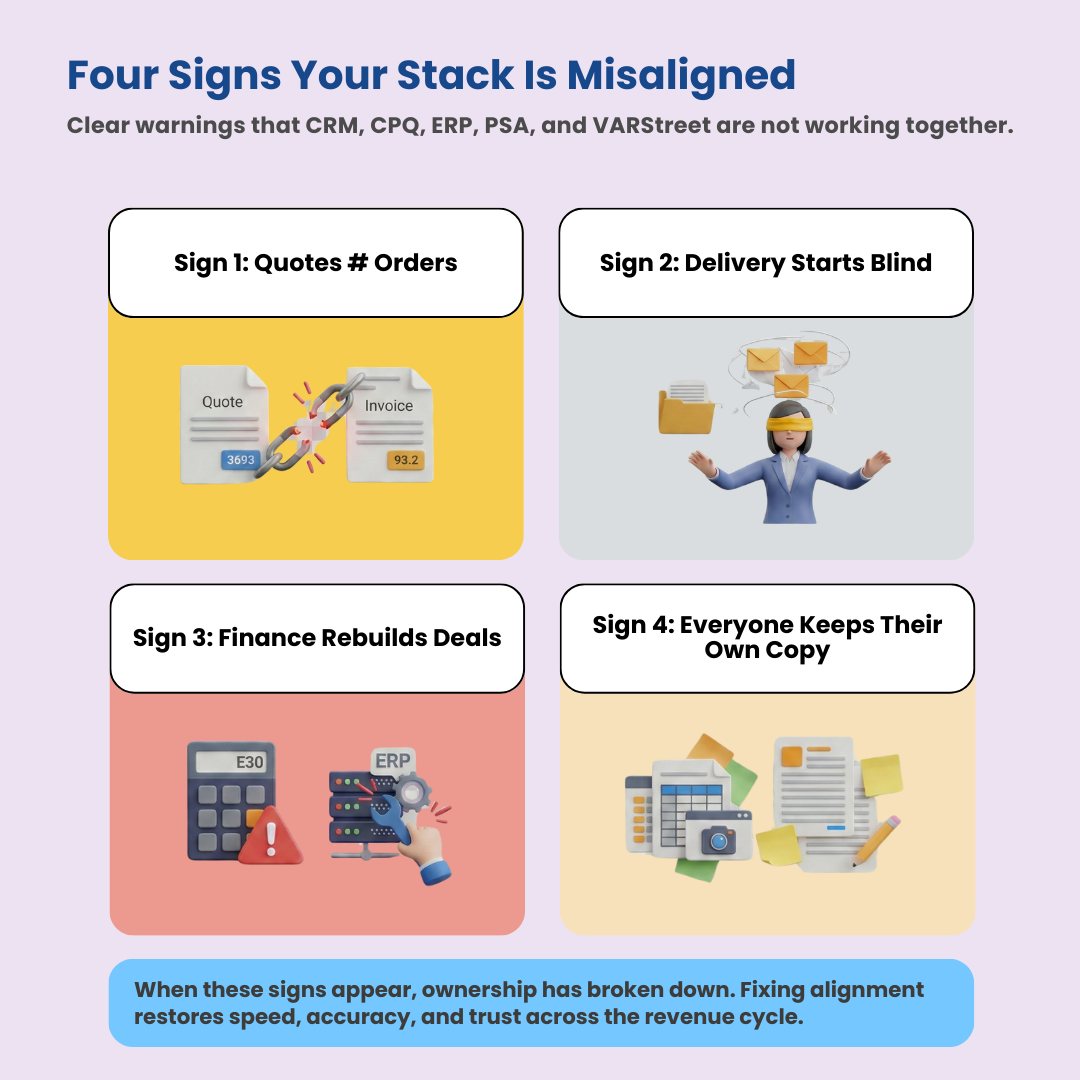
How to Reclaim Ownership Without Replacing Everything
You do not need to rip out your stack to fix ownership. You need to redraw the lines.
- Clarify the primary purpose of each system: Write down on one page what CRM, ERP, PSA, CPQ, or VARStreet is responsible for. Share it with sales, delivery, finance, and management.
- Move key workflows into the right system: If quotes live in CRM fields or spreadsheets, move them into VARStreet. If project tracking sits in Excel, move it into PSA. If invoices are being drafted outside the ERP, move them into the ERP.
- Use integration for handoffs, not duplication: Connect VARStreet to your CRM, ERP, and PSA so data flows at the right time in the right direction, without forcing every system to mirror every detail.
- Train teams on “where things live”: Sales should know that CRM is for relationships, and VARStreet is for quotes. Finance should know that ERP is the only system for finalizing invoices. Delivery should know that PSA is the only place to track work.
Over time, this restores trust in each system and reduces the need for manual checks.
Final Thoughts
Most VARs and IT resellers do not struggle because they lack tools. They struggle because their tools are doing jobs they were not meant to do. Clear ownership across CRM, CPQ or VARStreet, ERP, and PSA turns a noisy tech stack into a predictable revenue engine.
If your quoting, catalog, and ordering workflows feel heavier than they should, it is usually a sign that the CPQ role is not clearly defined. VARStreet gives VARs a purpose-built quoting and eCommerce hub that cleanly sits between CRM, ERP, and PSA, so each system can finally own what it does best.
If you want to bring order back to your quote-to-cash process, start by deciding who owns what, and then let VARStreet do the heavy lifting for catalogs, pricing, and quotes.