Table of Content
- Understanding the True Cost of Manual Quoting
- Where ROI Begins: The Four Value Pillars of Quoting Software
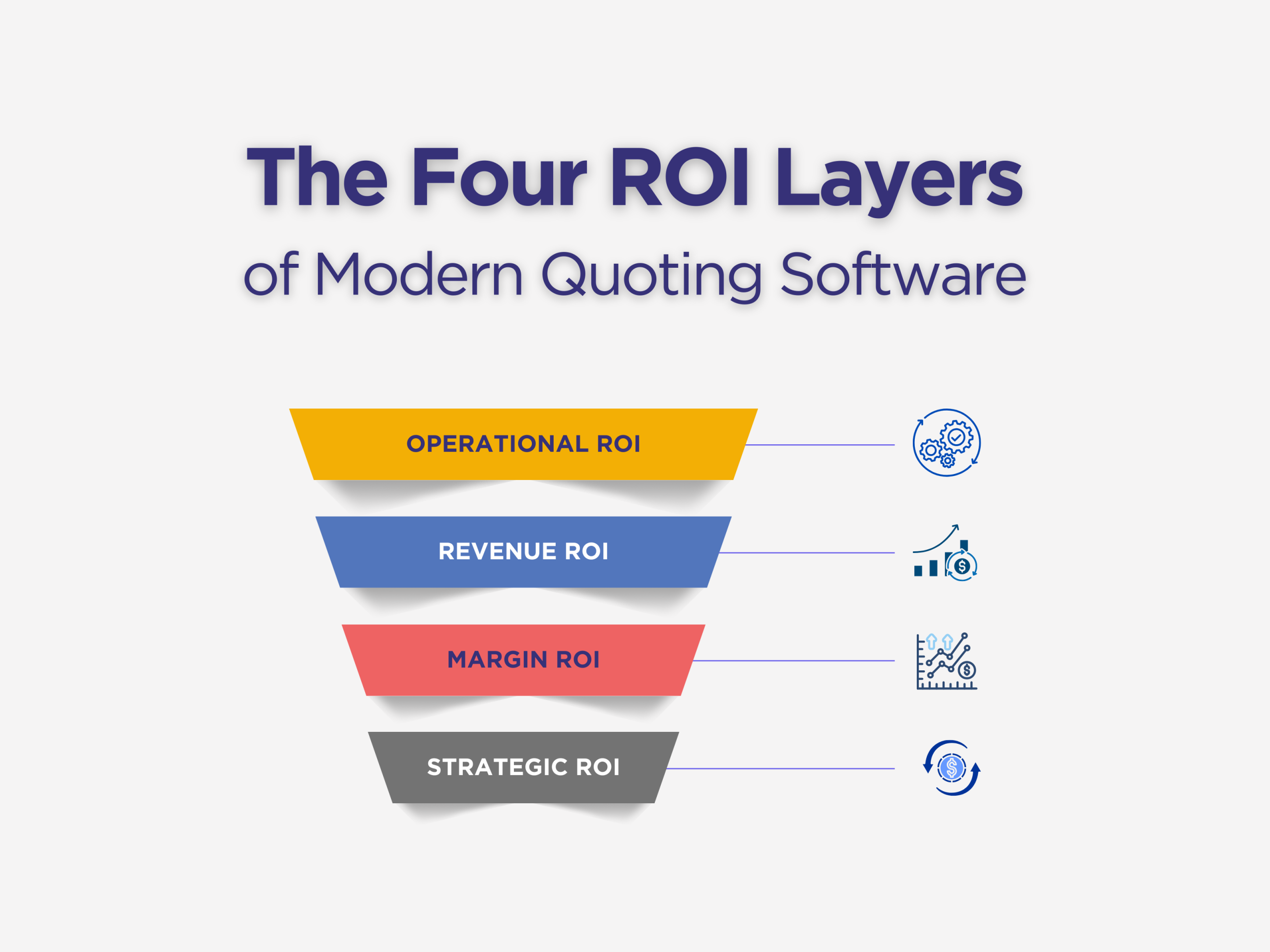
- Operational ROI: How Quoting Software Reduces Internal Cost
- Revenue ROI: How Quoting Software Directly Increases Sales
- Margin ROI: How Quoting Software Protects Every Deal
- Strategic ROI: Visibility, Forecasting, and Leadership Decisions
- How to Calculate the ROI of Quoting Software
- What Great ROI Looks Like in Practice
- How Quoting Software Supports VARs and IT Resellers
- ROI Comes From Doing the Work, Manual Quoting Cannot Do
- FAQs

Quoting software is not just a tool for assembling prices and products. It is a system that affects speed, accuracy, margin, and workflow quality across the business. A fast and accurate quote creates confidence, reduces friction, and increases your chance of winning. A slow or inaccurate quote does the opposite. It frustrates the customer, weakens trust, and gives competitors more time to respond.
This article breaks down the real return on investment behind quoting software. Instead of focusing on features, we focus on outcomes. You will see how speed turns into revenue, how accuracy protects margin, how automation reduces internal cost, and how structure strengthens forecasting and leadership decisions. By the end, you will have a clear understanding of where the ROI comes from and how to measure it.
Understanding the True Cost of Manual Quoting
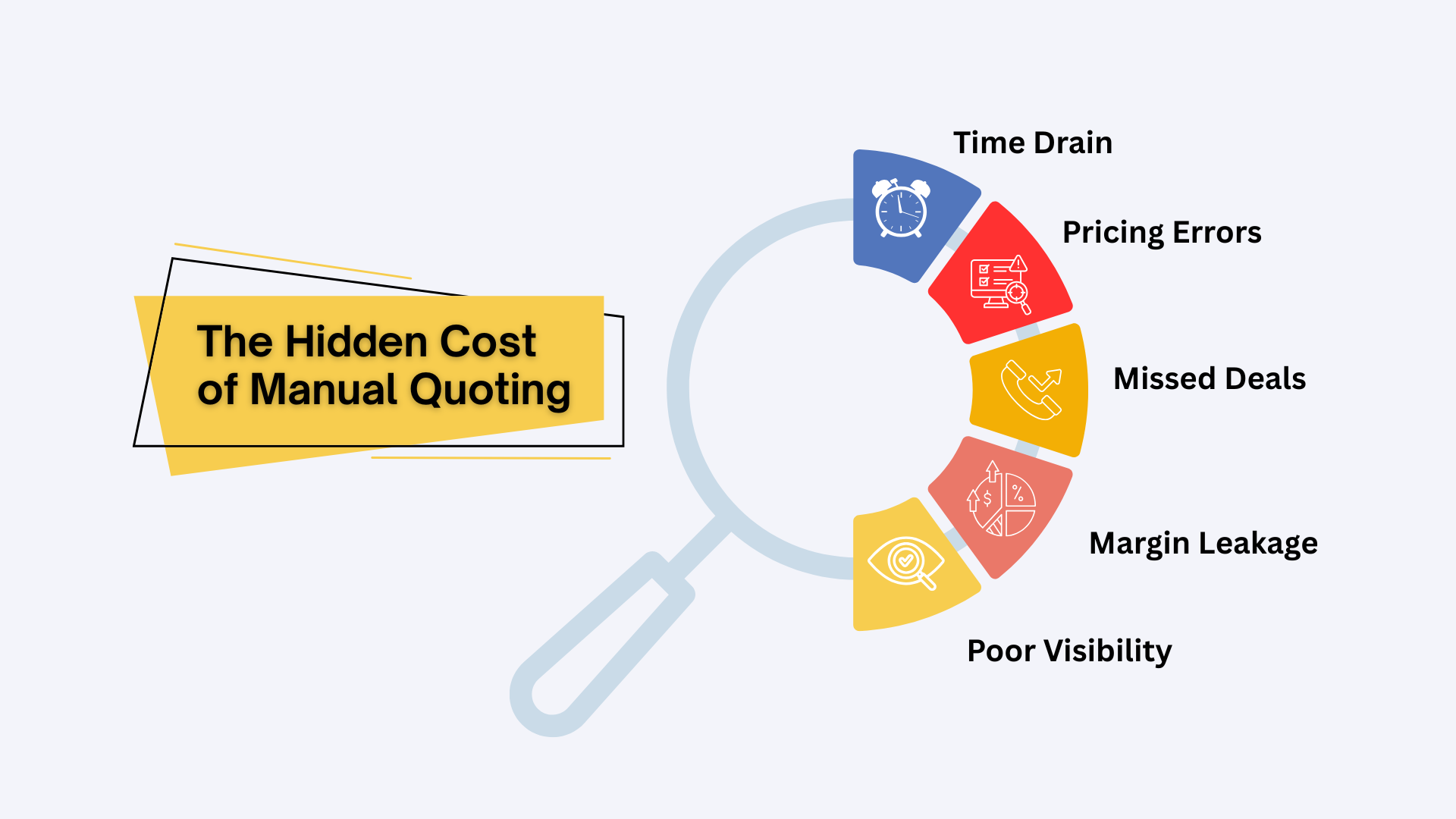
Most businesses underestimate how expensive manual quoting actually is. The cost does not show up on a single invoice. It appears in lost time, lost deals, lost accuracy, and lost margin across the entire sales cycle. These losses are real, but they are often invisible because they are buried inside everyday workflow habits.
The Hidden Expenses Behind Spreadsheets and Emails
When quotes are created manually, every step takes longer than it should. Reps spend time searching for updated pricing, checking distributor sites, confirming product compatibility, and formatting documents. They often switch between CRM, email, pricing files, and procurement systems just to complete a single quote.
Manual quoting also creates inconsistencies. Two reps may present the same product differently. Prices may be outdated. Discounts may be incorrect. Small mistakes often slip through, which leads to rework and backtracking. Even worse, customers feel the impact. When quotes take too long, they start exploring alternatives. When quotes contain errors, they cast doubt on the vendor’s reliability.
Why These Costs Go Unnoticed
Leaders rarely see how long quoting actually takes because the work is scattered across people and tools. No single step looks expensive, but the combined effort creates a significant operational burden. A rep who spends one hour per quote may not sound like an issue, but multiplied across dozens of quotes per week and several reps per team, the cost becomes substantial. The real cost is time that could have been spent selling or nurturing opportunities.
This is the starting point for ROI. Before automation can create value, you must understand how much value is already being lost.
Where ROI Begins: The Four Value Pillars of Quoting Software
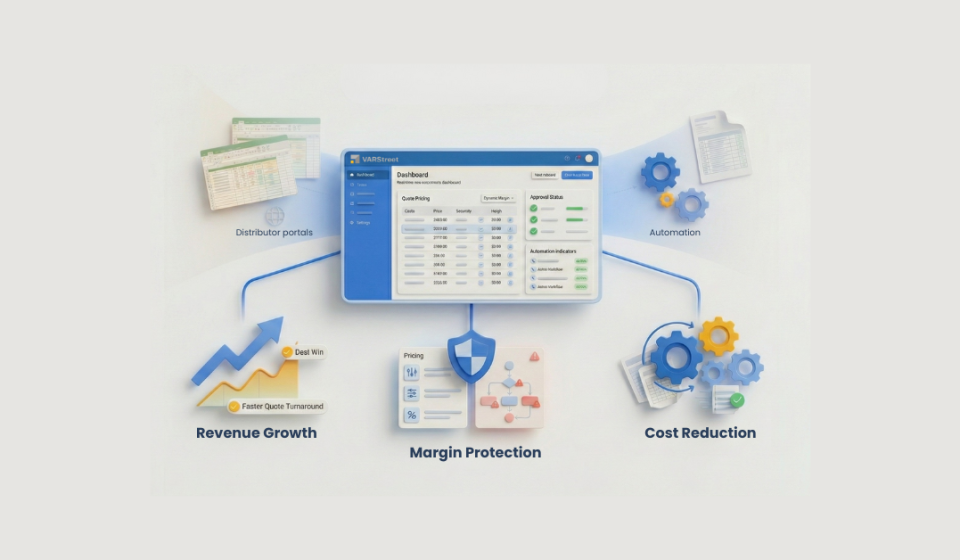
To understand the return on quoting software, think of it as an engine that supports four core pillars. These pillars work together to increase speed, reduce mistakes, protect margin, and improve workflow quality. The ROI becomes clear when you measure how much each pillar contributes to revenue and cost reduction.
Pillar 1: Speed to Quote
Speed is one of the strongest predictors of sales success. Customers who receive quotes quickly tend to stay engaged. They are less likely to shop around, less likely to lose interest, and more likely to trust the vendor who responded first. Quoting software accelerates the entire process by pulling in real-time pricing, automatically generating configured quotes, and enabling sales teams to respond in minutes rather than hours or days.
Pillar 2: Accuracy and Error Reduction
Manual quoting relies on human judgment, memory, and attention to detail. Even the best reps make mistakes when they are pressed for time or juggling multiple tasks. Quoting software removes most of these risks by using structured pricing, validated SKUs, and automated configurations. Accuracy is not only about avoiding errors. It is about preventing rework, reducing customer frustration, and maintaining credibility during the sales cycle.
Pillar 3: Margin Protection
Margin leakage is one of the most expensive hidden costs in sales. Incorrect discounts, outdated pricing, or inconsistent approval rules can reduce profitability without anyone noticing. Quoting software safeguards margin by applying pricing rules consistently, enforcing approval workflows, and using current distributor pricing. When margin protection happens automatically, leaders do not need to chase mistakes or correct quotes after the fact.
Pillar 4: Workflow Efficiency
The quoting process does not exist in isolation. It connects to CRM, procurement, order management, and billing. When reps build quotes manually, the information has to be reentered multiple times across different systems. This increases administrative load and creates opportunities for mistakes. Quoting software eliminates duplication by connecting the quote to the rest of the workflow. A single quote becomes the source of truth for the entire transaction.
Operational ROI: How Quoting Software Reduces Internal Cost
Quoting software does not just make sales teams faster; it also improves customer satisfaction. It removes layers of internal work that quietly increase operational expenses. When you replace manual steps with automation, you reduce the time people spend correcting errors, validating pricing, searching for information, or retyping data across different systems.
Reduced Sales Labor
Sales teams should spend their time creating opportunities, nurturing relationships, and closing deals. In reality, many spend a large portion of the day building quotes, formatting documents, checking pricing, and waiting for approvals. Quoting software shortens every one of these steps. Reps can generate quotes quickly and consistently, allowing them to focus on higher-value activities that directly impact revenue.
Reduced Administrative Load
Sales coordinators, operations teams, and finance departments spend significant time reviewing quotes to ensure accuracy. They cross-check pricing, verify margins, and look for missing information. Automation reduces this burden by generating quotes that already meet internal standards. Teams spend less time correcting mistakes and more time supporting customers.
Reduced Procurement Overhead
Procurement teams often face challenges when quotes do not match available stock or pricing. Quoting software aligns quotes with current distributor data, reducing disputes, clarifications, and manual adjustments. A clean quote leads to a clean purchase order, which leads to clean fulfillment.
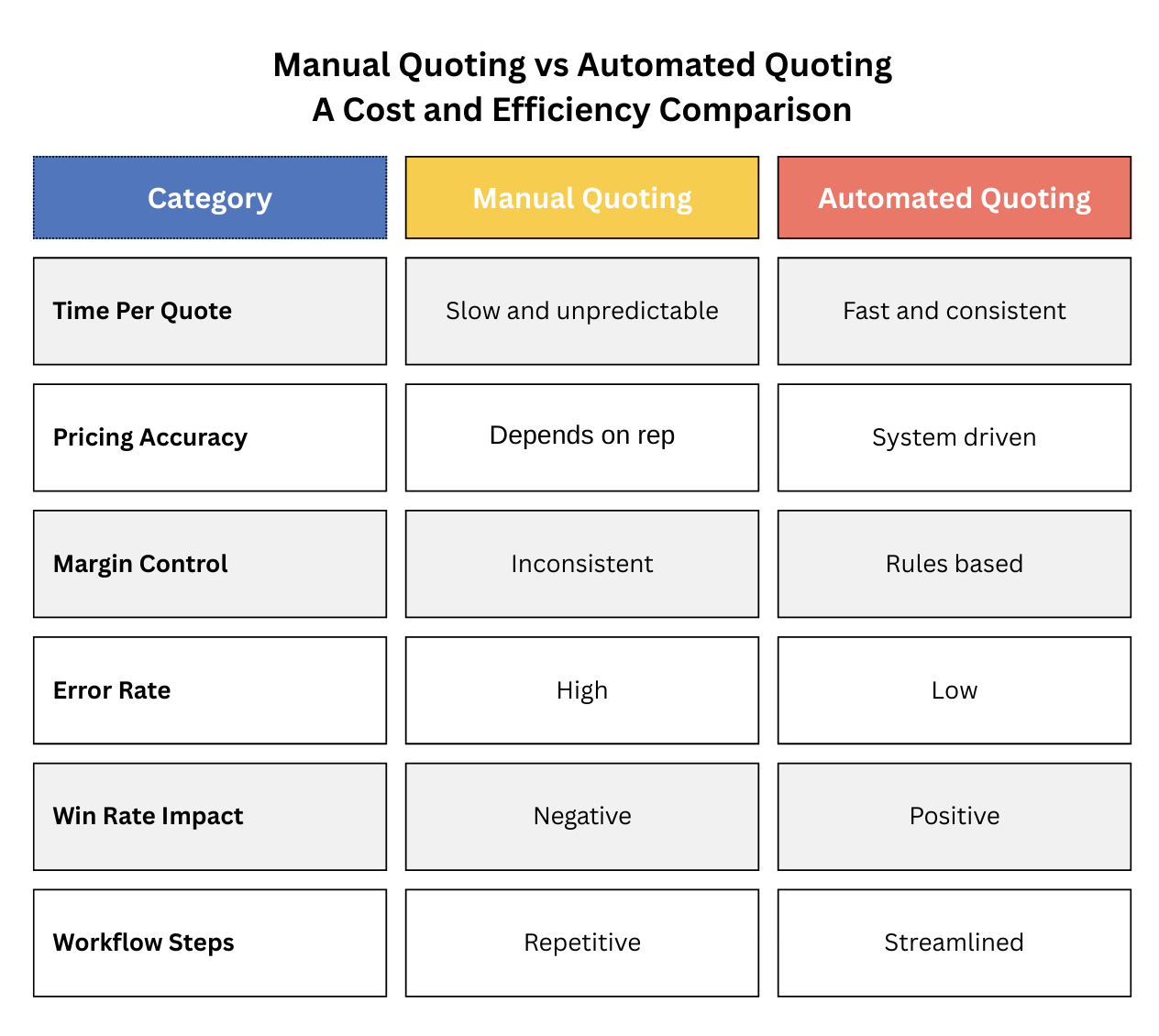
This comparison highlights what most teams already feel. Manual quoting is expensive. Automated quoting is precise and predictable.
Revenue ROI: How Quoting Software Directly Increases Sales
A quote is not just a document. It is the moment where interest becomes commitment. The faster and clearer that moment is, the more revenue you generate.
Higher Win Rates
Speed matters. When a customer requests pricing, they are evaluating the urgency, responsiveness, and professionalism of the company. A quick turnaround creates momentum. A slow turnaround gives competitors an opening. Quoting software shortens response times, which increases your chances of winning the deal.
Higher Deal Velocity
Manual quoting slows down the entire cycle. Customers wait longer. Approvals take longer. Revisions take longer. Automated quoting simplifies revisions, eliminates formatting issues, and provides a smoother customer experience. Faster cycles mean more opportunities are closed in the same period.
Higher Customer Confidence
Professional, branded, consistent quotes improve your company’s perception. Customers feel more confident when they receive a clear and accurate quote with no confusing details. Confidence reduces friction. Reduced friction leads to faster decisions.
Margin ROI: How Quoting Software Protects Every Deal
Lost margin is one of the most damaging hidden costs in sales. It rarely shows up in a single report, but it manifests as incorrect discounts, outdated pricing, or inconsistent approvals.
Consistent Pricing Logic
With quoting software, every quote uses the same pricing rules. This prevents reps from underpricing deals without realizing it. It also ensures that discounts comply with policy and that approval requirements are consistently met.
Better Upsell and Cross-Sell Visibility
When quotes are built manually, reps often forget to include accessories, warranties, or high-value add-ons. Automated quoting tools can surface recommended bundles or complementary items, increasing average deal size without adding pressure.
Error Prevention Equals Margin Protection
A single pricing mistake can wipe out the profitability of an entire deal. Automation eliminates most of these risks. You protect the margin by preventing the error before it happens, not by correcting it after it reaches the customer.
Strategic ROI: Visibility, Forecasting, and Leadership Decisions
Quoting software creates structured data that leaders can use to drive better decisions. Manual quotes live in inboxes and spreadsheets. Automated quotes live in systems that can be analyzed, tracked, and improved.
Better Sales Forecasting
With structured quote data, leaders can see which deals are active, which quotes are pending, and which quotes are aging. Forecasts become more accurate because they are based on actual activity rather than assumptions.
Better Reporting
Quoting software helps identify trends, such as common error points, frequently discounted products, or misaligned pricing patterns. Leaders gain visibility into both performance and risk.
Better Alignment Across Teams
When sales, operations, and finance share a single source of truth for quoting, communication improves. Teams no longer operate in silos. Everyone works from the same information, reducing confusion and keeping the business running smoothly.
How to Calculate the ROI of Quoting Software
The ROI becomes even clearer when you measure it. The calculation is straightforward when broken down into components.
Step 1: Measure Current Time and Labor Cost
Calculate the average time spent creating quotes manually. Multiply by the number of quotes created per month. Include time spent checking accuracy or requesting approvals.
Step 2: Measure Win Rate Before and After Adoption
Track how long it takes to get quotes today and how many opportunities stall or go silent. Faster quotes usually lead to higher conversion.
Step 3: Track Margin Errors or Rework Saved
Identify how often quotes need correction. Estimate the revenue impact of discount errors or outdated pricing.
Step 4: Evaluate Sales Cycle Improvements
Shorter cycles increase overall revenue capacity. Track how long deals take to close before and after automation.
Step 5: Project Annual Savings and Gains
Add together labor saved, margin protected, deals won, and revenue accelerated. The combined outcome is your ROI.