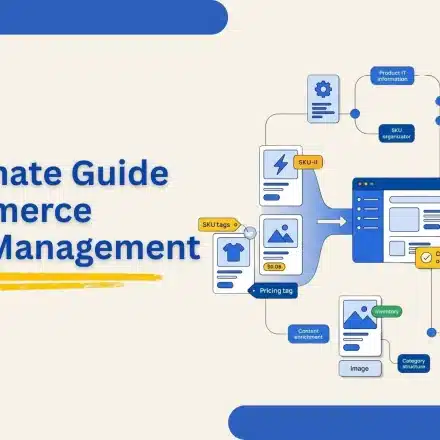
The Ultimate Guide to eCommerce Catalog Management
Table of Content
Most growing B2B sellers are running the same catalog. Product data is spread across shared drives and spreadsheets. A storefront admin holding a different version again. It works, barely. Then something breaks. A bulk update takes the storefront down. A price is wrong on three channels at the same time. A spec sheet a customer just downloaded is two versions old.
The spreadsheets are not the disease. They are symptoms. Somewhere between a few hundred SKUs and a few thousand, product data stops being a list you maintain and becomes a system you operate.
At that scale, the real problem is rarely the platform. It is governance. GS1, the global body behind the barcode standard, makes the same point: fragmented, inconsistent product data drives up cost and erodes buyer trust. That is the reframe this guide is built on. eCommerce catalog management is not a bigger spreadsheet or a prettier storefront. It is the discipline of running product data as operational infrastructure.
Key Takeaways:
- eCommerce catalog management is not data entry. It is the operational system connecting product data, search, customer experience and sales into one controllable layer.
- The platform is rarely the real problem. Governance is. Catalogs break from missing rules, not missing software. The spreadsheets are not the disease. They are the symptom.
- A catalog that works holds five properties at once: centralized, clean, complete, categorized and compliant. Missing any one of them does not produce a smaller catalog. It produces a slower sale.
- Spreadsheets suit a few hundred SKUs. Past a few thousand across multiple suppliers, maintaining them stops being data management and becomes damage control.
- For B2B sellers managing tens of thousands of SKUs across many suppliers, catalog management software turns multi-feed chaos into a single source of truth. That single source is what every downstream process depends on.
What eCommerce Catalog Management Actually Is
eCommerce catalog management is the practice of creating, organizing, enriching and maintaining all your product information in one central system, then distributing it accurately to every channel that needs it. The storefront is what the customer sees. The eCommerce product catalog is the layer underneath that decides whether what they see is correct.
For a B2B seller, that layer carries weight a consumer store never does. Product catalog management at scale means handling data from dozens of suppliers, each with its own format, its own pricing structure and its own update schedule, then turning all of it into one catalog a buyer can actually trust.
Most teams start in spreadsheets. That is fine, until it is not. You have outgrown spreadsheets when:
- Product data lives in more than a few places and no one is sure which copy is current.
- A bulk update breaks something downstream every time you run one.
- You cannot tell which version of an image or a spec sheet is the live one.
- The same product arrives from two suppliers and shows up twice, described differently.
- Adding a sales channel means re-keying the catalog by hand.
If three of those are true, you are no longer doing catalog management. You are doing damage control. Here is the difference a real system makes:
| Dimension | Spreadsheets | Catalog management software |
|---|---|---|
| Source of truth | Many files, no one is sure which is current | One master record, versioned and controlled |
| Bulk updates | One wrong cell breaks a category | Rule-based, applied through product families |
| Supplier feeds | Re-keyed and reconciled by hand | Ingested and normalized automatically |
| New sales channel | Catalog re-entered by hand | Published from one source to many |
| Practical ceiling | A few hundred SKUs | Tens of thousands across many suppliers |
Start here: Count how many separate places your product data lives right now: spreadsheets, drives, the storefront admin, supplier emails. That number is your diagnosis.
What Makes Catalog Management Different for IT Resellers?
IT resellers and MSPs face catalog management challenges that most B2B businesses never encounter. Instead of managing a few thousand products from a limited supplier base, they often work with hundreds of thousands of technology SKUs sourced from multiple distributors. Product availability, pricing, specifications, warranties, and lifecycle information can change frequently, making accuracy critical. A catalog management system for IT resellers must not only centralize product data but also normalize distributor feeds, maintain consistent product records, and support customer-specific pricing. Without these controls, quoting errors, inventory mismatches, and margin loss become difficult to avoid.
The 5 C’s of a Catalog That Works

1. Centralized
2. Clean
3. Complete
4. Categorized
5. Compliant
Where Catalog Management Breaks and How to Fix Each One
1. The multi-feed mess
2. Bulk updates that break things
3. Digital assets scattered everywhere
4. The wrong tool for the job
5. No single source of truth
How VARStreet Helps With Catalog Management
One of our product leads, Emma Wilson, puts it plainly:
“Most catalog problems are not data-entry problems. They are governance problems. Set the rules once, automate the feeds, and the catalog mostly maintains itself.”

FAQs
What makes catalog management different for IT resellers?
IT resellers manage large, frequently changing catalogs sourced from multiple distributors.
How can IT resellers keep pricing and inventory data accurate?
Automated distributor integrations help synchronize pricing, availability, and product information across catalogs and sales channels.
What is catalog normalization?
Catalog normalization is the process of standardizing product data from multiple suppliers into a consistent format for easier management and selling.
How do VARs manage large product catalogs?
Many VARs use catalog management platforms that automate product updates, enrich product content, and centralize catalog governance.
What are the key features of catalog management software?
Key features include centralized product data, automated supplier feed management, bulk updates, rich content support, categorization, and compliance tracking, making automation and data accuracy critical.
Pragya Bhardwaj
Pragya Bhardwaj is a seasoned B2B content writer with a strong background in SaaS and digital commerce. She specializes in creating clear, engaging, and search-optimized content that helps businesses connect with their audiences and build authority online. With experience across blogs, whitepapers, eBooks and website copy, Pragya brings both strategy and storytelling to every piece she writes. Editorial Policy
Read More