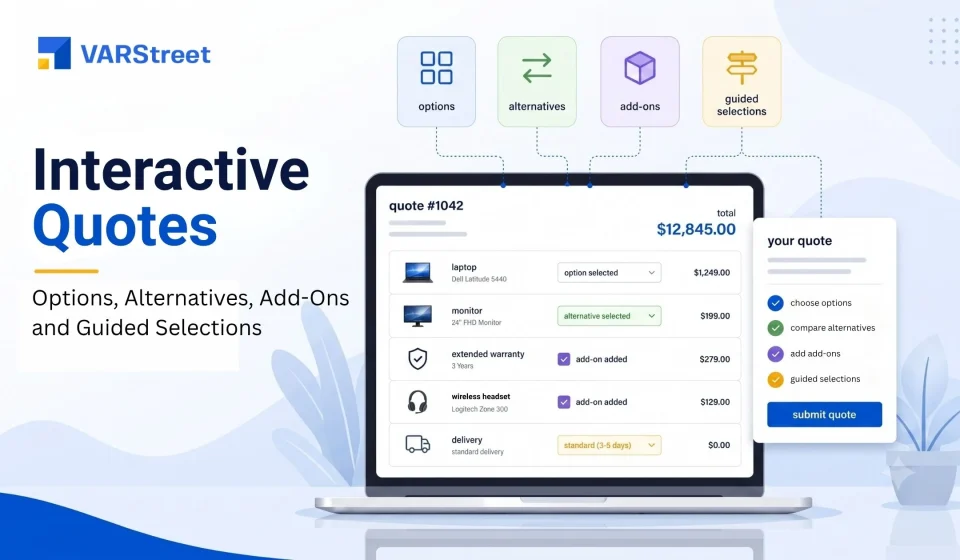
Interactive Quotes: Options, Alternatives, Add-Ons, and Guided Selections

Table of Content
- Why Static Quotes Break Down for IT VARs
- Structure Interactive Quotes Around Four Types of Buyer Choices
- How to Protect Pricing and Margins in Configurable Quotes
- Connect Interactive Quotes to Distributor Data and Procurement
- Use Bundles and Add-Ons to Package IT Solutions
- Interactive Quote Checklist for VARs
- How VARStreet Supports Configurable Quotes
- Conclusion: Make Interactive Quotes Easier to Buy From
- FAQs About Interactive Quotes
Want to make complex quotes easier for customers to evaluate? See how VARStreet helps IT resellers manage products, pricing, bundles, and quoting in one platform. Book a demo to see it in action.
Why Static Quotes Break Down for IT VARs
The problem with a static quote is not the document itself. It is what happens when the buyer wants to change something.
A typical VAR quote might start with a laptop, monitor, and warranty. The customer then asks for a higher-spec laptop for five users, an alternative warranty, and installation for the full deployment. Each change can send the sales rep back to the quote, distributor catalog, pricing rules, and spreadsheet.
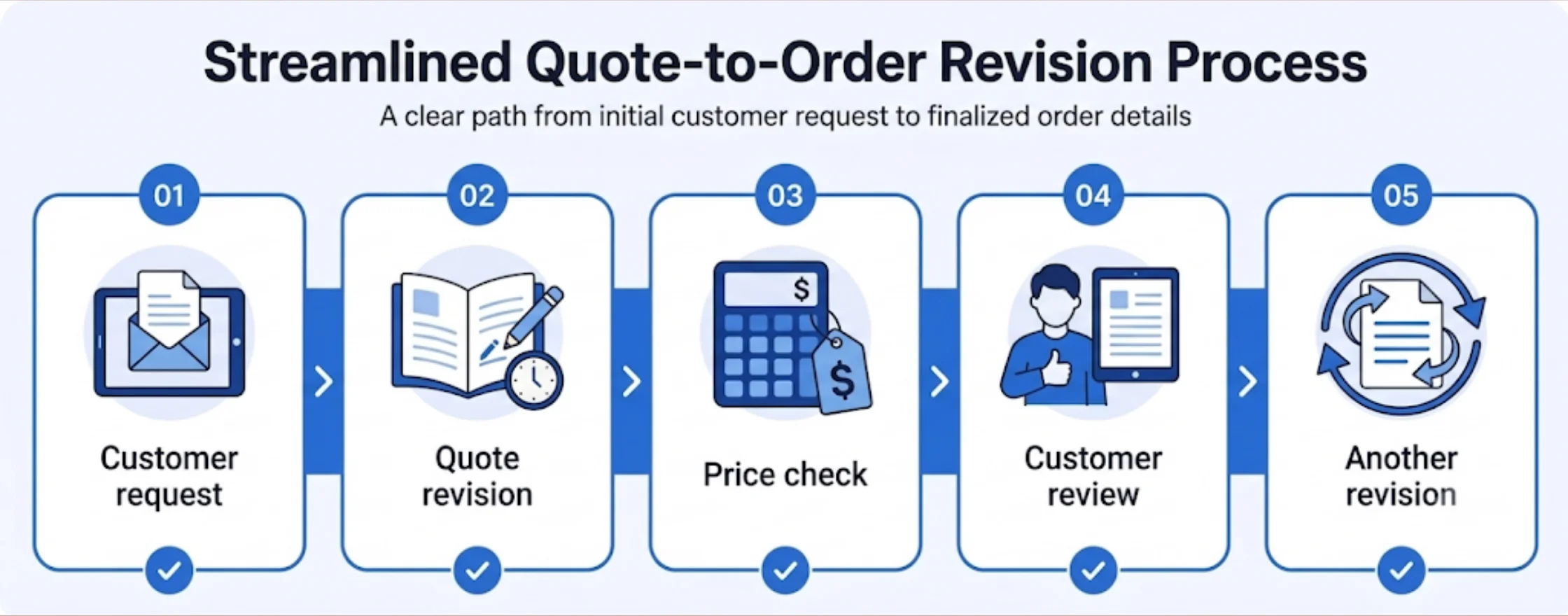
That creates a familiar cycle:
Customer request → Quote revision → Price check → Customer review → Another revision
The friction matters because B2B buyers now have to move across multiple channels during a purchase. McKinsey’s 2024 B2B Pulse Survey found that buyers use an average of ten interaction channels throughout their buying journey. The survey also found that roughly one-third of interactions are preferred in person, one-third remotely, and one-third through digital self-service.
For a VAR, the takeaway is practical. Your sales process needs to support buyer choice without turning every choice into another manual quoting task.
Interactive quotes can help by organizing those choices into clear options, alternates, and add-ons while keeping the underlying product and pricing logic controlled.
Structure Interactive Quotes Around Four Types of Buyer Choices
Not every choice belongs in the same part of a quote. The easiest way to keep an interactive proposal manageable is to decide what kind of decision the buyer needs to make and structure the quote around it.
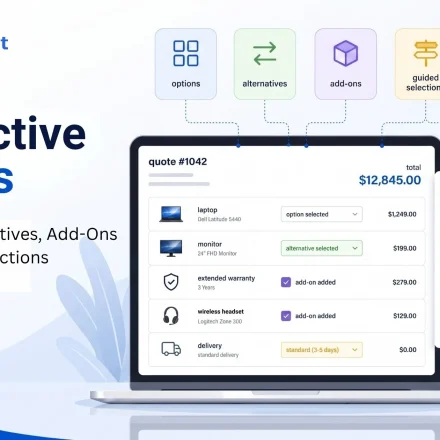
1. Options: Let Buyers Choose Between Configurations
Use options when the customer needs to select one version of the same solution. For example, a laptop deployment could offer:
- 16GB or 32GB RAM
- 256GB or 512GB storage
- Standard or premium warranty
Here, the goal is to provide meaningful choices to buyers without making them compare dozens of similar SKUs.
2. Alternates: Give Buyers a Backup
Alternates work when more than one product can meet the same requirement.
For example, a VAR could quote a preferred laptop and include an equivalent HP or Dell model as an alternate. This becomes particularly useful when distributor inventory changes.
The sales rep can offer a viable replacement instead of rebuilding the entire quote when the preferred product is unavailable.
3. Add-Ons: Expand the Deal Without Changing the Core Solution
Quote add-ons are products or services that complement the main purchase. Add-ons can be like:
- Installation
- Configuration
- Extended warranty
- Antivirus or security software
- Managed support
- Accessories
For VARs, this is an opportunity to turn a product sale into a more complete solution. VARStreet supports custom products and services such as installation and consulting, as well as product and service bundles.
4. Guided Selections: Help Buyers Make the Right Choice
Guided selections work best when customers know what they want to accomplish but are not sure which configuration fits. For example:
What will this device be used for?
→ Standard office work
→ Development and design
→ High-performance workloads
The choices can then point the buyer toward the appropriate configuration.
For VARs, the important point is to simplify the decision without opening up uncontrolled product selection. Your sales team should still control which products, prices, and configurations are available.
The choice you offer should match the buyer’s decision. Use options for different configurations, alternates for replacement products, add-ons for complementary products or services, and guided selections when buyers need help narrowing their choices.
How to Protect Pricing and Margins in Configurable Quotes
Giving buyers more choices does not mean giving them control over your pricing.
Before adding options or add-ons to an interactive proposal, decide which products, services, and prices sales reps can offer. This keeps the quote flexible for the customer without creating margin problems for the reseller.
For example, your pricing rules might specify:
- A standard markup for a product category
- Different pricing for specific customers
- Fixed prices for installation services
- Approved discounts for certain configurations
- Minimum margins for high-value hardware
VARStreet supports pricing rules based on products, categories, manufacturers, and customer pricing profiles. This allows resellers to apply different pricing structures without manually calculating every quote.
The same principle should apply to configurable quote options. If a buyer selects a different laptop, warranty, or service, the price should update according to the rules you have already defined.
Give buyers flexibility within clear boundaries. That makes the quote easier to evaluate without making pricing harder to control.
The test is simple: if a buyer changes a configuration, your team should be able to handle that change without starting the quote from scratch.
How VARStreet Supports Configurable Quotes
For VARs, interactive quoting depends on more than the buyer-facing proposal. Sales also needs reliable product data, pricing rules, and a way to move approved quotes into procurement.
VARStreet brings these capabilities together in one platform. Its aggregated catalog combines product data from 50+ distributors in the US and Canada, including pricing and inventory information.
Resellers can also add their own products and services through the custom catalog. That can include installation, consulting, furniture, or other non-distributor offerings.
For packaged solutions, VARStreet supports product and service bundles. Resellers can combine items such as a laptop, antivirus software, and installation into a single offering and apply bundle-specific pricing.
Pricing rules can also be based on products, categories, manufacturers, or customer-specific pricing profiles.
Together, these capabilities give VARs the foundation to build more flexible quotes while keeping product selection, pricing, bundles, and procurement connected.

Conclusion: Make Interactive Quotes Easier to Buy From
Interactive quotes should do more than make a proposal look better. They should help your customers make decisions faster while reducing the amount of manual work your sales team has to handle.
For IT VARs, that means presenting the right options without creating another round of quote revisions. Use options for different configurations, alternates for replacement products, and add-ons for complementary products and services. Keep pricing rules, product information, and distributor availability connected so every customer choice can still translate into a workable order.
The goal is not to give buyers unlimited choices. It is to give them relevant choices within a controlled quoting process. When that process is connected to your product catalog, pricing, and procurement workflow, your sales team can spend less time rebuilding quotes and more time helping customers choose the right solution.
Ready to simplify your quoting process? Book a demo of VARStreet to see how you can manage distributor products, pricing, quotes, bundles, CRM, and procurement in one platform built for IT resellers.