Fourteen vendors on your list. Two of the comparison guides you built it from were published by platforms that ranked themselves first.
That is not the real problem.
It is worth naming the smaller one first, though, because it shapes everything you read next. A large share of the comparison content ranking for this category is published by platform vendors, and several place themselves at the top of their own list. That is not necessarily bad faith. This article is published by a vendor too. It does mean a downloaded shortlist is a starting point rather than an answer, and it is why the template below is built from criteria you can use to score VARStreet out as easily as in.
Every guide ranking for b2b ecommerce vendors names the same audience: wholesalers, distributors and manufacturers. Those businesses set their own price list. They load it once and it holds.
Generic comparisons are written for manufacturers and wholesalers who own their pricing. Resellers buy cost from distributors, and it changes mid-deal.
Every platform answers yes to customer-specific pricing. Only the architecture behind the yes separates them.
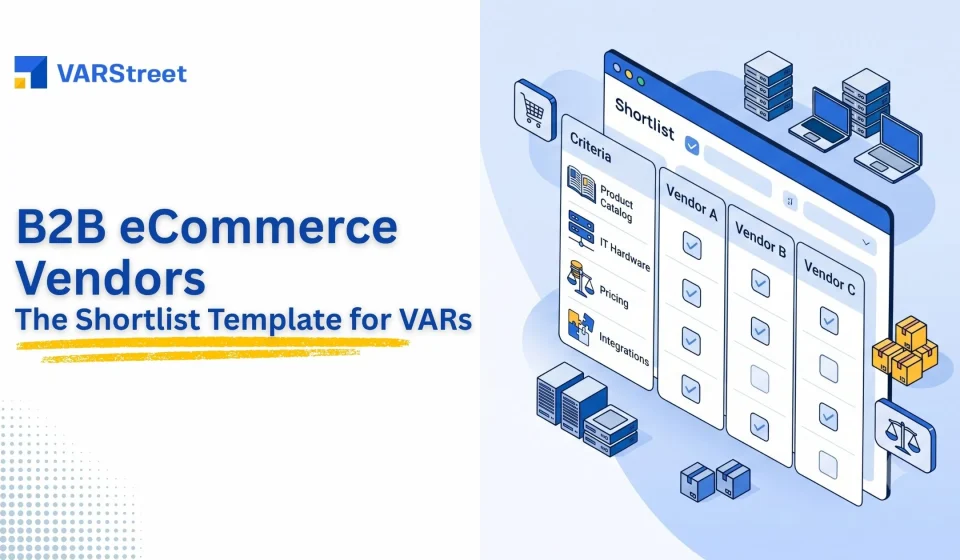
Five binary questions, answered on one call, cut a longlist of twelve to four before you book a demo.
Value-Added Resellers (VARs) and Managed Service Providers (MSPs) score the same seven criteria with different weights. Feed depth for one, contract pricing engines for the other.
A shortlist longer than four is not a shortlist. It is a decision you postponed.
Why can’t feature checklists separate B2B eCommerce vendors?
Ask twelve platforms whether they support customer-specific pricing. Twelve say yes.
The yes is worthless. It hides the architecture underneath.
One platform calculates that price live against your signed distributor feeds at the moment of request. Another reads it from a table refreshed overnight. Same checkbox. Different business.
What no published scorecard tests
B2B ecommerce platform comparison guides score features, and features have converged. Four things decide the outcome for a reseller, and none of them appear on a standard grid:
Feed architecture. Live pull, or file load
PunchOut. Native, or a third party you pay separately
Quote-to-order. Automatic conversion, or retyping
Line-level cost visibility. Whether a rep sees the floor before discounting
To be fair to the guides, they are accurate for their audience. A manufacturer with a fixed price book has no use for live feed depth. The criteria are not wrong. They are borrowed.
The borrowing is easy to miss because the vocabulary matches. Both businesses talk about catalogs, pricing rules and inventory. A manufacturer’s catalog is a list of what they make. Yours is a window onto what four distributors currently hold, and the two need completely different plumbing behind the same word.
Five questions that cut your eCommerce vendor shortlist in half?
You do not need a demo to eliminate a vendor. You need fifteen minutes.
Is distributor pricing pulled live, or loaded from a file? If the answer contains import, feed file, scheduled sync or nightly, that platform prices your quotes from yesterday.
Which of my signed distributors do you connect to today, by name? Not “we integrate with any distributor.” Names, and how long the last one took to build. A vendor who answers in weeks is telling you your launch date moves. A vendor who cannot name a single one of your distributors is quoting you a custom project without saying so.
Does an approved quote become a purchase order without retyping? Manual B2B order handling costs $50 to $150 per order once entry, corrections and exceptions are counted.
Is PunchOut native or resold? For anyone selling to enterprise or government through SAP Ariba, Coupa or Oracle, this answer moves first-year cost by five figures. It also decides how long implementation takes, since PunchOut has its own configuration and testing cycle regardless of who supplies it.
What is in the fully loaded year-one number, and what is billed separately? Implementation, connectors, catalog content, support tier, transaction fees. Ask for year three in the same email.
Any vendor who cannot answer all five on one call is not going on the list.
What the first question is really asking
A rep opens a quote Tuesday morning. Sixty Lenovo ThinkPads for a school district, priced off the catalog that loaded overnight. She checks margin on screen: 9%. She applies the district’s contract discount. She sends it at 4 pm. The district approves Thursday.
Ingram moved cost on that SKU at 2 pm Tuesday.
The order shipped at just under 4%. Roughly $1,900 gone on one deal. The opportunity record shows one number, and it was correct when it was written.
The rep did nothing wrong. The platform priced from a file, and the file was right at midnight.
How do you score the vendors that survive?
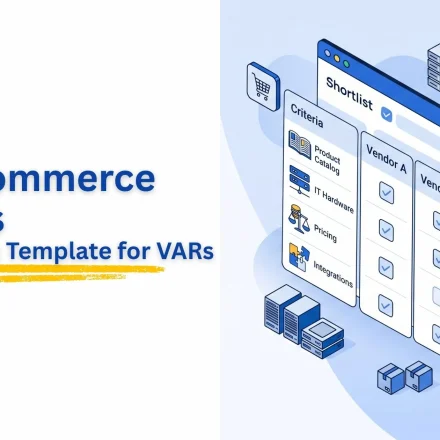
Score each surviving vendor 1 to 5 on seven criteria. Then apply the weight that matches your model.
Criterion
VAR Weight
MSP Weight
Live distributor feed depth and coverage
High
Medium
Customer-specific and contract pricing engine
Medium
High
Quote to order to purchase order flow
High
Medium
PunchOut and procurement support
High
Medium
ERP and PSA connector maturity
Medium
High
Account hierarchy, approvals, credit limits
Medium
High
Fully loaded cost, year one and year three
High
High
Why VAR and MSP weights differ
The weights differ because the damage differs.
A VAR is hardware-led and deal-based. A mispriced ThinkPad hurts once, inside one transaction. Feed depth and quote speed carry the weight.
An MSP runs on contracts. A mispriced managed service line repeats every month until renewal, and terms run twelve to thirty-six months. One bad rate on a NetSuite or ConnectWise-billed contract compounds.
Put numbers on it. An MSP quotes a 40-seat managed endpoint contract at $28 per seat, using a platform that could not hold the customer’s negotiated rate and defaulted to the list. The correct contracted rate was $34. That is $240 a month, and on a 36-month term it is $8,640 before anyone notices, usually at renewal. Pricing engines and credit controls carry the weight for a reason.
Three rules that keep the scoring clean
Score against your data, not their sandbox. Send three real SKUs and one real customer pricing agreement. Ask them to demo with it. Vendors who decline have answered.
Score the connector you need, not the connector count. Forty integrations and not yours is zero integrations. The same applies to depth: a connector that writes orders into your ERP but cannot read credit holds back out is half an integration.
Stop at four. A Forrester study commissioned by commercetools found 77% of digital commerce leaders overran their replatforming timelines. Long lists are one reason. Each extra vendor adds demo hours and internal debate, and rarely changes the answer.
One practical note on running the scoring. Have two people score independently before anyone compares notes, ideally one from sales and one from operations. Where their scores agree, move on. Where they diverge by two points or more, you have found a question the vendor answered vaguely enough for two informed people to hear different things, and that is the question to put in writing next.
How does VARStreet score on this template?
Run the same seven criteria on us.
A rep opens a quote. Cost from your signed IT and office supply distributors is already on the line, pulled live. The margin on screen is the margin you keep.
The customer approves. The quote becomes a purchase order in the same system. Nobody retypes line items into a second tool. The aggregated catalog carries product content, so the storefront spec matches what ships.
An enterprise buyer raises a requisition in Ariba. PunchOut takes them into your store, applies negotiated pricing and returns the cart to their approval chain. No separate service, no separate invoice.
Our Product Manager puts it simply: “Resellers rarely pick the wrong platform on features. They pick it on a checklist that never asked where the price comes from.”
What You Do Today
The Problem
What Changes
Score vendors on a downloaded feature checklist
Everyone answers yes. The list never narrows
Seven weighted criteria plus disqualifiers that narrow it in one call
Quote from a catalog loaded overnight
Cost moves mid-day. Deals ship below floor
Live distributor cost at the moment of quoting
Retype approved quotes into an ordering tool
Entry errors and days of lag
Quote converts to purchase order in place
Add PunchOut from a third party after launch
Year-one cost lands above the quoted number
Ariba, Coupa and Oracle PunchOut included
Run this check today
Open each shortlisted vendor’s own materials. Find the sentence describing how distributor pricing reaches the store. Write down the verb. Then email all of them the same question:
“A quote is built at 9 am. My distributor changes cost at 2 pm. The customer approves at 4 pm. What price is on the purchase order?”
Read the replies side by side. They will not match, and the gaps will narrow your list faster than a week of demos.
Getting started with VARStreet
eCommerce, quoting, CRM and procurement in one application, with 7 million products from 50 or more distributors. VARStreet XC starts at $99 per month.
What should IT resellers look for in b2b ecommerce vendors that other buyers do not need?
Live distributor feed architecture, native PunchOut and quote-to-purchase-order conversion. Manufacturers set their own prices, so published comparisons rarely score any of the three.
How many vendors belong on an ecommerce vendor shortlist?
Three or four. Beyond that, you add demo hours and debate without improving the decision.
Is the best B2B ecommerce platform for a VAR different from the best one for an MSP?
Usually. VAR damage happens inside one deal, so feed depth wins. MSP damage repeats monthly until renewal, so contract pricing engines win.
How long should a B2B ecommerce platform comparison take?
Two to four weeks. One week to screen with the five questions, then two or three demos scored against your own SKUs.
What is the most expensive shortlisting mistake?
Comparing license fees instead of fully loaded year-one cost. Implementation, distributor connectors, catalog content and PunchOut are often billed separately.
Pragya Bhardwaj is a seasoned B2B content writer with a strong background in SaaS and digital commerce. She specializes in creating clear, engaging, and search-optimized content that helps businesses connect with their audiences and build authority online. With experience across blogs, whitepapers, eBooks and website copy, Pragya brings both strategy and storytelling to every piece she writes.
Editorial Policy