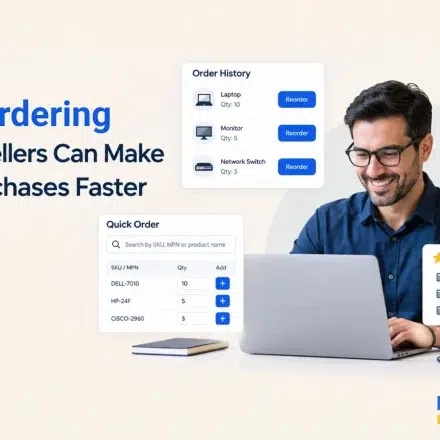
B2B Reordering: How IT Resellers Can Make Repeat Purchases Faster and Easier

Table of Content
- Where B2B Reordering Gets Slowed Down
- What a Faster B2B Reordering Workflow Looks Like
- 5 Ways IT Resellers Can Make Repeat Orders Easier
- Not Every Repeat Order Should Be Self-Service
- How to Set Up a B2B Reordering Workflow
- How VARStreet Supports B2B Reordering
- Conclusion: Make Repeat Orders Easier to Repeat
- FAQs
Where B2B Reordering Gets Slowed Down
Repeat orders become inefficient when customers and resellers have to repeat information that is already known.
Customers have to ask for products they already buy
When customers reorder by email or phone, they may need to identify products, confirm quantities, and wait for the previous order to be checked.
Order history, reordering, and saved lists can remove this back-and-forth by giving customers a starting point based on previous purchases.
Pricing has to be checked again
Repeat customers may have account-specific pricing, contracts, or discounts. A B2B eCommerce pricing strategy can define these rules, but they also need to be applied to each customer’s account.
Otherwise, a routine reorder can still require a manual price check.
Product availability can change
Any previous purchase does not guarantee that the same product or price is available today. Distributor connections can bring current product, pricing, and inventory information into the ordering process, so teams do not have to check multiple portals.
Orders can still require manual entry
An online order can create more work if someone has to copy it into another system. Connecting the customer order with the reseller’s back office and distributor procurement workflow reduces duplicate entry and keeps the order moving through fulfillment.
What a Faster B2B Reordering Workflow Looks Like
A faster reorder removes the steps customers and reseller teams should not have to repeat.
1. The customer logs in
The customer starts from the reseller’s B2B storefront rather than sending an email or calling a sales rep.
After logging in, the customer can access the products and pricing assigned to their account. This is especially useful when different customers have different catalogs, pricing agreements, or purchasing rules.
For resellers evaluating storefront options, factors such as B2B eCommerce platform compatibility can affect how easily the storefront fits into the existing sales and procurement workflow.
2. They find what they bought before
The customer should not have to remember every product number or search through the entire catalog for a routine purchase.
Order history gives buyers a starting point. Reordering and saved lists can make frequently purchased products easier to access, so the customer can repeat a familiar purchase without rebuilding the order from scratch.
This is particularly useful for products that customers purchase on a regular schedule.
3. The customer sees the right products and pricing
Once the customer selects the products, the storefront should reflect the rules attached to that account.
That can include:
-
- Customer-specific product catalogs
- Customer-specific pricing
- Contract pricing
- Product or category-level pricing rules
- Applicable purchasing restrictions
The customer gets the information relevant to their account instead of having to ask a sales rep to confirm it manually.
4. The customer places the order online
The customer reviews the items, quantities, and applicable pricing, then places the order through the storefront.
At this point, the repeat purchase has moved from a sales conversation into an established ordering workflow. The sales team can still step in when the purchase needs consultation, negotiation, or a custom solution.
5. The order moves into the reseller’s fulfillment process
The order should not stop at the storefront.
It needs to reach the reseller’s back office, where the team can process it and send the required PO to the distributor. With connected distributor workflows, the reseller can also work with current pricing and inventory information rather than checking each distributor separately.
This keeps the customer-facing reorder and the reseller’s procurement process connected instead of creating another manual handoff.

5 Ways IT Resellers Can Make Repeat Orders Easier
A smoother reorder process carries forward the products, pricing, and purchasing rules already established for each customer.
1. Give customers access to order history and reordering
Order history, reorder options, and saved lists help customers find products they have purchased before instead of searching the catalog again. This reduces routine requests for sales reps and makes familiar purchases faster.
2. Show each customer the products they actually buy
Customer-specific catalogs let resellers control which products and services each account can access. This keeps repeat purchases focused on approved products and makes them easier to find.
For larger or frequently changing catalogs, eCommerce catalog management also helps keep product information organized.
3. Apply customer-specific pricing automatically
Customer-specific pricing can reflect negotiated rates, contracts, and discounts. Showing the applicable price during checkout reduces manual price checks and keeps repeat orders aligned with account rules.
4. Let customers place routine orders online
A B2B storefront lets customers access their assigned catalog and pricing, select products, and place routine orders without starting an email conversation with sales.
Sales can then focus on purchases that require consultation, configuration, or negotiation.
5. Connect orders to distributor fulfillment
The reorder process should continue beyond checkout. Connecting distributor workflows can reduce manual re-entry and keep fulfillment moving.
VARStreet supports 50+ distributor connections, distributor procurement, online ordering, and automated order processing.
This connects the customer reorder with the reseller’s procurement and fulfillment process instead of creating another manual task.
Not Every Repeat Order Should Be Self-Service
Not every repeat purchase needs the same level of automation. Routine orders can move through self-service, while purchases that involve changes, negotiation, or product guidance can still go through sales.
Use self-service for routine purchases
Self-service works well when the customer already knows what they need and the purchase follows established rules. Regular laptop or desktop replacements, monitors, peripherals, networking accessories, and other frequently purchased products can often follow the customer’s existing catalog and pricing without requiring a new sales conversation.
This gives customers a faster way to place familiar orders while reducing routine requests for the sales team.
Keep sales involved when the purchase changes
Some repeat purchases still need a sales rep’s input, such as:
-
- A new product or configuration
- A large or unusual purchase
- A bundled solution
- Services or installation
- Special pricing negotiations
- A requirement that needs product guidance
Automation should handle the predictable parts of reordering while sales stays involved where customer input and expertise add value.
For IT resellers, this creates a clearer division of work. Customers get a faster path for straightforward purchases, while sales reps remain available for orders that need consultation, quoting, or negotiation.
How to Set Up a B2B Reordering Workflow
A practical reordering workflow starts with the products customers buy regularly and builds a clear path from selection to fulfillment. Use these steps to decide what should be automated and where your team still needs to be involved.